
Countering MAGA: The Democrats’ Next Move
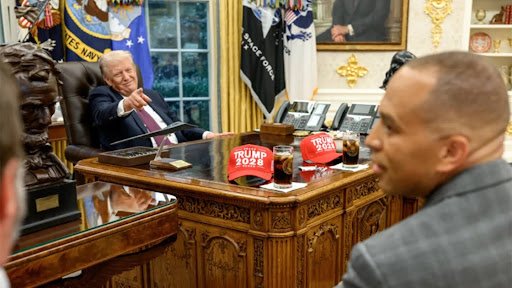
Donald Trump displaying “Trump 2028” hats in the Oval Office while meeting with Senate and House minority leaders Chuck Schumer and Hakeem Jeffries. Source: Fox News.
With Donald J. Trump currently serving his second term, voters look to 2028, wondering what the first Presidential election year after Trump’s presidency will look like. The Make America Great Again (MAGA) movement is nearing its ten-year anniversary since it redefined American politics, fueled by Trump’s populist rhetoric since his first presidential campaign in 2016. In response to Trump’s exit from the presidency, what path around MAGA will the Democratic Party chart for itself?
Who’s In for 2028?
After Vice President Kamala Harris’ loss in 2024, she has not yet “made up her mind” about whether or not she will run again in 2028. Harris’ hesitation about running in 2028 worries voters who doubt her commitment to a serious campaign, especially after the shortcomings of her 2024 bid. Many of these were caused, in part, by her extremely belated entry after President Joe Biden’s unprecedentedly late exit from the race in July 2024. However, Harris also struggled in her campaign with taking strong stances on issues to differentiate herself from the Biden Administration. This provided an easier target for Republicans to paint a negative image of her. For example, some Republicans have framed Harris as a failed border tsar due to claims about her immigration policies during her time in office. MAGA has had too much time to criticize Harris’s actions and connect them to Biden. Claims like this might continue to dissuade moderate voters and imply she would be unable to pull off a Democratic victory in 2028 against potential candidate Vice President Vance.
The Biden Effect
The key difference between frontrunners for the 2028 Democratic race is their association with the Biden Administration. Biden’s popularity ratings struggled throughout his term and took a sharper decline towards the end of his time in office, which continued to affect his campaign for a second term. His debate performance suffered, and brought major attention to his alleged mental decline, leading even high profile democratic officials, such as former Speaker Nancy Pelosi, to call for him to step down from the 2024 race. Harris was unable to escape the lower approval ratings of the Biden Administration, but at the same time needed the support of President Biden for her chance at winning the 2024 election, which is what fed the challenge of where to position herself on Biden’s former policies.
Newsom’s Advantage
Governor Newsom is quickly gaining popularity for his aggressive and comprehensive “closed fist” approach to standing up to Trump. Democrats have been pushing for their leaders across the board to put up more of a fight against the Trump administration, which Newsom has done through not only legal battles, but now even openly mocking the President’s Truth Social posts and style on Newsom’s own social media platforms, which could also help his polling with younger Democrats (where he currently falls behind Harris 27% to 13%). As one of the only Democratic leaders taking such a direct approach to dealing with Trump, and without having the direct connection to the Biden Administration that might harm Harris’ chances, Newsom might be able to rewrite the stereotype of the sensitive Democrats and win enough anti-Trump voters to defeat a Republican opponent in 2028.
Moving Forward
The next 3 years of Trump’s presidency will be crucial for both parties as they plan for the next Presidential race. A Vance campaign will have to decide whether or not to continue the policy path of the Trump MAGA movement and risk approval ratings associated with his time working for Trump, or ditch some of the extreme policies and risk losing base support and campaign funding. Success for Vance at this point seems like it will be largely contingent on how the United States responds to the rest of the Trump administration’s actions. So far, it is not looking up for Vance if he sticks with defending the MAGA agenda, as can be seen by the 2025 election season's sweeping democratic wins in races against Trump-endorsed candidates, including in states like Virginia and New Jersey. Currently, voters are have major concerns about the Trump administration’s role in the present economic situation of the United States, with a focus on issues such as executive overreach of tariff policy and resulting inflation, coupled with income inequality exacerbation, the historic government shutdown, and budget cuts to welfare programs that a huge portion of Americans are now feeling. Despite the availability of large donors for a future Vance campaign, if he continued to support this path for MAGA, these economic issues may very well remain prominent and act as a strong motivator for voters to turn away from supporting Vance.
For Democrats in the coming years leading up to 2028, Harris will still need to decide on her possible entrance to the race, and Newsom will need to strategize how to continue his public battle against Trump in order to rally the widest number of anti-MAGA supporters. Clearly, the numbers discussed above are very early guesses as to how the 2028 election will shape up , but the looming decision for the Democratic party candidacy is extremely important for success in the wake of the MAGA movement.