
What the White House Demolition Reveals About Trump’s Administration
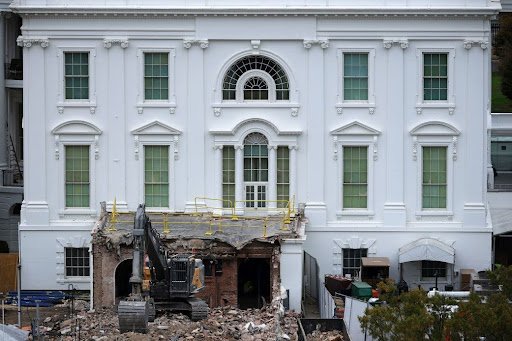
Construction crews demolishing the East Wing of the White House. Source: CNN.
President Trump has spent the first ten months of his second term tearing Washington down and remaking it in his image, metaphorically, and now literally.
On October 20th, construction crews began demolishing the East Wing of the White House to make way for Trump’s envisioned State Ballroom. The 90,000 square-foot ballroom will be used for state visits and other major functions.
This is not the first time that a president has made significant changes to the historic mansion. Many have expanded, converted, or renovated sections of the White House since it was first constructed under President Jefferson. Every president has made changes to decorations and furnishings to suit their tastes, while more than half a dozen have undertaken projects that substantially added to or changed the building’s structure. The most major modification in recent history came in 1948, when President Truman undertook a large-scale renovation to completely revamp the building’s dilapidated interior and add a second-floor balcony to the South Portico.
What sets Trump’s renovations apart from Truman’s, however, is the lack of oversight or external approval. Whereas Truman gained Congressional approval and appointed a bipartisan committee to oversee the project, Trump did not consult Congress or any of the other commissions that are typically consulted before a project of this scale. In fact, on October 29th, Trump fired the entire board of the US Commission of Fine Arts, an independent agency that reviews design plans for federal buildings.
This hasty action should not come as a surprise. It has been the modus operandi of Trump’s second term: act quickly and unilaterally, fire anyone who stands in the way, and deal with legal or constitutional conflicts later. This has been seen in Trump’s other actions like gutting federal agencies and replacing their leadership with MAGA loyalists, enacting tariffs without Congressional approval, and conducting military operations against alleged Venezuelan drug-smugglers with flimsy legal justification, among others. All of these measures follow a frighteningly effective blueprint, pushing through a flurry of executive actions that have stretched the limits of executive power and reshaped the federal bureaucracy, all before the courts have time to rule on their core legal issues.
This is not the first time that Trump has made his mark physically on the nation’s capital. His administration unfurled massive banners bearing his face on the facades of several federal buildings. He paved over the iconic White House Rose Garden. He touted plans to build a massive Arc de Triomphe-esque arch across from the Lincoln Memorial. It is not hard to see the signs of an image-obsessed President wanting to leave a permanent legacy—executive orders can be reversed, political tides can change, but a ballroom larger than the rest of the White House itself will certainly endure.
The symbolism of the White House demolition is almost too on-the-nose for an administration that has upended long-standing institutions and norms. However, the logistics of the ballroom project itself also allow insight into how this administration operates. From the start, the plans have been vague and ever-shifting. Trump had previously promised that the ballroom would not interfere with the existing building, and original cost estimates have been revised upwards by $100 million. This is a characteristic of Trump’s policies: everything from tariffs, to immigration policy, to foreign aid have been governed by uncertainty and sudden reversals.
Another point of concern is the project’s funding sources. The White House announced that all funds for the $300 million project would come from private donors. These donors include some of the largest tech, crypto, and defense corporations in the world, who stand to gain, or lose, the most from Trump’s policies, as well as wealthy individual donors, some from within the administration. This donor list reinforces a message that has been made clear through events like Trump’s crypto dinner in May: in this administration, money buys access. Buying into the president’s business ventures and funding his projects can earn his favor and protect him from his ire, better than any other form of negotiation. Never before has the distinction between corporate interests and presidential influence been so thoroughly blurred.
Trump’s demolition of the East Wing and construction of his ballroom of the White House is not only a monument to the volatility of his second term, but also a deeper reflection of the playbook of a president who is determined to bend Washington to his will.
At the moment, it appears that the construction of the ballroom, projected to be completed before the end of Trump’s term, is rolling full steam ahead. However, with the shifting design plans and vague oversight, it remains to be seen whether the final product will reflect what was originally envisioned. If it does, it is sure to become a stark, controversial reminder of Trump’s tumultuous second term.