
New Japan-U.S. Framework Secures Critical Minerals Amid Rising China Tensions
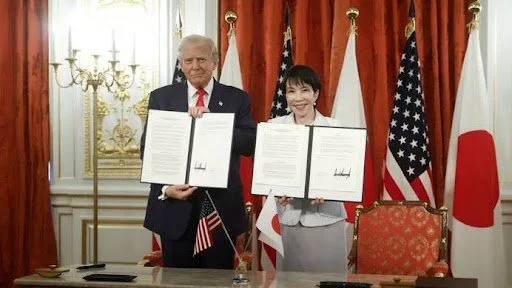
U.S. President Donald Trump and Japan’s Prime Minister Sanae Takaichi during a signing ceremony for an agreement on critical minerals and rare earths at the Akasaka Palace State Guest House, Tokyo, Japan, on Oct. 28, 2025. Source: Daily Sabah.
On October 28, Japan’s new Prime Minister Sanae Takaichi and United States President Donald Trump established the United States-Japan Framework For Securing the Supply of Critical Minerals and Rare Earths through Mining and Processing. The treaty used tools such as government financing and national stockpile to promote coordination both across upstream mining and downstream manufacturing to diversify supply chains, while mobilizing public and private capital to stimulate overall investment. The agreement marks the coming of a new “golden age” of the Japan-US alliance, equipping both parties to become stronger and more economically prosperous, according to Takaichi herself. The heightened economic cooperation crucially boosts the countries’ mutual security in the mineral supply chain. More importantly, the deal consolidates their mutual political alliances, forming an even stronger bloc against China’s expanding influence in Asia.
Both the U.S. and Japan have historically unstable supply chain conditions for mining raw materials. Rare earths are a vital source for electronic products, as they are widely adopted from smartphones and battery-powered vehicles to military drones. The U.S. Department of Energy estimated that in 2023, about 90% of refined rare earths came from China. Apart from possessing significant stocks, China dominates the global supply chain crucially because of its processing ability, as mined rare earths in other countries are often sent to China for refining. This is demonstrated in China’s leading position as a supplier of key manufactured products and technologies, accounting for 60% of the world’s manufacturing capacity for mass-manufactured technologies (e.g.wind systems, and batteries), and 40% of electrolyser manufacturing. In April 2025, China banned a group of 17 metals and seven rare earths from the U.S., causing major consequences for America’s military and healthcare. Such a move has led the U.S. to seek alternative suppliers, including Japan. As for Japan itself, its vulnerability to Chinese supply restrictions has been increasing since the 2010 embargo, as it continues to rely on China for roughly two-thirds of its rare earth imports.
Given the historical supply chain vulnerability of the countries, the new extension of China’s export controls in October only exacerbated the unstable situation. China has added five more rare earths to the original list of seven issued on April 4 for which export licenses are required, as well as magnets and other materials made from them. Combined with the immediate halt of rare earth technology and information, the control disrupts production of computer chips, which are used from smartphones to artificial intelligence systems. Furthermore, its restriction of battery-making materials influences the world’s electric vehicle makers, which are major consumers of batteries, as well as electricity companies that need Chinese technology to build large grid-storage batteries for solar or wind energy.
In light of growing disruptions for the U.S’s manufacturing, research, and development industries, the White House strategically turned to Japan for stronger support this October. One particular strength was the assistance given to U.S. magnet production. Rare earths are essential for making the magnets that power the electric motors in drones and offshore wind turbines, as well as the brakes, seats, and other systems in cars. Japan is among the few nations, except China, with deep magnet technology expertise. Firms such as Shin-Etsu Chemical and Hitachi Metals are pioneering core NdFeB and SmCo technologies. This significantly helps rebuild U.S. industrial capability in value-added magnet manufacturing.
Furthermore, while not mineral-rich in itself, Japan is a vital partner in strengthening the critical materials supply chains as a source of project finance, downstream manufacturing, and a research and development hub for materials research. As joint projects under the new framework are projected to attract between 2 and 3 billion dollars in combined public and private investment over the next five years, the framework has important implications for joint investment and facilitates technology spillover as a whole. Potential projects, including those by SoftBank, General Electric, and Panasonic, spanned in scale from 350 million to 100 billion dollars, and involved more than 20 Japanese and American companies, highlighting the mutual commitment made by both parties.
Apart from economic consolidation, the treaty crucially encourages closer political alignment. This is especially shown through the timing of the treaty, as it occurred a week before Trump visited Chinese President Xi Jinping during the APEC summit in South Korea, to buttress U.S. influence in Asia in advance. Such a move signals the U.S’s willingness to increase its overall economic presence in Asia. Furthermore, the treaty also inadvertently sidelines China from major global developments. As the U.S. continues to find alternative partners as Japan, the act is largely considered to be China’s own “decoupling.” ‘‘It’s one thing to put the gun on the table. It’s another thing to fire shots in the air,” U.S. Treasury Secretary Bessent commented as he explained how China can no longer employ critical minerals control as a coercive tool. Countermeasures exist, and there is no benefit in giving the world alarms of instability. As the U.S and Japan strengthen economic and political ties, geopolitical power contestations escalate. Beijing, as a consequence, has reconsidered its bold move to reach a “preliminary consensus” on export controls with Washington, extending a trade truce that is set to expire on November 10.