
Building for Whom? The Moral Blind Spot in the Democrats’ Abundance Vision
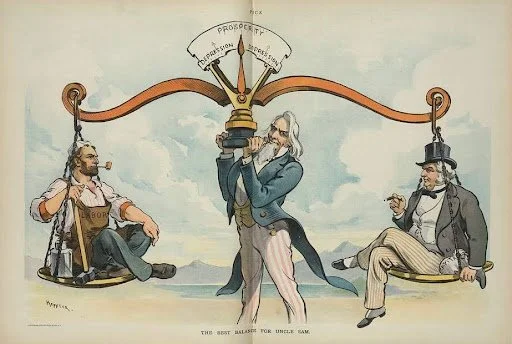
The best balance for Uncle Sam” American Political Cartoon. Source: Public Domain.
A few years ago, in the shadow of the pandemic, there was a striking feeling amongst the American populace that, in one of the richest countries in the world, working people were struggling more than ever to meet the cost of housing and everyday life. Vouchers, such as SNAP Emergency Allotments and COVID-19 Stimulus Checks, that were used to pay for finite resources, only made the price climb higher. An invisible, but very present, regulatory red tape hindered growth in Democratic-run cities of the United States. This was by no means a mere logistical problem, but the result of a pattern often seen in American governance.
There is a tendency for well-intentioned regulation and oversight to slow the very progress it seeks to ensure. Today, that idea has taken a new form, seeping its way through the Democratic party as the Abundance debate. On its face, this debate may appear to be only composed of dry policy memos on infrastructure and clean energy. However, if one were to take a step back and look at the debate from a broader vantage, it raises profound questions about what ‘progress’ means, and if regulation and redistribution can earn back public trust from an already cautious populace.
In March 2025, journalists Ezra Klein and Derek Thompson published their book Abundance, which lays out a clear problem: too many of America’s issues, such as housing shortages and stalled infrastructure, are not fundamentally about insufficient funds or delayed legislative initiatives. Instead, they are about a ‘scarcity mindset’ that has created a regulatory gridlock. In the context of Abundance, it’s a viewpoint that focuses on managing and redistributing what already exists rather than expanding what’s possible. The focus is largely on government-sanctioned housing, as Klein notes, particularly in high-demand areas like cities, growth and opportunity are sacrificed to unnecessary regulatory barriers. These barriers are often found in a tendency to logroll legislation by layering it with other social and political objectives to appease interest groups or constituencies. Yet, the proposed solution offered by the authors is simple: create a system of welfare that develops and delivers, rather than merely regulates and limits. In other words, if you want more homes, build more homes; if you want more clean energy, unlock the capacity to have more of it; and if you want infrastructure that works, stop letting regulation prevent its construction.
The notion that America can fix its housing crisis and rebuild its infrastructure simply by clearing a few bureaucratic hurdles is an optimistic illusion, however, there is an understandable appeal. For many Democrats, the ‘Abundance’ frame feels like a chance to reinvent liberalism. In reality, however, America has lost its capacity to act. Infrastructure projects take decades, and housing prices have become unaffordable in the face of zoning laws. The U.S. housing shortage stands at 3.8 million homes, and major infrastructure projects cost an average of 240% more than in Europe. There is no doubt that something in our system is broken. Yet the movement to build more and faster risks reducing politics itself to a reckless pursuit of speed, disguised as reform.
Historically, these blind spots are nothing new. The urban renewal projects of the 20th century were driven by optimism: if the government could build efficiently enough, prosperity would follow. Yet, in cities such as Detroit, New York, and St Louis, that vision has now displaced the diverse neighborhoods, fracturing any sort of equality in the process. These earliest forms of abundance were measured based on quick development, but not on the people they would benefit–or hurt. The modern Abundance movement risks doing the same, aligning itself with corporate interests that stand to profit from deregulation. Efforts to streamline housing development have often yielded domineering high-rises rather than genuinely affordable homes. In California, for instance, rezoning and upzoning have expanded the overall housing inventory, but not always in ways that serve lower and middle-income residents. Klein rightly argues that meaningful reform in this regard requires that rezoning areas be restricted to single-family housing to allow for more diverse forms of development. Yet, even with such changes, the results still favor luxury construction over affordability, accelerating gentrification and scarcity within the communities that are meant to benefit.
Abundance might be largely technical, but there is a visible cultural element to it as well, unfortunately lacking within what Abundance stands for altogether. Many of the movement’s supporters advocate for framing politics in this regard as a matter of efficiency. Politics will forever have a moral dimension to it, and stripping that in favor of pragmatism risks failure. The reason why projects such as the New Deal succeeded was not because of the infrastructure it sought to improve, but because it was tied to a moral obligation, putting people back to work and revitalizing communities. Today, there is a ‘build faster’ ethos that sounds detached from values altogether.
Within the Democratic Party, Abundance has produced an increasingly visible divide. On one hand, more modern Democrats (1990s-present) tend to favor the Abundance agenda when it means equitable access to things like education, energy, and healthcare, but not when it results in unchecked growth or materialism. On the other hand, traditional Democrats of the 1960s-1980s look at Abundance through industrial growth with New Deal-style labor protections and welfare programs. This affects many of the communities in which Abundance seeks to provide. Labor unions, for instance, are concerned that streamlined permits could undermine hard-earned protections for workers by allowing developers to bypass requirements for prevailing wages. The same goes for environmental activists who worry that the desperate rush to build will undercut hard-won conservation goals. Yet, advocates like Klein argue that the current regulatory framework has turned even clean-energy development into a challenge through layers of environmental review. From Klein’s perspective, the costs of outdated regulation outweigh the benefits, where the rules designed to protect the environment often prevent building the infrastructure required to save it. The real challenge for Democrats then is to find a path that accelerates clean-energy construction while preserving what environmentalism is all about. Overarchingly, Abundance has created a rift in which the question ‘what should liberal governance prioritize?’ looms over the movement.
To be clear, America does need renewal. Infrastructure is aging, and housing is unaffordable. Perhaps, though, the root of the question doesn't just lie in legislation, but in a whole reconstruction of what civic purpose means. Building more housing means nothing if families cannot afford it. The challenge is not to build just for the sake of building; to develop, just for the sake of developing. But rather, to do these things rightly, ensuring that America constructs for its populace, thereby strengthening communal bonds. The true test of Abundance is not how much is built through excess, but whether what is produced serves the enduring good of the nation itself.