
What Mikie Sherrill’s Victory Means for the Future of New Jersey
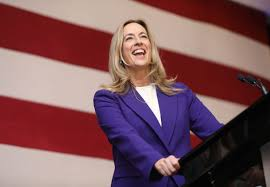
Mikie Sherrill gives her victory speech on November 4 after becoming governor-elect of New Jersey. Source: New Jersey Monitor.

On November 4, Mikie Sherrill won the 2025 New Jersey gubernatorial race with 57% of the vote. She defeated Jack Ciattarelli, becoming the 2nd female governor in New Jersey’s history. Sherrill’s victory was part of a sweep by Democrats in November. From Democratic socialist Zohran Mamdani to moderate Abigail Spanberger, Democrats across the political spectrum won major victories in the recent special elections.
Sherill’s Navy background, high voter turnout, and an anti-Trump platform led to her victory, offering a blueprint for Democrats running in the next few years.
Throughout her campaign, Sherrill emphasized her service in the Navy. Sherrill graduated from the US Naval Academy in 1994 and spent almost 10 years on active duty. As a helicopter pilot, she flew missions in Europe and the Middle East. She incorporated her experience into the gubernatorial race—one of her campaign ads was filmed in a helicopter, and her campaign website’s logo even includes a helicopter. In contrast, Ciattarelli’s top aired ads began with Ciattarelli stating that “New Jersey's been home to my family for more than 100 years.” The difference between the candidates’ ads was day and night. Sherrill’s ad clearly illustrated her past service in the Navy and her future capacity to serve as governor. Meanwhile, Ciatarelli’s ad simply focused on his family’s historical connection to New Jersey, offering no indication of his ability to handle the role of governor.
High voter turnout also was another feature of this election. For the first time ever, more than 3 million people in New Jersey voted in the gubernatorial race. In particular, Democrats showed up to vote in droves. From urban Hudson County to rural Gloucester County, Democrats received thousands of more votes than they did in the 2024 Presidential Election. Additionally, counties across New Jersey shifted to the left, from a 23-point shift in Hudson County to a 1.6-point shift in Hunterdon County.
Donald Trump’s job as president also came into play in the election. In a rally a few weeks before the election, Ciattarelli stated in reference to Trump that “We’re very thankful for all that he’s done to secure the border and enhance national security. We’re very thankful for all he’s done to improve the economy. And I’m sure people notice what’s going on with gas prices!”
Meanwhile, Sherrill titled Ciattarelli the “Trump of Trenton” and ran ads showing Ciattarelli praising Trump and his policies.
Sherrill also made affordability the center of her campaign. In a recent interview after her win, she said, “the reason I was so focused on affordability issues is because my communities are focused on affordability issues and how they’re going to be successful.”
Affordability is an issue that united Democrats across the political spectrum in the November elections. From Democratic socialist Zohran Mamdani to the more moderate Sherrill, Democrats were able to win by focusing on affordability. This indicates an issue that Democrats should focus on in the 2026 midterms and beyond to keep the momentum of November’s elections going.
Sherrill’s win in particular shows what can happen when Democrats make affordability the center of their campaign. 7 out of 10 families in New Jersey that said their finances were falling behind voted for Sherrill, leading to her dominant win; 25% of New Jersey voters in total said their finances were falling behind, representing a sizable portion of voters.
Historically, New Jersey has been a fairly reliable blue state. Democrats won New Jersey and its 14 electoral votes by double digits in the 2016 and 2020 presidential elections. However, some believed the state was moving to the right after the 2024 presidential election in which Donald Trump lost New Jersey by just 5 points— he lost the state by 12-point shift from 4 years earlier.
Ultimately, Sherrill’s win indicates a leftward shift in New Jersey politics will likely carry over into the 2026 and 2028 elections. Harris won in New Jersey in 2024 by less than 6%, leading some to believe New Jersey was becoming a swing state. To put this in context, Biden won New Jersey in 2020 by almost 16%, and Clinton won by about 13% in 2016. However, New Jersey experienced its lowest-ever turnout in a presidential election year in 2024, indicating that Harris’ win by such a low margin may be somewhat of an outlier. This contrasts with New Jersey’s consistent position as a blue state in the past and with Sherrill’s recent and dominant win. A decisive win for the Democratic candidate for governor shows New Jersey is returning to its roots as a consistently blue state.