
Protecting Maduro: How the Concentration of Power has led to the Downfall of Venezuela
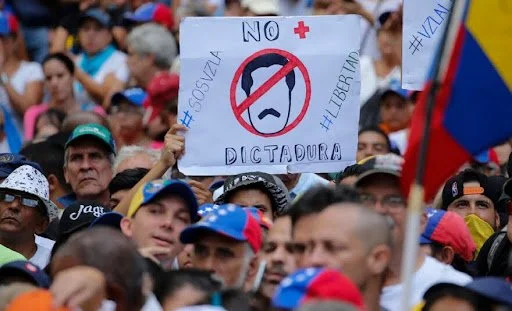
Venezuelan citizens protest the rising dictatorship of Nicolas Maduro. Source: U.S. Department of State.
Following two failed coup attempts against President Carlos Andrés Pérez in 1992, Hugo Chávez rose to national prominence and was elected president in 1998 on a socialist platform. As a Venezuelan military officer, Chávez was upset with Pérez’s response to the 1980s oil crisis and the corruption within the government. His movement, called the Bolivarian Revolution, ran on promises to end the corruption, use the wealth from the country’s oil industry to reduce poverty and inequality for its citizens, and create a new political system. At first, it did just that. Chávez was what UNC Chapel Hill Political Science Professor Caitlin Andrews-Lee called a charismatic leader; he recognized the suffering of the people, enacted unprecedented action to resolve that suffering, and cultivated a compelling, quasi-religious narrative. Because of this, Venezuelans viewed Chávez as a national savior, with his approval ratings reaching over 80% during his first year in office.
Riding his popularity and charisma, Chávez enacted a new constitution in 1999 that gave him “unprecedented control over the three branches of government.” Additionally, he enacted policies and laws that were hugely beneficial in the short term by promoting political participation and alleviating poverty and inequality, but were not sustainable in the long term. Some of these policies being Plan Avispa and Plan Reviba, which built and rebuilt homes for the poor in the nation. Additionally, over two million people received medical treatment during his presidency. While they were effective in the short term, these policies and programs created too much rapid change, and the country could not keep pace financially with the resources they had. The Venezuelan government spent more than it received as oil prices began to rise.
During his presidency, “petroleum reserves dwindled, and government debt more than doubled.” He also took measures that bordered on authoritarianism by ending term limits, taking control of the Supreme Court by packing it with 12 new justices, gutting PDVSA, Venezuela’s state-owned oil company of experienced workers, and enacting reforms that created a path towards dictatorship.
Despite an attempted coup, Chávez continued to have a strong following, and even had a political ideology named after him, Chavismo—a brand of left-wing populism. By the time he died in 2013 from cancer, he had endorsed another Chavismo candidate, Vice President Nicolas Maduro, to succeed him. Chávez’s popularity carried over to Maduro and the chavistas elected him as the next president of Venezuela in April of 2013.
Maduro inherited an unstable, corrupt government that was solely supported based on the sheer charisma of his predecessor, despite his dictatorial tendencies. However, instead of enacting policies to counter the downfall of the government, Maduro doubled down on Chávez’s decisions, knowing that his support stemmed from the blessing of the late president and the unfaltering chavistas, and he has continued to establish an authoritarian state in Venezuela..
Maduro made the Venezuelan economy even more volatile, and by the time that the global oil prices fell in 2014, Venezuela was in a crisis.
Once again, Maduro is in the position to make a decision between helping the economy or consolidating more power into his authoritarian regime. As a petrostate, a country where the majority of its economy is based in the oil industry, Venezuela was used to the booms and busts of oil production. In 2011, the oil industry accounted for 23.15% of the nation's GDP and made up 96% of the nation’s exports. While the profits from oil dropped, the wealth from the previous boom should have been enough to save them from this crisis; however, the “additional income disappeared into a corrupt system that the Chavista state administers and sustains.” Maduro has chosen to save himself and gain more power through repression, manipulation, and censorship.
While some on the international left argue that Venezuela’s crisis stems from foreign influence and U.S. imperialism, this is not the case. While these factors may have made the issue worse over time, they did not cause the crisis. The oil crisis did not even truly cause the problem. The problem in Venezuela today is the recent history of leaders taking power and control for themselves at the expense of the Venezuelan people’s well-being.
This is seen when Maduro refused to address inflation in the nation, due to the unstable economy and lack of austerity measures in place, because he did not want to admit defeat in any way. During his presidency, inflation rose from 40.64% in 2013 to over 65,000% in 2018. The Venezuelan economy completely collapsed, and Maduro was at the root of it.
As stated earlier, an important characteristic of a charismatic leader is establishing a compelling narrative, and while Maduro is not a charismatic leader, he tries his best to carry on Hugo Chávez’s legacy. To do so, he supports the narrative that the United States is the reason Venezuela is in a complete crisis.
Beginning in 2015, the U.S. sanctioned Venezuela for undermining democratic processes and human rights abuses by blocking oil imports from PDVSA and preventing the government from accessing the U.S. financial system. While the sanctions have exacerbated the economic crisis, they were not the root cause of it, as Maduro claims. The Venezuelan government had the opportunity for the easing of some sanctions in 2023, but Caracas failed to meet the conditions for a fair election, which is yet another example of Maduro’s government prioritizing its grip on power over alleviating the economic stress it’s placed on its people.
As for a transition to a new regime, it is not certain that Venezuela will see one in the near future, but it is making strides towards it. Maduro does not have the same unconditional and unfaltering support that Chávez once did, and Venezuelans are beginning to speak out against the regime in as many ways as they can under a dictatorship. Additionally, Maduro’s narrative about the United States causing this severe crisis is not substantiated, as the United States has provided almost $3.7 billion in humanitarian, economic, development, and health assistance to Venezuela, showing its longstanding support of the Venezuelan people and ending their plight.
As the United States and the international community become more involved in the Venezuelan Crisis and the Venezuelan opposition party leader, María Corina Machado, wins the 2025 Nobel Peace Prize, the potential for external pressure and influence increases. These developments may open pathways toward a political transition and national renewal. Venezuela deserves a leader who prioritizes the survival of its nation over itself.