
Trump’s “Frank and Honest” Relationship with Female Reporters
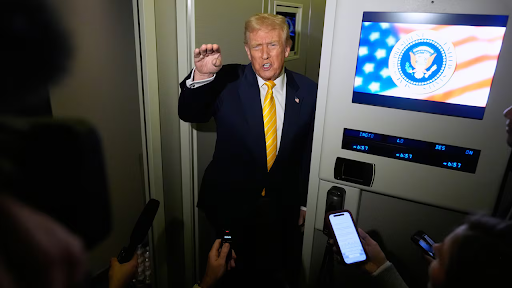
‘Quiet, Piggy’: As Trump berates female reporters, what's the breaking point?”, depicting Trump speaking to reporters on Air Force One in November 2025. Source: CBC.
The current administration seems to have a plethora of problems interacting with anything it deems as hostile press and journalism. These problems are evident through both rhetoric and actions taken by the Trump Administration in 2025. Beginning soon after Trump took office, the Trump Administration attempted to suppress public broadcasting by cutting $1.1 billion worth of NPR and PBS funding, as well as filing lawsuits against outlets like ABC and The New York Times based on claims of their alleged defamation of Trump.These press-related issues continue to be observed on official fronts, such as White House Press Secretary Karoline Leavitt's controversial statements regarding the Administration's view of the Democratic Party. In October, she said on Fox News that “the Democrat Party's main constituency are made up of Hamas terrorists, illegal aliens, and violent criminals.” From direct attacks and funding cuts to controversial rhetoric used by spokespeople, Trump’s individual snaps at female reporters are the latest manifestation of his rivalry with the American press.
“Quiet, Piggy!”
An example of Trump’s reactions that seemed to spark the most public attention was his response to Bloomberg reporter Catherine Lucey’s question about his behavior towards the release of the Epstein Files. While she was questioning the President, he interrupted by pointing at her and saying “Quiet. Quiet, piggy.” While this instance and his use of demeaning name-calling was one of the most blatantly aggressive examples of Trump’s negative treatment of specifically female reporters, there have been multiple others that reinforce his sexist tactics where he uses much more extreme and offensive language towards women. As blatant as this seems to most, he has a history of using “dog-whistle” sexism, where he insults both genders, but makes his insults against women specifically gender or appearance based as well as in many cases more viscous.
A Month of Continued Attacks
In late November, when asked by CBS White House Correspondent Nancy Cordes about the shooter of the two national guard members in DC—an Afghan who had been thoroughly vetted—and why Trump blamed the Biden administration, Trump responded “Because they let him in. Are you stupid? Are you a stupid person? … You’re just asking questions because you’re a stupid person.” Less than a week later, in response to a New York Times article about Trump’s physical health co-authored by Katie Rogers, Trump stated that Rogers is “ugly, both inside and out.” Most recently, over the weekend, Trump posted on Truth Social calling CNN’s Kaitlan Collins “Stupid and Nasty,” and on December 8th, when asked by ABC reporter Rachel Scott about the administration's plans to release footage of the Department of War’s recent controversial boat strike, Trump directly attacked Scott, saying “You are an obnoxious - a terrible, actually a terrible reporter,” also describing her as “the most obnoxious reporter in the whole place.” This name calling and highly unnecessary behavior is unacceptable when flaunted by a representative of one of the most powerful governments in the world, and sets a terrible example to the detriment of American moral leadership and character.
The White House on Defense
The most offensive part of this issue is the entire administration’s continual stance of defending Trump’s dog-whistle sexist remarks. His abrasive reactions to the questions of female reporters simply doing their jobs are about as blatantly sexist as a person holding the highest governmental office can get away with, not that they should be able to do so at all. Even so, representatives like Karoline Leavitt have taken up the defensive over his behavior. Leavitt went as far as to say in an official White House press briefing, that his rhetoric is just exemplification of how “frank and honest” he is with the press corps, and that “the president being frank and honest to your faces rather than hiding behind your backs is a lot more respectful than what you saw in the last administration.”
Rhetorical Fallout
The range of Trump’s problems with the American press, specifically with female reporters, has been vast. If the leader of the United States of America and his representatives are able to justify the level of misogyny and disrespect in his interactions with female members of the press as simply “frank and honest,” there is a long road ahead of us for reaching equal treatment between genders in the modern political sphere. Because of Trump’s success with this rhetoric throughout his three campaigns, since the most recent election, research has observed an increased frequency of misogynistic rhetoric by both cultural and political figures. As Trump continues to behave and speak this way, those figures that idolize him and hope to follow in his footsteps continue to mirror him, representing a frightening pattern for the future of American politics, society, and culture.