
In the Wake of a National Guard Killing, Trump Presses a Broader Agenda
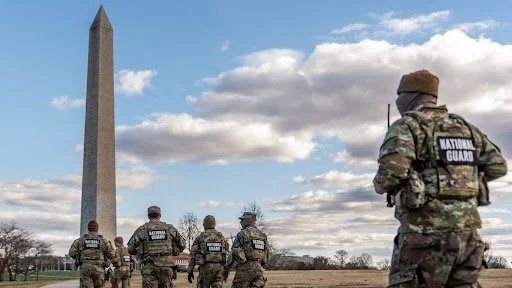
National Guard troops near the Washington Monument in Washington, D.C. Source: NPR

President Trump’s crackdown on crime continues after the killing of two National Guard members in Washington, D.C., on November 26th. Sarah Beckstrom and Andrew Wolfe, Guard members from West Virginia, were shot while on patrol near the Farragut West metro station by Rahmanullah Lakanwal, an Afghan national. Both were immediately hospitalized, with Beckstrom succumbing to her injuries a day later. Lakanwal previously worked in a counterterrorism unit operated by the CIA in Afghanistan, which allowed him to be evacuated and admitted into the US in 2021, following the Taliban takeover of the country. The shooting is under FBI investigation.
In response to the attack, the Trump administration beefed up military presence in the nation’s capital. Trump has called for the deployment of 500 more National Guard troops, bolstering the 2,200 troops already stationed in D.C. since August. The Pentagon also announced that all National Guard members in the city are now armed. As is the case with the recent Guard deployments across the country, the White House has not provided any timeline for how long the troops will stay, nor defined any measurable goals besides “addressing the crime epidemic.”
The National Guard is no stranger to being put in harm's way. After all, they are often called in to restore order during civil unrest, natural disasters, and other large-scale emergencies. However, the recent shooting stands out, as it appears to be the only instance where the violence occurred by ambush and was aimed at Guardsmen who were on patrol, not responding to an active disturbance.
Trump and his allies have seized on the shooter’s nationality to launch broader anti-immigrant and anti-Muslim rhetoric. Following the incident, Trump unleashed a barrage of inflammatory Truth Social posts, reviving familiar attacks on political foes while promoting a new slate of immigration policies. He attacked the Biden administration’s immigration policies and made derogatory remarks on political adversaries like Congresswoman Ilhan Omar and Minnesota Governor Tim Walz. Trump made unsupported and incendiary claims about immigrants, asserting that the majority of the country’s foreign-born population is “on welfare, from failed nations, or from prisons, mental institutions, gangs, or drug cartels.” He also vowed to “permanently pause migration from all third world countries,” and to “denaturalize migrants who undermine domestic tranquility.” Under federal law, the president does not have the authority to denaturalize citizens. Historically, denaturalization has been confined to cases where an individual has committed fraud in the naturalization process itself, rather than for crimes committed afterwards. However, the Trump administration has proven that it has few reservations about pushing the limits of executive power.
The deployment of the National Guard itself is an example of that approach. From the outset, there have been questions over the extent of executive authority over the Guard and whether the deployment violates federal laws that generally prohibit the National Guard from being used for domestic law enforcement purposes. Only a few days before the shooting, a federal judge ruled that the deployment of National Guard troops to DC is illegal. However, this attack adds a new wrinkle to the ongoing legal battle. A direct attack on National Guard troops certainly bolsters the Trump administration’s claims that crime is spiraling out of control in DC, providing legal and rhetorical justification for their continued deployment. Critics argue that the National Guard is not trained or equipped to handle domestic law enforcement needs, and its increased presence may actually heighten the risk of violent confrontations, especially now that all troops are armed.
Ultimately, the killing of two National Guard members in D.C. underscores a trend that has become all too familiar in American politics: the politicization of tragedy. The response should be an unequivocal condemnation of violence, and measured, substantial debates on security and executive authority. Instead, a growing desensitization to political violence, a divided political climate, and an ambitious administration have transformed this incident into yet another catalyst for the Trump administration’s expansion of presidential power and attacks on immigration. The loss of two lives could now have sweeping consequences that alter the lives of millions of Americans. The cycle is clear: each new tragedy is amplified and quickly folded into broader partisan agendas. We can only brace for the next one.