
Columbia’s New Bonnet: NATO, Greenland, and the New Age of Expansion
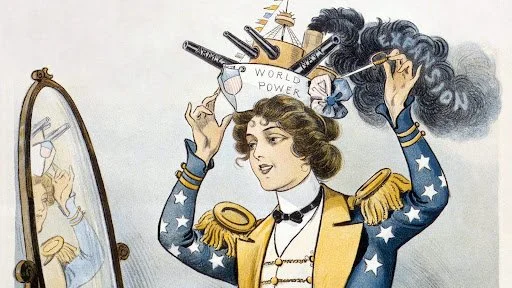
Segment from the cover of Puck Magazine, April 6th, 1901, produced by Alamy.
The long-standing transatlantic alliance between the United States and Europe is deteriorating, as implied by Danish Prime Minister Mette Frederiksen last week. In a solemn message to the public, Frederiksen said that if the U.S. continues to pursue Greenland with militaristic intent, “everything stops,” and the security that had been established through NATO since World War II would come to an end. Shortly after Fredrieksen’s broadcast, Europe rallied behind Denmark, with France and Germany sending physical troops to the area, and a resigned European Union holding emergency sessions to decide how to handle the conflict. However, as President Donald Trump looks to the indigenous island’s natural resources and strategic location, there is an increasingly uneasy feeling of unnecessary risk, much like that of the Cold War.
The United States has held influence in Greenland since 1951, when, under the Greenland Defense Agreement, it was given permission to build a permanent military base under the NATO framework. This was the result of an agreement within NATO after the U.S. proposed to buy Greenland in 1946, before it was rejected. In his first term, President Trump hinted that he wished to fulfill old ambitions, calling a potential acquisition of the island a “large real estate deal.” Now in his second term, Trump has begun to act on such rhetoric, deeming the control of Greenland as essential to preventing Russia and China from gaining more of a foothold in the Arctic.
This feels oddly familiar. In the Cold War, the race was to space. It appears that in the 21st century, the race is to the resource-laden vastness of the Arctic. What makes Greenland the center of this new conflict are two main factors: its rare earth minerals and its strategic location. Greenland holds vast, largely untapped wealth in various reserves of oil, copper, and uranium, and with growing accessibility to these minerals due to melting ice, global interest in the region has skyrocketed. In a world where technology is in growing demand, these resources, largely located in the Southern part of the island, have driven up international interest, including that of President Trump. Coupled with its location between North America, Europe, and the Arctic, the island allows for strategic monitored military surveillance, already holding a crucial naval chokepoint and radar and missile defense systems. NATO and Denmark already use Greenland as an essential asset because of its location, and that is exactly the threat. The U.S. wants it all to itself, nevermind that the Danes have occupied the island for more than 300 years. It’s all about one thing: outcompeting Russia and China.
President Trump’s focus on Greenland has drawn negative criticism from allies, old and new, as Europe braces for what is now known in international circles as the ‘Greenland Crisis.’ In late 2025, Prime Minister Fredrieksen attempted to enter into negotiations with the American President, but after a ‘horrendous’ result, the Danish leader openly expressed her concern in early 2026. Her message was clear: violating NATO would bring its end as an international alliance, and therefore an end to a stable continent. Following Fredrieksen’s broadcast, Europe rallied. UK Prime Minister Keir Starmer and European Commission President Ursula von der Leyen entered into negotiations with NATO Secretary-General Mark Rutte to establish a message of solidarity. In response, Trump issued new tariffs on eight European countries purely to pressure Denmark and penalize allies. The new tariffs, which are set to take place on February 1st, 2026, will mean a 10% rate on European goods, jumping to 25% if an agreement isn’t reached before June. Many European leaders have condemned this as “economic blackmail.” As a result, European countries, including France, Germany, Sweden, and Norway, started sending small contingents of troops in a show of support for Denmark.
To the Greenlanders, who have always struggled with their identity as a semi-sovereign country, looking to one day become an independent state, the general view against Trump has been one of outrage and defiance. Many of the young people who call the island home assert that their land is “not for sale.” To the local population, it isn’t about the economics, or even about NATO. It’s about the colonial rhetoric and anxiety it produces.
While it is uncertain what the growing military presence in Greenland will mean, the American response will be swift, fiery, and uncertain. This is a new age for the global world. Europe, which has long tried to create a close relationship with the U.S., has now had to take on a new direction, standing up for itself in light of American aggression. Opposition is rising on all fronts; protests in Scandinavian cities with banners stating slogans like “Yankee go home!” and even American legislators who are concerned with this new phase of expansion. This is not surprising. The U.S. has always been a country of exploration, first from sea to shining sea, then to space, and now to the Arctic. The real question lies in what the line is between exploration and invasion. a