
Indifference is Not an Option: Remembering Renée Nicole Good
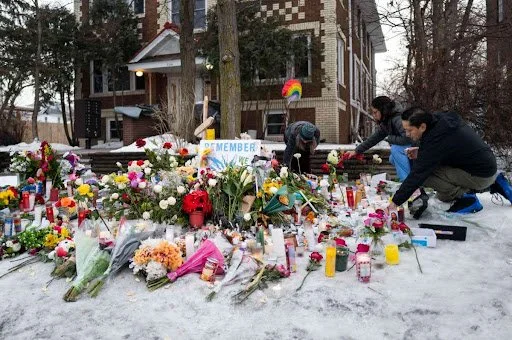
Memorial held for Renée Nicole Good in Minneapolis, Minnesota. Source: Getty Images.
On Wednesday, January 7th, community members gathered to support their community during an U.S. Immigration and Customs Enforcement (ICE) operation in Minneapolis, Minnesota, where ICE agents fatally shot Renée Nicole Good, a poet, mother, and partner. According to a private autopsy, she was shot at least three times. The interaction between Renée Good and ICE agent Jonathon Ross remains disputed. Homeland Security officials and members of the Trump Administration claim she intended to run the agent over with her vehicle and argue that the ICE agent used justifiable force. Others argue there is no clear evidence she struck him at all, and that her actions may have been an attempt to escape a chaotic situation. What is clear is that the agent used deadly force in response to an unclear threat.
To understand why this incident has sparked intense debate and protest, it’s important to grasp the role thatICE plays within the American immigration enforcement system. ICE was created in 2002 following the 9/11 attacks as a part of the Department of Homeland Security. Its mission is to “protect America from cross-border crime and illegal immigration that threaten national security and public safety.” ICE has the authority to detain individuals, hold them in custody, and remove them from the country.
ICE claims its officers prioritize safety and are highly trained in de-escalation. Investigative reporting has documented repeated misconduct by ICE personnel, and news coverage has reported aggressive encounters with protesters, raising concerns about oversight and training. Experts have described current training materials as “horrifying.” The data is even more telling. Sexual assault remains a persistent problem in detention facilities, with 70% of facilities reporting at least one allegation. Local jails have become one of the most powerful engines of deportation. Nearly half of ICE deportations originate in local custodial facilities. Only about 5% of people detained by ICE have violent convictions, and 73% have no convictions.
Death is an indication of a pattern of deaths of unarmed civilians in their vehicles. Reportedly, ICE agents have shot unarmed civilians in cars at least nine times in the last four months, with two more individuals shot in Portland following Renée’s death. Due to this pattern, it is crucial to critically inspect ICE’s authority to use deadly force to enforce immigration laws. Deadly force should be used only when an officer believes someone poses an imminent threat. It cannot be applied against anyone who crosses their path and goes against their ideals. This principle should be taken as sound and narrowly contested.
The persistence of these incidents suggests that the problem is not only how deadly force is used, but how the law defines and regulates that authority in the first place. Many of the most consequential injustices in our country stem from ambiguity built into our laws, a problem whose origins lie in the Constitution itself. Constitutional malleability comes with practical benefits, such as flexibility, discretion, and longevity. It can lead to the interpretation of law based on personal ideology, allowing each side to use vague language to justify unjust behavior.
Public reaction to Renée Good’s death exposes another problem in the United States: desensitization. Commentators like Tucker Carlson have criticized conservatives for not treating her death as a tragedy; that criticism is deserved. Regardless of political beliefs, a life lost at the hands of the state should never be met with indifference or applause. When death becomes background noise in policy debates, as it often does, something has gone deeply wrong. We, as citizens, should question vague “use of force” language that grants near-automatic immunity. Standards as they stand are subjective, and we should demand clearer laws that define what “justified force” actually means.
Accountability depends on clarity in both our laws and our actions. Legislators must eliminate vague language that allows misconduct to go unchecked, and the public must demand transparency and independent oversight. Communities should be empowered with knowledge of their rights and access to resources, such as Know Your Rights cards, so no one is left vulnerable in moments of fear.