
SAMHSA Grant Cuts Expose the Fragility of the U.S. Mental Health System
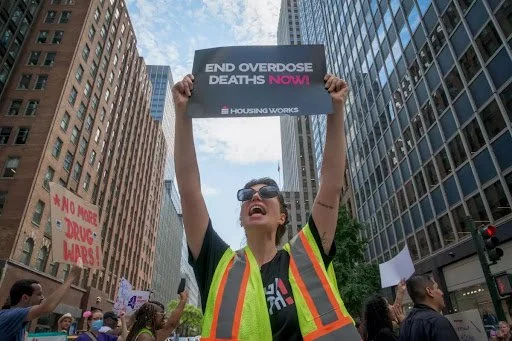
A protester holding a sign during International Overdose Awareness Day in New York City. Source: Houston Public Media.
On Tuesday, January 13, up to 2,800 grantees of the Substance Abuse and Mental Health Services Administration (SAMHSA) abruptly lost funding. These cuts halted naloxone distribution, overdose prevention efforts, mental health and substance abuse support in schools, and substance abuse recovery programs. The cuts affected nearly all discretionary funds, accounting for nearly $2 billion of SAMHSA’s budget. Less than 24 hours later, US health officials countered and began reinstating the funding to mental health and substance use programs. Some programs received notice of reinstatement on January 14, while others are waiting for an official notice that they can resume work.
The sudden cuts have the potential to disrupt the already fragile system surrounding substance and mental health treatment, particularly for areas that struggle heavily with substance abuse and diseases of despair, a category of mortality “driven by economic, social, and psychological factors” and due mainly to suicide, alcoholism, and drug overdoses. The United States has been in the midst of an opioid epidemic for several years. Overdose rates have begun to fall in recent years, but they are still the leading cause of death for adults ages 18 to 44 in the United States. One of the most effective overdose prevention methods is the public distribution of medications such as naloxone, commonly known as Narcan, which is responsible for saving tens of thousands of lives in the last 15 years. Without the funding for its distribution, tens of thousands of people could die.
Another essential point of substance abuse prevention and mental health treatment lies in education programs. Before the reinstatement, the American Psychiatric Association (APA) stated that it had lost funds for many of its education programs, including one that offers mental health training to staff in elementary through high school institutions. With the loss of funding, marginalized and low-income communities will bear the brunt of the consequences; the repercussions of federal cutbacks fall unevenly across populations. In communities that rely heavily on Medicaid or the Children’s Health Insurance Program (CHIP), new eligibility barriers will inevitably strip coverage from children, even those who qualify. Cuts to Medicaid-funded school services put schools at risk of violating the Individuals with Disabilities Act (IDEA) and deny children with disabilities access to the therapies they are legally entitled to receive. In rural districts, the cuts could lead to the elimination of the already scarce accessible school-based mental health providers.
Minority groups that face the nation’s highest rates of suicide and overdose, including the LGBTQ+ and tribal communities, are at risk. LGBTQ+ youth, who have already lost access to the “press 3” option on the national 988 suicide and crisis line, have been met with newly proposed rules by the Centers for Medicare and Medicaid Services that would prevent hospitals from providing gender affirming care. Tribal youth could face the elimination of suicide and substance abuse prevention programs funded by Tribal Behavioral Health Grants. Black communities in the US have been disproportionately impacted by opioid overdoses and receive less access to sustained treatment, prevention resources, and recovery support already. Without a stabilized system of federal investment and an investment in systems that are not impacted by political shifts, these disparities will widen.
Congress appropriated the funding to SAMHSA, which distributes grants to organizations across the country, and there is no indication that Congress itself was involved in the cancellations. Although funding negotiations between Republicans and Democrats were ongoing, the cuts appeared to be politically driven, as the administration unexpectedly used its regulatory authority to terminate the funding. The Trump Administration could have ended funding because programs might not have been aligned with the administration’s priorities. The emphasis of the program is on “innovative programs and interventions” aimed at reducing mental illness, substance use, overdoses, and suicide, which tend to align with the priorities of the Democratic Party. The move to reinstate the funding dealt a setback to the agenda of Health and Human Services Secretary Robert F. Kennedy Jr. He has pursued potentially aggressive and legally challenged reductions to federal health agencies and proposed consolidating SAMHSA into a new entity called the Administration for a Healthy America. The decision to reinstate came after intense bipartisan lobbying to reverse the cuts, including a letter to Kennedy signed by 100 House members.
Mental health and substance use workers are already facing high levels of burnout and high caseloads. These sudden funding costs can potentially push professionals out of the field and discourage future workers. SAMHSA has already lost about half its workforce over the last year due to layoffs and resignations likely connected to Trump’s efforts to downsize the federal staff. The future of the healthcare system remains uncertain, as staffing shortages and inadequate funding for mental health and substance abuse treatment continue to put lives at risk.
The consequences of instability in federal mental health and substance use funding are immediate. Even brief funding interruptions can halt medication distribution, force layoffs, and reduce treatment in areas that already face major provider shortages. Additionally, people who survive one overdose are at a significantly higher risk of another, meaning that disruptions in care can quickly translate into more lives lost. Moving forward, it is important to prioritize the continuation of educating communities and policymakers about the importance of mental health care access and the detrimental impacts of restrictive policies on patients.
Policymakers should establish multi-year funding protections for behavioral health programs, strengthen the workforce pipeline, and ensure lifesaving interventions such as naloxone remain consistently available regardless of political shifts. Politicizing the public health funding going to mental health and substance abuse patients could further destabilize the system and disproportionately place low-income and minoritized groups in danger. Sustained, bipartisan investment in mental health and substance use care is not only a policy decision; it is a determinant of whether thousands of Americans live or die.