
Trump’s DOJ and The Battle Over Federal Reserve Independence
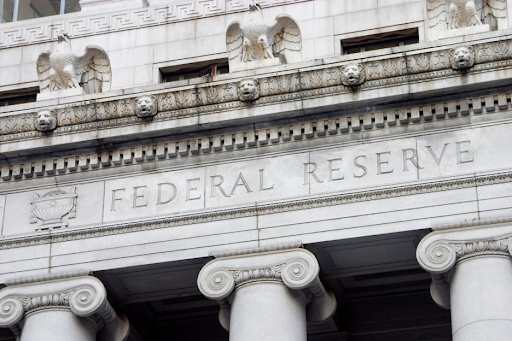
The engraving at the top of the Federal Reserve building. Source: The Federalist Society.
Following a months-long battle over establishing federal interest rates, the United States Department of Justice (DOJ) launched a criminal investigation into Jerome Powell, the chair of the Federal Reserve. Specifically, the DOJ honed in on testimony Powell provided to the Senate Committee on Banking, Housing, and Urban Affairs regarding renovations for two Fed buildings. Following the announcement of the investigation, Powell released a statement asserting, “I have deep respect for the rule of law and for accountability...But this unprecedented action should be seen in the broader context of the administration's threats and ongoing pressure.” Last year, U.S. Attorney General for the District of Columbia, Jeanine Pirro, approved the probe launched by the DOJ into Powell. On January 12, Pirro retaliated by stating that the Fed ignored multiple requests for congressional testimony, while arguing that Powell is the only actor in the case who has suggested indictment.
Despite the targeting of independent agencies being a historically rare phenomenon, Powell’s indictment is not the only instance of the Trump administration directly targeting its dissidents. Over the last year, the DOJ launched criminal lawsuits against former FBI Director James Comey and New York Attorney General Letitia James, mere days after the president complained about their alleged ineffectiveness. Before their criminal indictments, Trump approved executive orders instructing investigations into two federal officials who were heavy critics of his first administration, as well as groups he deemed left-wing terrorists. Greg Brower, U.S. Attorney for Nevada under Republican President George W. Bush and Democratic President Barack Obama, said, “The DOJ seems to be taking its investigative and prosecutorial leads from the White House in certain cases.”
Unlike previous investigations, Powell’s indictment has provoked reactions from lawmakers across the political aisle. Most notably, Republican Senator Thom Tillis of North Carolina, a member of the Senate Banking Committee, has spoken against the probe launched by the DOJ. Specifically, he has stated that he will not confirm any additional nominees to the Fed Chair until Powell’s indictment is properly investigated. Furthermore, Tillis eliminated any possibility that the White House is not attacking the independent state of the Federal Reserve. Alongside Tillis, many Republican members of Congress, such as Senate Banking Committee member John Kennedy and Senator Lisa Murkowski, have questioned the president’s intentions. Outside of the federal government, Jamie Dimon, CEO of JPMorgan Chase, told reporters, “Anything that chips away at that [Fed independence]...will raise inflation expectations and probably increase rates over time.” Despite repeated criticisms, President Trump stood his ground and insisted that lower interest rates are necessary while blaming Powell for doing a poor job managing the Fed.
In previous administrations, the idea that presidents should not decide who comes under criminal investigations based on political affiliation has been a respected understanding, despite no official law explicitly limiting presidential involvement in law enforcement. In an anonymous statement to Reuters, two officials acquainted with the Trump administration have stated that Stephen Miller, the White House Deputy Chief of Staff, disclosed the president’s wishes of targeting Powell to the DOJ. Another White House official, also speaking anonymously, defended Miller’s actions and reiterated that Trump is merely “holding criminals accountable.” The passing of information among officials is not an isolated incident; during his first presidency, the president would often suggest that his administration launch investigations into his political opponents. This time around, according to White House aides, Trump is growing impatient at U.S. Attorney General Pam Bondi’s lack of progress on achieving his agenda, such as handling the Epstein files and targeting those who deny the 2020 presidential election was stolen. However, in a public statement, Trump praised Bondi by saying that she is making “tremendous progress” in fostering a “safe” America.
Outside the realm of political controversy, the probe launched against Jerome Powell has established a wider debate regarding the future of not only the Federal Reserve’s independence, but that of other government agencies. For decades, the Fed’s separation from political pressure has been treated as the foundation of economic stability, dividing expert-backed monetary policy from short-sighted political goals. If that barrier falls, the aftershock will be felt well beyond Washington, causing further public distrust in the government. The investigation into Powell and the Federal Reserve is not simply a legal talking point, but a test of whether one of the nation's most influential agencies can remain free from partisanship.