
Black History Month: The Legacy of Martin Luther King Jr. and the American Dream
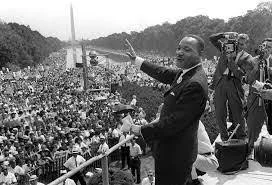
Martin Luther King Jr. at the National Mall. Source: AFP.
Let’s start with the present day America.
Our news headlines revolve around immigration crackdown by ICE, countrywide protests by individuals braving the winter snow, universities walk out days, peace walk of Buddhist monks from Texas to Washington DC which are all sites of resistance and renewal. It feels to me we are living to witness the divided states of America, rather than the united one.
This year, America has reached another milestone in its history when it will celebrate the 250th anniversary of its independence, which is a remarkable feat, by any standard for a modern democracy.
In one sense, American society has come full circle, grappling once again with the same fundamental questions that defined King’s era: Who gets to speak? Who pays the price for demanding equality?
Martin Luther King Jr. is often remembered as an American civil rights hero: a dreamer, a unifier, a symbol of harmony. He was non-violent but disruptive. He challenged the moral foundations of American society and exposed the contradiction between American democratic ideals and its lived realities. He forced the nation to confront the uncomfortable truth that proclaiming freedom is not the same as practicing it.
For many immigrants, including those who arrive legally as students, scholars, and professionals, the freedom to fully participate in civic life feels conditional. There is a quiet but pervasive fear; fear of protesting in the streets of American cities, fear of being misunderstood, fear of attracting the attention of immigration enforcement, fear of being seen not as a contributor but as an “outsider.” The presence of Immigration and Customs Enforcement (ICE) has created a climate of fear in American cities and states, but the presence of ICE has a chilling effect on the rights central to and defining of American life.
“I will not go out to protest during the walk out at the university campus”, a friend of mine, an international student, told me last week. When I asked my friend why, I was told, “I am fearful because of ICE”. While I respected my friend’s decision, It got me thinking about where America has come to when people are fearful to stand up for their rights.
If King were alive in today’s America, what would he say, or think?
Societal fear and silence have their consequences. In his letter from Birmingham Jail on April 16th 1963, King urged people to take action and not to remain silent in the face of injustice and discrimination. He wrote, ‘We will have to repent in this generation not merely for the hateful words and actions of the bad people but for the appalling silence of the good people’.
According to King, being silent is not neutrality; it is complicity because silence reshapes the public sphere and negative collective outcomes in a given society.
The Divided State of America
Last year, I came to the United States as an international student to pursue my Master's studies in Global Affairs as a Rotary Peace fellow. Like many individuals who came to live in the US, I was drawn by the enduring idea of America as the “Light of the World.” The land where opportunities are not handed out, but earned through hard work and innovation. The place where freedom of thought, speech, and conscience are not privileges you are born into, but rights which you can exercise, regardless of your background. Since arriving in the US, I have been blown away by the generosity of strangers-turned-friends, openness, and willingness to listen and learn. The genuine warmth among the American people deserves to be acknowledged and respected. It has been a privilege of my life to experience this and, for that, I am forever indebted.
And yet, living in the United States in 2026, it is impossible to ignore another America, a deeper unease in society. Beneath the language of liberty and opportunity lies a growing tension about the erosion of civil liberties, belonging, and fear, one that places America unmistakably at a crossroads. It is at this moment that the legacy of Martin Luther King Jr. feels less like a history or a finished work, but more like a distant dream yet to be realized, blurred in the midst of chaos and confusion. The recent political, social, economic polarization and inequalities in American life and society are the harsh realities of the world. The climate of fear and victimisation is not the America King advocated for. The gains from King’s era of civil liberties do not match the inequalities of modern day which creates the notion of ‘otherness’ divided on the lines of race and immigration status.
King’s Legacy and America’s Modern Day Challenges
As a researcher, I find current events in the US intellectually fascinating in one sense, and yet disturbing, in another. America is revealing itself in real time, testing the resilience of its institutions and the sincerity of its democratic commitments as crackdown on immigration continues and civil liberties are besieged by politics of the modern day.
Across the Atlantic, my family, friends and colleagues in the UK keep asking me, “Are you okay in the US”, referring to disturbing images of protests and ICE operations they see on their TV channels.
Against the political polarisation of American life, I am deeply touched by the Americans whom I met which has touched my heart. I meet professors, classmates, neighbors who have opened their hearts and home and welcome me in their lives. I am also conscious of political events which has made me, just like my friend, more cautious about where I go, how I speak, and how visible I make myself. The label “un-American,” once associated with civil rights activists, now feels uncomfortably close for anyone who challenges the status quo from the margins.
King’s legacy of social justice and civil liberties has its relevance in modern day America. Silence and standing as bystanders is not the American dream envisioned by the founding fathers' belief in natural rights, human dignities and freedoms.
If America is standing at a critical juncture of its 250 long democratic history, then King’s life can be a lesson we can learn from.
King believed in the unity of a nation. A house divided in itself, can not stand. Maybe it's a moment for unity to reflect on what the US has achieved and what is at stake. If the American freedom of life, liberty and happiness is at stake then King’s advice of unity is the way forward to protect what has been achieved and preserve it as it did, since 1776 and not to give it away so easily.