
Children of Wartime Veterans Scholarship
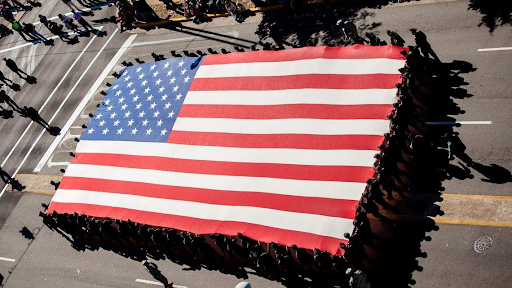
An image pulled from The Charlotte Observer article, “North Carolina,” depicts a massive American flag being carried by dozens of participants as it stretches across a downtown street during a Veterans Day parade. Source: The Charlotte Observer.
Established in 1934, the North Carolina Children of Wartime Veterans Scholarship was created to honor the state’s veterans by helping their children access higher education. The program provides financial assistance to the children of combat veterans who served in conflicts after World War I, some notable being the Korean and Vietnam wars. Eligibility is extended to students whose parents are:
deceased
disabled between 20 and 90 percent, being the rate of how much a service-connected condition decreases a veteran's overall health and ability to function
or listed as prisoners of war or missing in action during wartime.
Since its inception, the scholarship has supported the education of more than 20,000 children of North Carolina veterans. Recipients may use the award for up to eight undergraduate semesters within an eight-year period, and funds are restricted to colleges and universities within the state.
The program is structured into four separate scholarship classifications, each offering varying levels of support for tuition and, in some cases, room and board, depending on a student’s circumstances. Designed as both an educational resource and a symbolic gesture of gratitude, the scholarship reflects North Carolina’s longstanding commitment to honoring military service.
However, recent budgetary decisions within the North Carolina General Assembly have led to a reduction in funding for the program. For many student recipients, these cuts feel like a betrayal from the scholarship’s original mission, raising concerns that the sacrifices made by their families in service to the nation are being treated as a secondary priority.
For William Dishmon, a junior majoring in nursing at UNC, the announcement of possible funding cuts and proration for the Children of Wartime Veterans Scholarship came at the worst possible time, when he was studying for a pharmacology final exam. “When you're in the midst of studying, and your scholarship may be totally defunded, it puts a huge emotional toll on you,” Dishmon remarks. He continues by expressing his surprise, and the situation that he was put in; he did not anticipate having to email and call NC legislators in the middle of his studying to try and plan for a financial future he had never anticipated needing to manage mid-year. Dishmon’s father served in the United States military in Operation Desert Storm, and after leaving the war, he returned with chronic back pain and was classified as 30% disabled due to his service.
When asked what the scholarship meant to him, Dishmon stated, “This scholarship didn’t make college easier—it made it possible. Without it, I never would have gone to UNC. Having that stability lifted an enormous weight off my shoulders, which is why the current situation feels so overwhelming.” Dishmon continues by stating that while there is only a 25% proration in scholarship funding, the future is unknown, and leaves many students in an unexpected and tough predicament, where they must choose whether or not they can afford to continue with their education. He remarks that while his family will be able to continue to support him in his academics, the 25% proration will impact his experience, and he believes that the proration and freezing of scholarship offers will significantly change the experience of children of wartime veterans.
Dishmon and many other students have been contacting General Assembly members to be able to identify the problem and to lobby for the continuation of the Children of Wartime Veterans Scholarship. Senator Phil Berger, President Pro Tempore of the North Carolina Senate, contacted Dishmon to express his gratitude and appreciation for Dishmon's outreach.
In response to student concerns, Senator Phil Berger’s office cited long-standing financial issues within the Children of Wartime Veterans Scholarship program. According to the statement, fiscal mismanagement under prior leadership at the Department of Military and Veterans Affairs caused the program to operate beyond its available funding for several years, a problem compounded by a growing number of eligible recipients. Berger’s office emphasized that the General Assembly has taken steps to stabilize the program, including transferring fiscal oversight to the State Education Assistance Authority during the 2024–25 academic year. The office also pointed to recent legislation aimed at maximizing existing appropriations, noting that without these actions, hundreds of students across UNC institutions and community colleges would not have received scholarship support this year. However, because the General Assembly is not currently in session, lawmakers say they are unable to allocate additional funds to offset the prorated Spring 2026 awards.
In his final remarks on the issue, Dishmon said, “Our parents served this state and country before without hesitation, and we are now asking the NC General Assembly to do the same for us. Education funding should not be treated as negotiable when students are enrolled. It has forced students into impossible choices.” As lawmakers debate budgets and logistics, students like Dishmon are left to deal with the consequences in real time. For many families, this scholarship is not a bonus or a political talking point; it is the difference between staying enrolled and being forced to step away.
If North Carolina is serious about honoring the service and sacrifice of its veterans, the General Assembly must treat the Children of Wartime Veterans Scholarship as a commitment, not a line item that can be delayed or diminished. The cost of inaction will not be measured in dollars, but in the futures of students who were promised better.