
Trump Threatens an Increase in Global Tariff Rate
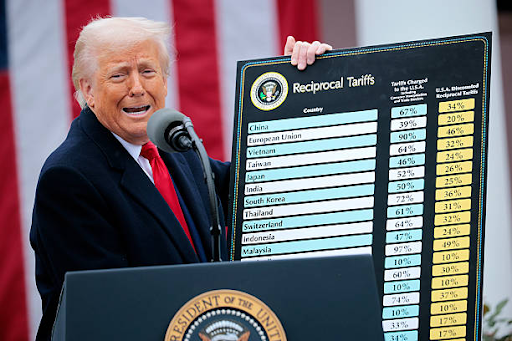
United States President Donald Trump holds a “Make America Wealthy Again Event.” Source: Getty Images.
The Supreme Court recently struck down Trump's use of emergency powers to impose tariffs under the International Emergency Economic Powers Act (IEEPA). In a 6-3 decision, the Court ruled that the tariffs exceeded the authority given to the president by Congress under the 1977 law, which allows the executive branch to regulate commerce during national emergencies caused by foreign threats.
The Court's ruling primarily discussed how far the IEEPA allows a president to go in shaping trade policy. In writing for the majority, Chief Justice John Roberts argued that the statute’s language does not support Trump’s such a sweeping interpretation of executive authority. Roberts emphasized that terms like “regulate” and “importation…contain no reference to tariffs or duties,” signaling the Court’s growing unwillingness to accept expansive claims of presidential power based on vague congressional language.
By rejecting an interpretation no previous president has asserted, the Court is not only limiting this specific use of IEEPA, but also reinforcing a stricter boundary between legislative and executive authority—one that could constrain how future administrations invoke emergency powers to justify major economic actions.
The case also raised questions about the application of the Major Questions Doctrine—a Supreme Court principle stating federal agencies cannot regulate matters of vast “economic and political significance" without clear and explicit authorization from Congress.
By classifying tariffs as a matter of “economic and political significance,” the Court reinforced its reliance on the Major Questions Doctrine, reflecting its increasing role in policing the limits of federal power, potentially shifting more responsibility back to Congress and expanding judiciary influence over major policy decisions.
The shift of power tilting away from the executive branch has forced Trump to find alternative pathways, including placing new barriers around his tariff initiatives, such as —including utilizing Section 122 of the Trade Act of 1974. This allows the president to temporarily impose tariffs if the U.S. faces serious balance-of-payments problems and major trade deficits.
By imposing Section 122, tariffs can be no larger than 15%, redirecting Trump's plan to raise tariffs from the initial 10% to 15%.
This provision is significant as it shapes Trump's initiatives, placing a legal ceiling on how high these tariffs can go.
As this decision places new limits on the use of emergency powers to impose tariffs, it carries several legal implications—most notably assisting in strengthening the Major Questions D no octrine.
This ruling set the precedent that the Court has the authority to shut down broad executive interpretations, shifting to relying on more specific authorities when it comes to future trade restrictions requiring tariffs.
However, the Trump administration's authority to impose these tariffs is highly contentious. In a dissenting opinion, Justice Brett Kavanaugh argued that Trump had the authority under IEEPA to impose the tariffs, while also countering the “Major Questions Doctrine,” and stating that Congress intended in the IEEPA to give the president sweeping power to impose tariffs.
Kavanaugh noted in his dissent that “numerous other federal statutes authorize the President to impose tariffs and might justify most of the tariffs at issue in this case,” reinstating that this ruling will not stop these initiatives.
These loopholes reflect a broader concern within the U.S. government, demonstrating how even with the judiciary attempting to impose stricter limits on the executive, it may not be able to bring a definitive end to the expansive use of executive power.
This view has been reflected by various officials, including White House spokesperson Steven Cheung who stated that “President Trump will not be stopped” in a social media post.
Such loopholes, however, carry various international implications, forcing countries to respond cautiously.
The European Union for example, delayed approval of its trade deal with the U.S. to seek clarity, with officials warning that the new 15% rate could breach previous commitments. Japan and Korea have similarly expressed frustration, arguing that the new Section 122 tariff undermines earlier negotiations under the IEEPA framework.
Canada and Mexico , whowhomich were previously exempt from certain US tariffs under the USMCA agreement, could now be directly impacted by the expanded Section 122 tariff, putting their exports to the US at risk.
Not only are countries abroad reassessing their relationships with the United States, but the ruling also allows for deeper scrutiny of the balance of powers within the federal government: while the decision reinforces the judiciary's role as a check on executive authority, it also exposes the limits of that power, as the Trump administration turns to alternative legal pathways. The Supreme Court’s ruling as such suggests that constraining executive action is not simply a matter of judiciary intervention, but of how clearly Congress defines presidential authority.
Ultimately, this case highlights an ongoing institutional tension: even as the court draws firmer boundaries around executive power, the flexibility of existing statutes may continue to provide avenues for presidents to pursue similar policies through different means, generating tensions abroad and at home.