
The SAVE America Act Will Not Affect All Married Women Equally
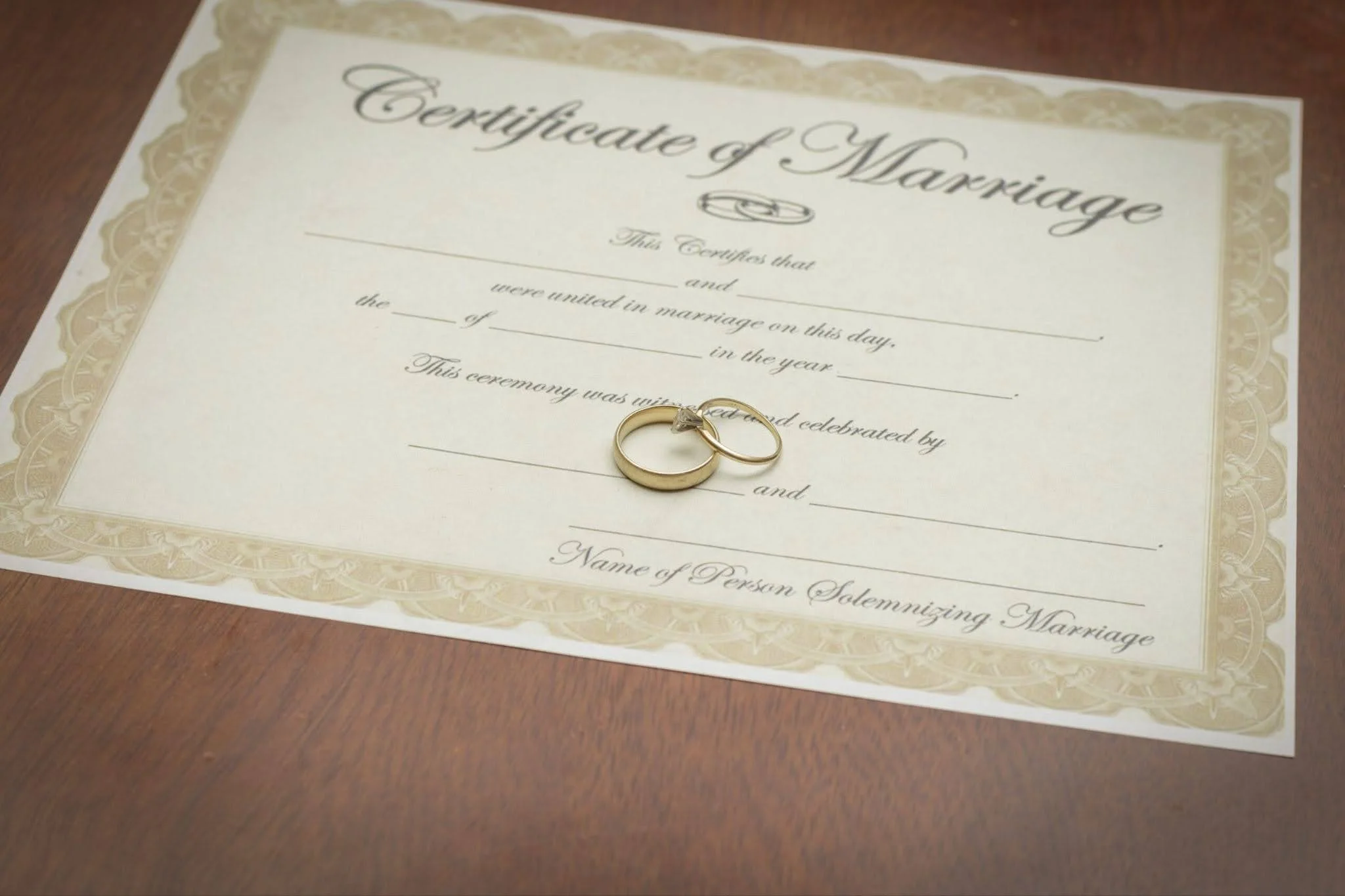
Marriage certificate and wedding rings. Source: People Magazine.
Author’s note: This article uses the term “sapphic” rather than “lesbian” to label marriages and relationships between women. “Sapphic” is an umbrella term that includes any queer woman (cisgender or transgender) who is attracted to women. All lesbians are sapphic, but not all sapphics are lesbian.
The SAVE America Act’s mission is to combat alleged voter fraud by requiring everyone to prove their U.S. citizenship when registering to vote. Although non-citizen voting is both illegal and extremely rare in the United States, the SAVE America Act would require prospective voters to provide “documentary proof of citizenship” (DPOC) that explicitly verifies U.S. citizenship. In addition to presenting a photo ID, voters must present a document such as a birth certificate, passport, naturalization certificate, consular report of birth abroad, or adoption decree listing a U.S. birthplace. Voters would have to present both documents each time they register or re-register to vote and would be required to do so in person.
Election officials verify citizenship by presenting both one’s photo ID and DPOC. Still, if someone’s name is listed differently on both documents, they could provide alternative documents and then sign an affidavit swearing to their honesty. According to the Bipartisan Policy Center, approximately 28.4 million Americans lack readily available documents fulfilling the DPOC requirement. In response, some have changed their name or gender since their original issuance.
Think tanks, non-profits, and mainstream media have warned that the SAVE America Act risks jeopardizing the suffrage of marginalized groups, such as married women who postnuptially changed their surnames. Indeed, many married women would be subject to the SAVE America Act’s “alternative documents” provision and would most likely be asked to provide a marriage certificate documenting their name change. This implication has been rightfully criticized due to the history of sexist voter laws dictating women’s suffrage, including those that allowed women to vote only if they registered under their husbands’ surnames. Asking married women to provide additional “proof of citizenship” during voter registration echoes that sexist history. The SAVE America Act risks stripping the suffrage of married women who changed their surnames rather than kept their maiden names.
As widely circulated in the media, approximately 69-70 million American women have changed their surnames after marriage. However, that statistic focuses on women who are in heterosexual marriages with men. It must be noted that not every woman who marries a man is straight; some of them fall under the sapphic umbrella and are bisexual, pansexual, or even asexual. Nevertheless, the broad categorization of “married women” has occurred under the lens of heteronormativity, which presumes that every person is intrinsically straight and adheres to “traditional” gender expectations, for women, that entails marrying men and then subsequently adopting their surnames.
News outlets and political organizations have relied on heteronormative frameworks to analyze the potential effects of the SAVE America Act on married women, particularly the heteronormative expectation of changing surnames. While it is worth talking about how straight women are oppressed, there has been nearly zero discussion about how women married to other women could also be affected by the SAVE America Act. Statistics are not readily available on how many women change their surnames after marrying other women, but that does not warrant the exclusion of sapphic women from mainstream discourse. The failure to ask questions about the potential harm to married sapphic women under the SAVE America Act shows a lack of regard for intersectionality and how sexual orientation affects women’s experiences with sexism.
Even though sexism oppresses all women, its effects are not felt equally amongst all women. As it pertains to sexual orientation, sexism works with homophobia to oppress sapphic women more than straight women. A term that names this exact dynamic is heterosexism, which privileges heteronormativity and discriminates against women who are not in relationships with men. In short, anything that affects straight women affects sapphic women at higher proportions. And while intersectional feminism has become a popular term in recent years, that framework has not been effectively utilized in mainstream discourse about the SAVE America Act’s potential effects on married women voters.
Needless to say, it is not too late to start incorporating intersectional feminism into it. This can be done by recognizing and emphasizing this dark truth: the SAVE America Act will not affect all married women equally.
How Could the SAVE America Act Strip Sapphic Women of Their Suffrage?
Depending on the execution of the “alternative documents” provision, the SAVE America Act could end up disenfranchising sapphic women disproportionately. As previously explained, anyone whose name or gender is listed differently on their documents would be asked to provide additional documents proving their name change and real identity, and sign an affidavit, which does not guarantee a favorable outcome. Additionally, the acceptable alternative documents would be determined by each U.S. state, meaning that its application will likely be incongruent throughout the country. While marriage certificates could be one of the alternative documents, the SAVE America Act does not list any specific documents that would satisfy the provision. Because of the SAVE America Act’s ambiguous nature, states could feel emboldened to dictate not only which documents are acceptable, but also whose documents will be accepted as “sufficient proof of citizenship.” That is to say, its potential effects on married women are not solely about the name change concerning whom the woman marries.
Given the ongoing attempts to undermine marriage equality and LGBTQIA+ rights, states could decide to disenfranchise sapphic women by rendering certificates documenting sapphic marriages as “insufficient” proof of citizenship while rendering certificates documenting straight marriages as “sufficient” proof of citizenship. Such disenfranchisement would most likely happen in secret, and state officials could incorporate that protocol as an unwritten rule in the voter registration process. It would be their way of keeping the disparity hidden from the public, while at the same time subordinating sapphic women as lower-level citizens.
How could that dynamic arise in real life? Consider this possible scenario: Hazel changed her surname after marrying her wife, Tabitha, and recently tried to reregister to vote after moving to another state. Hazel had to use her birth certificate to fulfill the DPOC requirement. Despite supplementing her documents with a marriage certificate and a signed affidavit, she received notice that she provided “insufficient proof of citizenship” and was blocked from becoming a registered voter in her new home state. She tried to appeal the verdict by providing additional documents to prove a postnuptial name change on government records, only to see her evidence repeatedly rejected. She wondered if her exclusion was motivated by homophobia and later found out that other married sapphic women had been going through the same issues. They had also been blocked from the state voter rolls, and their appeals were constantly rejected. Meanwhile, they noticed that married straight women had their name change evidence approved after their first appeal. This motivated Hazel and the other sapphic women to file a lawsuit against state officials alleging imbalanced application of the “alternative documents” provision, as well as 14th and 19th Amendment violations.
If such a scenario become reality in any U.S. state, its officials would likely be violating the 19th Amendment and the Equal Protection Clause of the 14th Amendment. The Equal Protection Clause of the 14th Amendment was expanded in interpretation following the Supreme Court’s decision in Obergefell v. Hodges (2015), which required all states to recognize same-sex and heterosexual marriages. Treating marriage certificates differently during voter registration would run counter to the Equal Protection Clause and introduce systemic homophobia into the voter registration process equally.
To be clear, there has never been a rule explicitly stating that sapphic women or other queer people cannot vote in elections. Though as more queer people live their lives openly, there are attempts from homophobes and transphobes to prevent them from not only loving who they want, but also from exercising their human rights in general. This can be observed from multiple facets, most notably with the lack of federal anti-discrimination protections for LGBTQIA+ people. Some states have anti-discrimination protections in place for LGBTQIA+ people, but most do not. According to the Movement Advancement Project, 27 states and 3 territories either have a “negative” or “low” score when it comes to how their policies treat queer people. In other words, those states and territories lack tangible policies that affirm LGBTQIA+ rights and protections.
Homophobia is a virus in society, and like other viruses, it mutates over time based on the conditions of its environment. Even with same-gender marriage being legal, discrimination against sapphics and other queer people is technically not illegal in all of the U.S. Public accommodations such as banks, restaurants, retail stores, entertainment venues, and even transportation systems can deny queer people service and kick them out of their buildings. States are also continuing to push for a series of queerphobic bills in real time. As of May 29, 2026, 530 anti-LGBTQIA+ bills are being considered in 43 states + Puerto Rico, according to the ACLU. Ten states are also currently working to pass resolutions demanding the Supreme Court reverse the Obergefell v. Hodges decision, with South Carolina most recently introducing its resolution on April 2nd. And although the Respect for Marriage Act (2022) requires that same-gender marriages be recognized across state lines, discrimination against LGBTQIA+ people can still happen outside of marriage recognition.
The attempts at undermining queer rights are one indicator that the SAVE America Act will not impact all married women equally. Another way that the SAVE America Act could incite sexuality-based disparities is through having monthly “voter purges.” Under the supplemental Make Elections Great Again (MEGA) Act, the SAVE America Act would require all states to run their voter rolls through the SAVE system every 30 days and purge anyone flagged as a non-U.S. citizen. It must be noted that the SAVE system is highly inaccurate. The North Carolina State Board of Elections conducted its own investigation of the SAVE system and the NC DMV databases and found that 97.6% of people flagged as non-citizens in the DMV databases were in fact U.S. citizens.
Furthermore, the SAVE America Act allows the federal government to use voters’ personal information. They could use that information to conduct identity-based voter purges and frame them as essential for “ensuring voter integrity.” In fact, identity-based purges are already underway without the SAVE America Act being enforced into law. The Barbed Wire reported that some queer and trans individuals with Hispanic surnames have been purged from the voter rolls in Texas. Trans voters, including trans sapphic women, face the highest risk of disenfranchisement due to laws making it increasingly difficult for them to update their gender marker on documents. That being said, cis sapphic women should not feel safe from this either. After trying to disenfranchise trans people, state governments could work alongside the federal government to purge women who are married to other women off the voter rolls. Most likely, state officials would attempt to keep those efforts covert by purging only some sapphic voters at a time instead of purging them all at once. At least, they could do that if they sought to hide their homophobic voter purges from the public.
The mention of those possible disparities is not an attempt at “grasping straws” or “inventing” an issue. It is also not an attempt to “sew division” in the women’s rights movement. Rather, it is the forecasting of something that could go undocumented, unresearched, and unaddressed if not called out. Like straight women, sapphic women are affected by the 19th Amendment. Nevertheless, sapphic women have faced erasure and exclusion from historical narratives about women’s suffrage, even though they were pivotal to the ratification of the 19th Amendment. With heightened awareness of sexist power dynamics and how they affected women of all sexualities, sapphic suffragists made very substantial contributions to the suffrage movement. They challenged gender expectations in many ways, such as wearing men’s clothing, abstaining from relationships with men, and even engaging in romantic relationships with other women. Particularly in the Northeast, some sapphic suffragists were in domestic partnerships called “Boston Marriages,” consisting of two women who cohabitated and managed their own affairs without the involvement of a man.
Notable sapphic suffragists include Anna Howard Shaw, Jane Addams, and Susan B. Anthony, who were in relationships with women in their lifetime. Unfortunately, homophobic attitudes about two women in relationships have prevented the sapphic history of the suffrage movement from receiving greater coverage in historical narratives. Anti-suffragists painted suffragists as “man-haters” in their opposition to the 19th Amendment, and that insult was especially targeted at women whose sexuality and gender presentation challenged heteronormativity. Such rhetoric infiltrated subsequent waves of feminism. Most notoriously, Betty Friedan in 1969 labeled lesbians as a “lavender menace” to the women’s rights movement. She was the president of the National Organization for Women (NOW) at the time, and she believed that including lesbians in the feminist movement would destroy its progress, as well as portray feminists as “man-haters.”
Friedan’s words inspired lesbians to counterprotest by forming a group called Lavender Menace the following year. While Lavender Menace was short-lived and exclusive of bisexual women, their message was that women who loved other women not only had a place in the feminist movement but were essential to its advancement. And that is true. Lesbians and other sapphics are not a menace to the feminist movement; the real menace is heterosexism, which powers the wheels of homophobia.
So, when discussing how the SAVE America Act will affect married women, it is imperative to include sapphic women in the narrative. Their experiences are connected to the issue of women’s suffrage, which should not be dismissed in favor of sticking with heteronormative frameworks. Failure to think outside heteronormative frameworks perpetuates the erasure of sapphics from the feminist movement, which, ironically, upholds sexism and stagnates the advancement of women’s rights.
One Must Not Ignore the SAVE America Act’s Homophobic Implications
Last year, Representative Maxine Dexter (D-OR) sought to reform the SAVE America Act by adding an amendment to ensure that married women would not be disenfranchised while registering to vote. Her amendment was rejected, which she addressed in a subsequent speech. But the reality is that there is no fixing the SAVE America Act. It is inherently structured to disproportionately strip the suffrage of marginalized groups, with married women being no exception. Even so, women who are married to other women face a greater risk of disenfranchisement under the SAVE America Act, because the states in which they try to vote could decide that their marriage denies them the right to be registered voters. State officials could disenfranchise sapphic women by 1) concocting an unwritten rule to deem their marriage certificates as “insufficient proof of citizenship” and 2) disproportionately purging them from voter rolls while framing the purges as “something that could happen to anyone.” Those are possible scenarios that news outlets and political entities should start highlighting in their messaging about the SAVE America Act.
Same-sex marriage has only been legal in the U.S. for 11 years, but systemic homophobia still exists and keeps morphing as time goes on. Note that under the SAVE America Act, election officials can face 5-year prison sentences for registering someone who has not proven their U.S. citizenship, even if the person is a U.S. citizen. Imagine if it became a crime to register married sapphic women and ensure that they exercise their right to vote. Imagine if state officials actually disenfranchised sapphic women in the two ways theorized above. That is how systemic homophobia in the electoral process would look, and it would enable states to violate the 14th and 19th Amendments.
Historically, anti-LGBTQIA+ oppression has been handled via lawsuits. But why wait until a lawsuit is filed to call out the homophobic implications of the SAVE America Act? The time to call them out is now.