
Virginia’s Gerrymandering Gamble
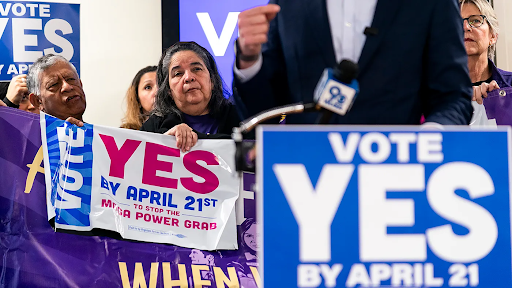
Supporters of the Virginia Redistricting Amendment. Source: The Hill.
Virginia voters head to the polls today to decide a constitutional amendment that could redraw the state's congressional map and flip as many as four House seats to Democrats — a vote with stakes that extend well beyond Richmond. The amendment is a direct response to Republican redistricting efforts in other states, pushed along by Trump's explicit encouragement to draw favorable maps before November's midterms. Virginia Democrats, holding majorities in both chambers of the General Assembly, proposed the measure as part of a broader national Democratic counteroffensive. If it passes, the new map would project a 10-1 partisan split, with Democrats potentially gaining four additional House seats. The awkward part is that Democrats built their case on the very principle they're now abandoning. In 2020, Virginia voters approved a constitutional amendment giving redistricting power to a bipartisan commission — a reform Democrats championed. Governor Abigail Spanberger, who signed the current referendum into law, was among those who once called partisan gerrymandering detrimental to democracy. Republicans have gleefully used her old footage in ads. Democrats counter that unilateral disarmament isn't principle; it's losing. With Republicans holding a narrow 218–213 House majority, a handful of redrawn Virginia seats could determine control of Congress. A recent poll gives supporters a slim 53–47 edge, and the result is expected to be close. Legal challenges loom regardless of the outcome and the Virginia Supreme Court has already signaled it will weigh in after votes are counted. Whatever voters decide today, the precedent is the real story: mid-decade redistricting is now a weapon both parties are willing to use.