
Tensions Escalate Further Over Seized Tanker
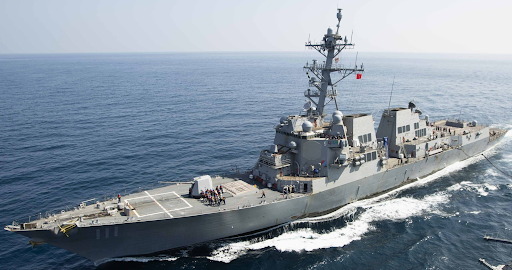
The USS Spruance. Source: Seaforces.
On Sunday, the USS Spruance, a guided missile destroyer, fired on and disabled the Iranian-flagged cargo ship Touska in the Gulf of Oman before U.S. Marines boarded and seized the vessel. U.S. Central Command confirmed that a warning had been issued over a six-hour period before the strike, calling the action "deliberate, professional, and proportional.” The seizure escalates a naval blockade the U.S. has maintained on ships entering and exiting Iranian ports since last week. Iran has characterized the blockade as a breach of the ceasefire brokered in late February. Iran’s parliamentary speaker Mohammed Bagher Qalibuf was blunt in response, declaring it “impossible for others to pass through the Strait of Hormuz while we cannot.” True to that warning, Iran has again effectively closed the strait, which carries roughly 34% of the world’s crude oil and natural gas. The diplomatic picture is no clearer. U.S. President Trump threatened to destroy every power plant and bridge in Iran if Tehran refused his terms, even as U.S. envoys including Vice President JD Vance and Steve Witkoff were set to travel to Islamabad for a second round of negotiations. Iran's military command warned it would “soon respond and retaliate” against what it called armed piracy, while a ceasefire expires by Wednesday. The Touska incident lays bare the structural contradiction at the heart of this ceasefire: both sides are enforcing blockades they consider legitimate while accusing the other of violations. That's not a misunderstanding – it is two incompatible definitions of the deal sharing the same body of water. With the strait functionally closed, a Wednesday deadline approaching, and Iran promising retaliation, only time will tell whether this is a negotiating tactic or the prelude to something considerably worse.