
Phelan Removed as Navy Secretary
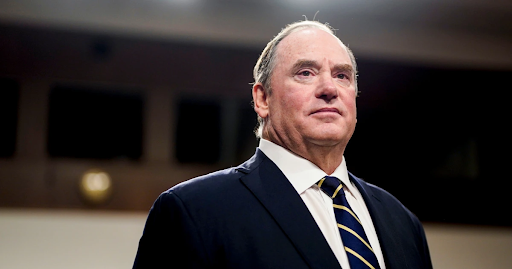
Former U.S. Navy Secretary John Phelan. Source: NBC.
On Wednesday, April 22, the Pentagon announced that Navy Secretary John Phelan was leaving his post “effective immediately” – a phrase that the Trump administration has gotten considerable use out of. Phelan, a financier and longtime Trump donor confirmed in 2025, had no prior military service. He now finds himself with no job, either. The firing came during a White House meeting on shipbuilding, where Trump, frustrated by slow progress on his so-called Golden Fleet initiative, became convinced Phelan needed to go. He told Defense Secretary Pege Hegseth to “take care of it,” which he did. According to six sources familiar with the matter, Phelan did not know he was being fired until he saw the Pentagon spokesman’s post regarding his departure. The official explanation was no explanation at all. Pentagon spokesperson Sean Parnell thanked Phelan for his service without providing a clear reason for his exit. Unofficially, the picture is a bit more messy. Sources told CNN that Hegseth believed Phelan was moving too slowly on shipbuilding reforms and was also irritated by Phelan’s direct line to Trump, which Hegseth viewed as an attempt to bypass him. One administration source put it bluntly: “Phelan didn’t understand he wasn’t the boss.” Navy Undersecretary Hung Cao, a 25-year Navy veteran and former Republican congressional candidate, has taken over as acting secretary. The timing is, to put it charitably, awkward. The U.S. Navy is currently enforcing a blockade of Iranian ports, has seized two ships in the Strait of Hormuz, and is maintaining a significant presence around a waterway through which over a fifth of the world’s oil and gas passes. The firing caught members of Congress and Pentagon officials by surprise. The ouster adds to the pile of military officials who have abruptly exited under Trump's second term. Hegseth has previously removed Joint Chiefs Chairman CQ Brown Jr., Navy Adm. Lisa Franchetti, the head of the Coast Guard, the head of the Defense Intelligence Agency, and Army Chief of Staff Gen. Randy George, among others. Phelan's firing follows a pattern the administration has now repeated enough times to call it doctrine. The pattern that loyalty to the chain of command matters more than competence, and the chain runs through Hegseth. What's notable here is that the instability isn't occurring in peacetime. The U.S. is actively running a naval blockade during a fragile ceasefire with Iran, and the civilian head of the Navy just learned he was fired from a post on X. This is a signal that the administration views wartime operations as no constraint at all on internal power consolidation. Whether Hung Cao can provide stability or simply serves as a more compliant placeholder is the question the Navy now has to answer while managing one of the most strategically sensitive waterways on earth.