
The General Becomes President: Myanmar's Democratic Facade
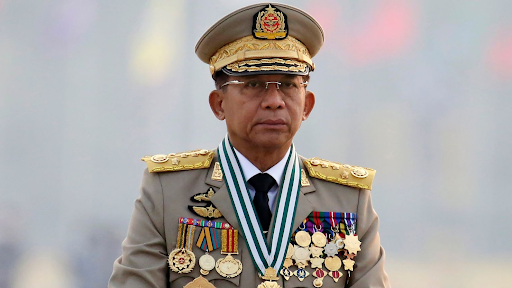
Myanmar General Min Aung Hlaing. Source: CNN.
On April 3rd, 2026, Myanmar’s parliament elected General Min Aung Hlaing as the country’s president. The Presidential Electoral College, composed of 584 representatives, delivered 429 votes to Min Aung Hlaing, a margin that conveys the message of who controls the room. The election follows a general election held in three phases between December 2025 and January 2026, a procedure organized by the same military junta that seized control of Myanmar in the 2021 Myanmar coup d'état. The coup was launched on the day parliament was scheduled to swear in the NLD, Myanmar's pro-democracy party, which had just won 396 out of 476 seats. Rather than accept the result, the military claimed mass voter fraud, detained Aung San Suu Kyi and President Win Myint, and invoked Articles 417 and 418 of the constitution to declare a state of emergency. These were provisions the military had written into the 2008 constitution itself to guarantee the Tatmadaw a permanent grip on power regardless of election outcomes. That same constitution reserves 25% of parliamentary seats for active military personnel and grants the commander-in-chief independent control of the Defense, Border Affairs, and Home Affairs ministries. Even before the coup, the military was never truly out of power, it simply wanted more. The human cost of the ensuing protests have been staggering, with 1,500 people since the coup, including at least 100 children, killed by junta forces, and thousands more arrested. Fast forward to the present day, opposition groups and international analysts have argued the recent election process lacked legitimacy, pointing to restrictions on political participation and the exclusion of major opposition parties. Min Aung Hlaing stepped down as Commander-in-Chief on March 30th, 2026, as presidential candidates are constitutionally barred from concurrently holding another office. Congratulations have poured in from Vladimir Putin and Xi Jinping, whose governments have propped up the junta throughout its campaign of violence against its own people. What happened in Naypyidaw this week was not a democratic transition, it was a calculated act of legitimacy laundering, and it deserves to be recognized as such. Myanmar's 2008 constitution, drafted by the military itself, was specifically engineered to guarantee the Tatmadaw a permanent stake in governance. The more significant question is what this transition means in practice. By formally assuming the presidency, Min Aung Hlaing is doing something strategically important: he is attempting to shift his international standing from coup leader to head of state. The distinction matters enormously for sanctions relief, diplomatic recognition, and access to international institutions. It is a bid to normalize, not just consolidate. Whether Western governments take the bait, by gradually reengaging with Naypyidaw under the logic that a "civilian" president is preferable to open military rule, will likely be one of the more consequential foreign policy questions of the coming year. If history is any guide, the temptation to find a workable point of diplomacy will prove difficult to resist, even when that point is the same general who ordered soldiers to massacre his own citizens.