
Hegseth Fires Army’s Top General Amid Escalating Iran War
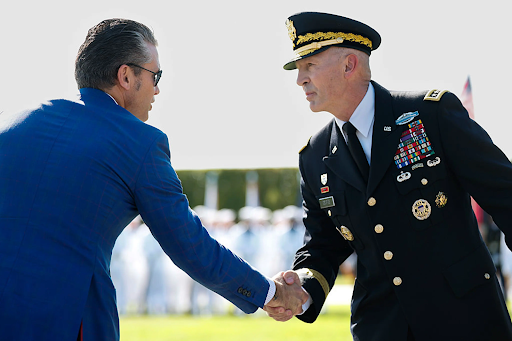
U.S. Secretary of Defense Pete Hegseth shaking hands with with Army Chief of Staff Gen. Randy George. Source: TIME.
As the United States enters its fifth week of active conflict with Iran, U.S. Defense Secretary Pete Hegseth has ousted the Army's highest-ranking officer, Gen. Randy George. The Secretary’s decision has raised urgent questions about whether the administration is prioritizing political loyalty over military experience at the worst possible time. George was not alone in his dismissal, as Hegseth fired two additional Army generals the same day: Major General William Green Jr., the Army’s chief of chaplains, and General David Hodne, commander of the Army Transformation and Training Command. These removals represent a combined 111 years of military experience chopped from the Army’s senior leadership in a single afternoon. No official explanation was offered for any of the three firings. A Pentagon spokesperson said only that the Department was “grateful for General George’s decades of service.” Sources, however, paint a far more turbulent picture behind closed doors. Democratic Senator Chris Murphy, who is a member of the Senate Foreign Relations Committee, wrote “It’s likely that experienced generals are telling Hegseth his Iran war plans are unworkable, disastrous, and deadly,” in a Friday post on X. Additionally, disagreement was fueled between Hegseth and senior Army officials when the Secretary blocked the promotion of four Army officers to become one-star Generals in recent months. These officers, found in a promotion list of 29 others, include two Black officers and two women, and the unusual decision to remove the officers prompted some senior military officials to question whether they were being singled out because of their race or gender. Hegseth has reportedly made the move to dismiss the senior officers because he wants someone who will implement his and President Trump's vision for the Army. These removals reflect a deliberate and accelerating effort by the Trump administration to reshape the U.S. military in its own ideological image, prioritizing loyalty over institutional knowledge at a moment when the nation is actively at war. The timing is what makes this particularly striking. These firings did not occur during a period of peace or transition, instead they occurred while American aircraft are being shot down over Iran and U.S. forces are engaged in the most significant Middle East conflict in decades. The assessment that experienced generals are being removed precisely because they are pushing back on war plans they view as unworkable raises a question that demands an answer: is the administration silencing its most experienced military voices at the moment it needs them most? History offers a sobering precedent. The politicization of military command during active conflict rarely ends well. What is unfolding inside the Pentagon today is more than a personnel matter — it is a test of whether America's military institutions can withstand the same loyalty purges now reshaping its civilian cabinet.