
The Intelligence War Behind the Front Lines
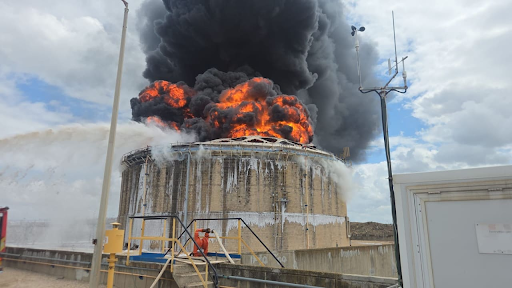
An Oil Refinery in Haifa catches fire after being attacked by Iranian missile. Source: Jpost.
As the U.S.-Iran conflict enters its sixth week, one of the most underdeveloped stories may not be happening in Tehran or the Strait of Hormuz, but Moscow instead. On Sunday, Ukrainian President Volodymyr Zelenskyy revealed in an Associated Press interview that Russia has provided Iran with satellite intelligence on more than 50 Israeli energy grid targets, all of which are civilian infrastructure, not military targets. The revelation itself is alarming, but Zelenskyy’s broader framing is what makes it even more significant. "All the experience Russia gained during the war against Ukraine is being transferred to Iran," he said — a pattern that began with Shahed drone technology and has now extended to precision targeting of civilian energy systems. The strategic logic is not hard to follow. Russian intelligence reportedly told Iran that Israel's power grid is characterized by a high degree of isolation, and unlike European nations, Israel does not import electricity from neighboring countries. This means that damaging even a few central components could trigger a total and prolonged energy collapse. Russia has spent years learning exactly how to do this to Ukraine. Now it is teaching Iran to do it to Israel. U.S. officials have also said that Russian targeting information has included the locations of American warships and aircraft in the Middle East. This is no longer simply a case of two authoritarian governments sharing a mutual enemy. Russia is actively helping to kill Americans. The timing is also worth noting. Rising oil prices, fueled by the closure of the Strait of Hormuz, have bolstered Moscow's war budget while global attention shifts away from Ukraine. Russia has every incentive to keep this war going as long as possible, and now it is directly contributing to its escalation. The Trump administration, meanwhile, eased sanctions on Russian oil earlier this month, citing the need to increase global supply amid the Iran war. What is emerging is a conflict with a shadow architecture: Iran fighting on the surface, Russia supplying the intelligence underneath. Whether Washington is prepared to reckon with that reality, or whether it will continue treating this as a bilateral war with Tehran, may determine how it ends.