
Russia’s Third Usage of Nuclear Capable Missiles
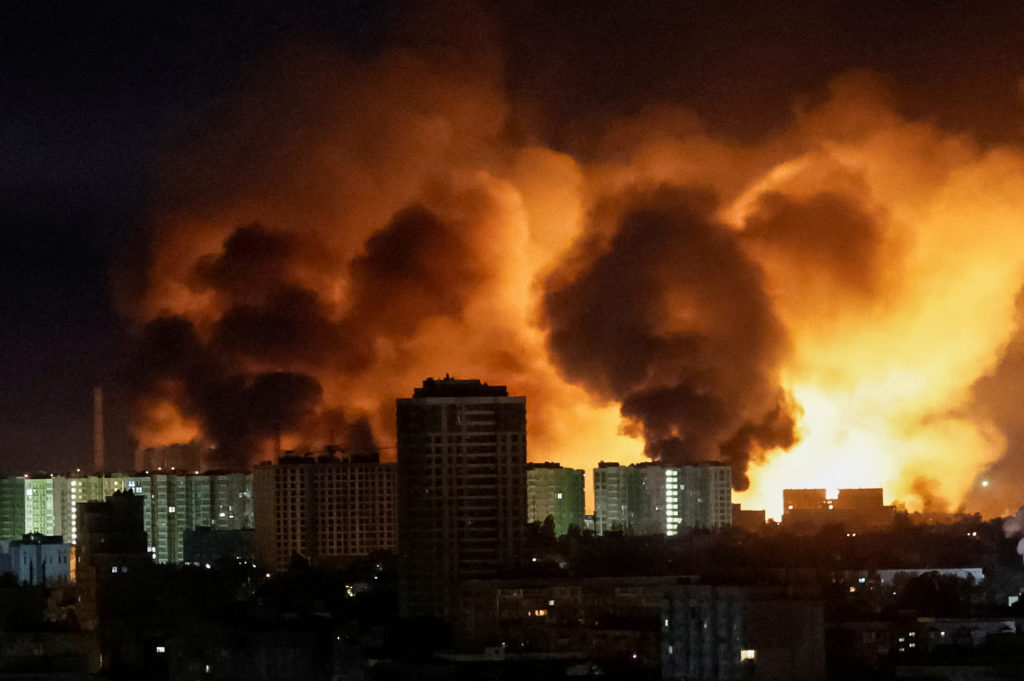
Russian drone and missile attacks in the early morning on May 24, 2026. Source: PBS.
On the morning of May 24, 2026, the sky above Kyiv, Ukraine, lit up for hours due to a large-scale military attack by Russia. The Russian overnight barrage killed four people, wounded more than 80, and destroyed about 30 buildings, marking one of the heaviest bombardments of the city since the war began. Damage was recorded in every district of the capital city. The Chornobyl Museum, devoted to the worst nuclear accident in history, was destroyed. One of the city's oldest markets, Lukianivskyi Market, was heavily damaged. Residents sheltered in crowded metro stations as missiles and drones continued striking after sunrise. It was, as Mayor Vitali Klitschko put it, a “terrible night.” Although the scale of the attack, while staggering, was not what made Sunday’s attack different, it was the weaponry Russia decided to use. Ukrainian President Volodymyr Zelensky confirmed that Russia deployed the Oreshnik hypersonic ballistic missile, a weapon capable of carrying either conventional or nuclear warheads. This attack marks the third time in the four-year war that Russia has deployed the weapon. Moscow framed the strike as retaliation for Ukrainian attacks on civilian infrastructure in Russian-occupied eastern Ukraine. Russia’s usage of a nuclear-capable missile is alarming, and EU diplomat Kaja Kallas accused Moscow of using “a political scare-tactic and reckless nuclear brinkmanship.” The usage of this weapon was a nuclear delivery system deployed in a conventional war, on a civilian capital, to signal displeasure. It can be implied that Russia is not using it because it is the most accurate or effective tool available; it is using it because it carries an implicit threat that conventional munitions do not. The launch of a missile of this caliber by Moscow is a reminder that Russia has a nuclear arsenal and is willing to blur the line between conventional and nuclear warfare when it sees fit. The international community has largely treated each Oreshnik deployment as a discrete escalation to be noted and condemned. Allowing nuclear-capable missiles to become a routine instrument of conventional warfare, unremarked upon, unanswered, normalizes nuclear coercion as a tool of statecraft. The West cannot deter what it refuses to name, and future military decisions like this must be further condemned.