
War Crimes In Ukraine and the UN Charter: An Inadequate Mechanism of Protection?
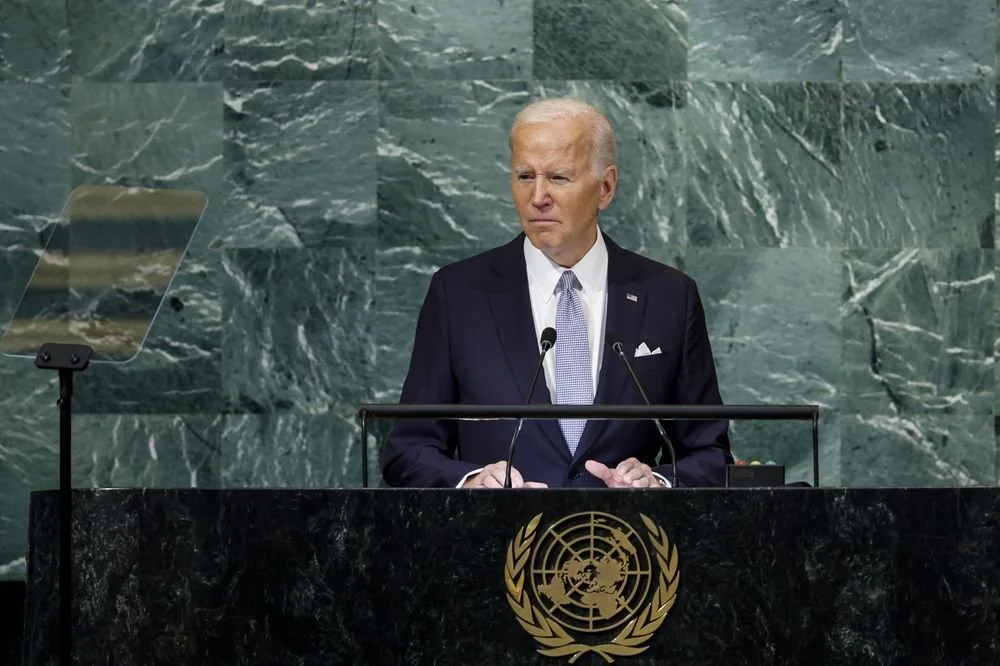
Biden addresses the UN General Assembly in New York City. Source: Bloomberg
As Russia continues its invasion into Ukraine, many foreign leaders continue to vehemently oppose President Putin and his government’s unlawful actions. After a thorough investigation, a United Nations commission recently concluded that Russia committed war crimes in Ukraine, which has incited even more outrage from world leaders. UN Secretary-General António Guterres even warned that these recent developments could lead to “an endless cycle of horror and bloodshed.”
Discussing war crimes requires an examination of the UN Charter, which President Biden referred to in his recent speech to the UN General Assembly. “The UN Charter,” Biden states, “the very basis of stable international order, is under attack by those who wish to tear it down or distort it for their own advantage.” France is a permanent member of the UN Security Council, and its government has expressed similar rhetoric to Biden’s, with President Macron describing Russia’s aggression as a return to imperialism. While China assumed a more neutral position in the discourse about Ukraine, Foreign Minister Wang Yi clearly stated that China would support all peaceful efforts to resolve the crisis, but noted that “the legitimate security concerns of all parties” was important as well during his speech to the UN General Assembly. This notion of possible tension between China and Russia received a small degree of confirmation from Putin himself, admitting that China has “questions and concerns” about the conflict in Ukraine. Along with these verbal messages, global powers have sent foreign aid to Ukraine to bolster their repudiation against Russia. The U.S. recently announced it would be sending $2.2 billion in long-term military aid to Ukraine and eighteen other European countries threatened by Russia’s militancy, as well as an additional $675 million directly to the Kyiv government. Governments are not the only actors sending aid to Ukraine; NGOs, such as the international humanitarian organization CARE, have created initiatives to help those trying to flee Ukraine. The refugee crisis created by the war has grown exponentially, and currently there are approximately 6.6 million people displaced inside the country and 6.3 million have fled to neighboring countries such as Moldova, Hungary, and Poland.
In assessing the world’s reaction to the atrocities being committed in Ukraine, it is important to account for the perspective of the Russian people as well. With Putin’s recent announcement of military mobilization within Russia, the first of its kind since World War II, protests and demonstrations occurred across the country. In terms of actual approval for Russia’s war in Ukraine, initial statistics from the Levada Center, an independent polling firm in Russia, indicate a general support for the war from Russians, but Russia added even tighter restrictions to news and free speech since the beginning of the conflict in February. Therefore, there is no certainty that Russians have been presented with the same facts as the rest of the world, as they live in a more solitary media bubble.
The conflict in Ukraine also sparked a major debate on the efficacy of war crime laws. The UN Charter is a major instrument of international law. Previously mentioned by Biden, Russia’s actions equate to a multitude of violations of the Charter, including the killing of thousands of civilians. That being said, the extent to which Russia has committed these crimes calls into question the efficacy of the treaty. While on paper it is functional in communicating the do’s and don’ts of international law, how governments go about actually enforcing such broad policies in real life is a distinctly separate issue.
The UN commission's findings of war crimes make it evident that the UN Charter has not protected the Ukrainian people from a global power that is trying to extinguish their very identity. Additionally, Russia’s continual presence in the UN Security Council complicates taking additional measures to censure the nation’s actions, as indicated by Russia’s recent veto of a UN Security Council resolution that condemned the “sham” referendums and annexations of Ukrainian territory.
As the United Nations and other global actors continue to bring forth various sanctions against Russia, one can only hope that these global efforts, in combination with Ukraine’s recent success in de-occupying areas of its territory, will continue Ukraine’s advancements within the conflict. Indeed, the current state of the war makes it clear that the UN Charter is no more than a superficial document to Russia.