
Virginia Election Indicates Shift Among Latino Voters
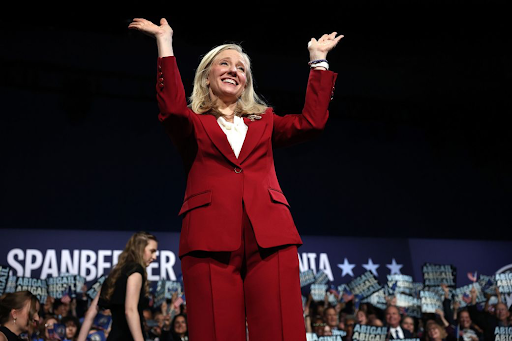
Abigail Spanberger appears for the crowd on election night after a comprehensive gubernatorial victory. Source: CNN.
On Tuesday, November 4th, Virginia elected its first female governor. Democrat Governor-Elect Abigail Spangberger decisively beat Virginia’s Republican incumbent Lt. Governor Winsome Earls-Sears, garnering 57% of the vote.
Although a Democratic governor is not unusual for Virginia, a nearly fifteen-point victory in a state currently led by pro-Trump Governor Glenn Youngkin was a surprise.
Hardly a polarizing candidate, Spanberger ran as a moderate. She has a background in national defense, serving as a case officer in the CIA, and was the first Democrat elected to Virginia’s 7th congressional district. She appealed to voters on both sides of the political aisle, focusing her campaign on the cost of living, healthcare, education, and immigration reform.
Despite her moderate leanings, Spanberger has an energized base, while at the same time tapping into a demographic who voted in higher numbers for Trump in 2024 than they did in either of his previous elections: Latinos.
According to the New York Times, Virginia counties with high proportions of Latino voters experienced a massive shift from the 2024 presidential elections to now. Fairfax County (17.4% Hispanic) saw a 13-point increase in Democratic votes; Prince William (25.7% Hispanic) saw a 16-point increase, and Arlington (15.7% Hispanic) saw a 9-point increase. These Northern Virginia counties have some of Virginia’s highest concentrations of Latino residents and are where political analysts estimate Republicans lost the gubernatorial race. On the city level, Newsweek’s Kate Plummer writes, “Manassas Park, where Latinos make up 46 percent of the population, Democrats increased their share of the vote by 22 percentage points compared to the November 2024 election.”
These results beg the question: why did Latino voters shift their preferences so radically? Did Abigail Spanberger have a unique appeal to these voters, or is this larger than just one candidate?
New Jersey’s gubernatorial election results offer a broader perspective of how Latinos are voting across the country. ABC News claims some key New Jersey counties with a plurality Latino population voted Democratic, often doubling the margin Harris had in those same counties in 2024. Not quite Spanberger’s margin, yet still a monumental shift towards the Democrats.
Reasons for Latino voters’ dramatic shift o may seem obvious; Trump and the Republican Party have tremendously increased immigration control and harshened rhetoric around migration. In just his first 100 days in office, President Trump overhauled US immigration policy, changing the standards for entry and increasing deportations for those already in the country.
Given these changes, Latino voters might naturally change how they view Trump and, as a result, any candidate with an (R) beside their name. However, overhauls to immigration control are clearly part of Trump and the Republican Party’s platform in 2024 and indeed even a cornerstone of their campaigns, yet they still saw a historic number of Latino voters vote red.
In other words, the return to the left is not entirely attributable to Republican immigration policy, contrary to what initially seems to be the case. The shift can actually be attributed to a different 2024 Republican talking point—affordability.
In an interview with MSNBC, Senator Ruben Gallego (D-AZ) described the mood he recently observed among Latino voters. Gallego says “I’ve been hearing the same thing again and again from Latino voters. They’re working harder than ever, sometimes double shifts, yet they’re struggling to make ends meet.” Affordability was a key reason Latinos voted more Republican in 2024 than they have in past elections though, as Gallego goes on to say, “[Latinos’] paychecks don’t stretch as far as they used to [before Trump].”
Abigail Spanberger emphasized affordability and the cost of living for working class and middle class families, which is ultimately why she won. Though immigration certainly played a role in flipping a large number of latino voters who voted red last year, Spanberger’s promise to deliver on the economy is what cemented her to become Virginia’s next governor.
Latinos offered a referendum on the current Republican-led government this election and their role in Abigail Spanger’s win must not be understated. Regardless of how or why they voted this election, the party that overperforms with Latinos will continue to win in the elections to come;
The newfound importance of carrying the Latino vote mirrors how other demographic groups have historically played kingmaker in national and statewide elections. From 1980 through 2000, white Catholics—the so-called Reagan Democrats—were a pivotal swing bloc, shifting between parties and heavily influencing the outcome of national elections. Though they have mostly voted for Democrats in the past few elections, major shifts towards Trump first in 2020 and then in 2024 demonstrate that this may be changing. The fluidity of the Latino electorate causes both Democrats and Republicans to battle for their vote and will put issues they believe to be important to Latinos at the forefront of political conversation.
In addition to their candidate flexibility, Latinos are often located in particularly important states for national elections. They make up significant percentages of states with high electoral vote counts like California, Texas, and Florida, much like white Catholics did at the turn of the century. Latinos now make up large portions of swing states like Pennsylvania, Georgia, and North Carolina, where presidential candidates focus time, money, and energy.
As demonstrated by the drastic shifts among Latino communities in Virginia, Latino voters look poised to play a crucial role as kingmakers in forthcoming elections. Expect candidates to devote more resources to persuading the Latino voters in their state or country to vote their way. Latinos are gaining a unique influence. They will crown the next American president and decide the future of the country.