
Playing Politics With Hunger: SNAP Benefits Caught in the Aftermath of Intense Government Shutdown
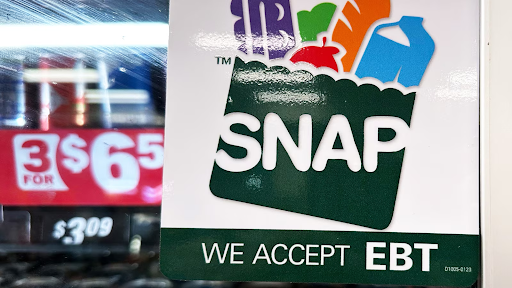
A SNAP sign displayed at a grocery store. Source: ABC News
On November 1, the Supplemental Nutritional Assistance Program (SNAP) ran out of funds for its recipients. The EBT cards that recipients use were not refilled at the beginning of the month as normal, leaving many Americans without the ability to buy enough food to sustain themselves through the week. Amidst the government shutdown, millions of Americans were fearing for the worst. Approximately 1 in 8 people, which amounts to 42 million nationwide, rely on the program to supplement their income and afford groceries. Overall, the large number of people who rely on SNAP heightened the detrimental impact of this funding pause.
Although normal federal appropriations were halted, Federal Judge John McConnell Jr. ordered Trump to use the SNAP program’s contingency fund to issue all November payments by Friday, November 7th. However, the legality was a point of major polarization. The day before Judge McConnell's order was issued, Trump made it clear that he intended to defy it. Amidst clouds of public and judicial confusion around the release of SNAP funds, Trump stated they "will be given only when the Radical Left Democrats open up government, which they can easily do, and not before!”
This raised the question of who truly wields the power to keep federal assistance payments running in shutdown situations. The answer varies among politicians on both sides of the aisle. Trump and others have argued that the government shutdown did not constitute a national emergency, pushing forth rhetoric that it is only happening because of the Democrats' insistence. Vice President J.D. Vance supported this partisan sentiment, stating, "In the midst of a shutdown, we can't have a federal court telling the president how he has to triage the situation.”
Some people have blamed Democrats in the Senate for the lack of funding due to refusing to vote for a continuing-resolution bill that excludes the issuing of health-care subsidies under the Affordable Care Act. They justified this choice due to the fact that subsidies are set to expire in the next fiscal year. Since this would result in unaffordable coverage for millions of Americans, they have been persistent in pushing for forceful action.
However, other leaders, such as Kamala Harris, were clear in asserting that this shutdown was entirely in GOP politicians’ hands. “Let me be clear: Republicans are in charge of the White House, House, and Senate. This is their shutdown,” she stated. Senator Cory Booker of New Jersey also attributed the ongoing gridlock to Republicans not considering making any tangible changes to ensure affordable healthcare.
Still, no one governmental branch is unilaterally responsible, as both the Senate and the Trump administration are heavily involved in the budget process. At the same time, the USDA’s shutdown plan guidance did explicitly state that multi-year contingency funds can be given to recipients even during an appropriations lapse. The Center for Budget and Policy Priorities, in a memo earlier this month, has advised the President to exercise discretionary authority and tap into USDA's contingency fund while lawmakers continue negotiations, since previously he refused to do so until the normal appropriations process is carried out.
Political leaders and average Americans alike were angered by the fact that the lives of seniors, low-income parents, the disabled, retired veterans, and more have been turned into a partisan issue. Senator Amy Klobuchar, in a recent statement, asserted that the Trump administration must “stop playing politics with hunger.”
Many politicians argue that the use of the emergency fund was in fact appropriate and should not be a point of political bargaining and power struggle, given the sheer amount of Americans relying on SNAP to help them get through each week. Without this money, their survival could be at great risk, as many vulnerable populations are physically unable to travel to food banks or live far away from them.
Representative Melanie Stansbury of New Mexico, in particular, has highlighted the immense urgency of the situation at a recent press conference. In a TikTok which has recently gained traction, she explained how the program works in terms easy for the average American to understand, and said that SNAP benefits are what’s keeping many Americans from falling off the edge.
Overall, the SNAP funding crisis is incredibly high-stakes, and the intense political back-and-forth reflects the vulnerability of social assistance programs when appropriations are hanging in the balance. In the SNAP program’s 61-year history, the program has never been completely halted due to a government shutdown, making this event unprecedented.
Since then, President Trump signed off on a government funding bill Wednesday, November 12th, ending the 43-day shutdown. This bill has allocated approximately $107.5 billion for SNAP and $8.2 billion for the Special Supplemental Nutrition Assistance Program for Women, Infants, and Children (WIC). The positive news is that this funding will stretch until September 30, 2026.
However, it is not without its significant pitfalls, and serious changes are to take effect soon. The One Big Beautiful Bill Act, signed on July 4th, has made way for certain eligibility requirements for people who are to receive SNAP benefits. The age limit for able-bodied adults without dependents (ABAWDs) who must meet SNAP’s general work requirements to hold on to their benefits for more than three months has been raised from 54 to 64. This is estimated to impact millions of Americans nationwide.
Additionally, certain exemptions to the SNAP work requirements for homeless individuals and individuals who were in foster care at the time of turning 18 have been changed under the bill. Asylum seekers are also no longer eligible to receive SNAP. When it comes to the impacts of this loss of support, the damage done has the potential to be catastrophic.
Each state has had uniquely different ways of handling this hunger crisis during the shutdown, with many states still experiencing delays in the benefits being issued. There are food banks who are ramping up services to try and meet the gap in available meals. However, there is a limit to their capabilities as they are only equipped to be supplementary assistance. In North Carolina specifically, Governor Josh Stein has facilitated an $18 million contribution to local food banks, funded by organizations like AmeriHealth Caritas.
There is much still unknown about how these new restrictions will play out in practice. The next couple of weeks and months will be crucial in determining access to not just SNAP, but other federal assistance programs in our nation.