
Federal SNAP Lapse Brings State-Level Responsibilities Into Focus
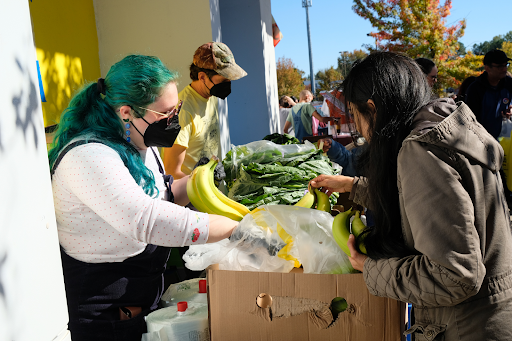
Volunteers at the Scrap Exchange in Durham hand out food. Source: WUNC.
When the USDA announced that Supplemental Nutrition Assistance Program (SNAP) benefits for November would be paused during the federal shutdown, more than 1.4 million North Carolinians were left uncertain. SNAP is one of the nation’s largest anti-hunger programs, and four out of five participating families include a child, senior, or adult with a disability. With the USDA refusing to use its contingency funding, North Carolina families had no guarantees. Counties warned that households would not receive their expected November SNAP deposits, including more than 125,000 residents in the Triangle.
North Carolina’s first response came through legal action. NC Attorney General Jeff Jackson filed a suit against the USDA for withholding more than $230 million in food assistance, arguing that “it must take immediate action to keep families from going hungry.” County social services departments continued to process applications despite having no funds to distribute. State and local organizations also stepped in. Governor Josh Stein announced that the State of North Carolina will grant $10 million to local food banks, AmeriHealth Caritas will give $5 million, and The David & Nicole Tepper Foundation will give $2.5 million.
Local governments throughout NC have also stepped in. The Department of Social Services Director of Durham, Maggie Clapp, launched a food drive to collect non-perishable items for those who can't afford them, after the Durham Community Food Pantry had been nearly emptied, and $21,000 of food cards went in one day. With nearly $6 million towards SNAP in Durham on the line, departments don't have enough funds to cover the missing benefits. In Orange County, commissioners approved an emergency budget addition of $54,000 to help residents provide food.
Most of the rapid response didn’t come from the state, but from residents themselves. Community-run food stations appeared across the triangle. Outside a Raleigh bus stop, volunteers stocked tables with groceries and toiletries, refilling bins daily as people stopped by looking for things to take home. They’ve raised more than $11,000 over the past 3 weeks, with donations from coworkers, neighbors, strangers on social media, and senior living facilities. Throughout the state, food trucks and local restaurants are giving away free meals to anyone who needs them.
On November 14, Congress reached a deal, and SNAP benefits were restored and loaded onto EBT cards within days. But for many families, the damage was already done. A two-week lapse forced households to drain savings, fall behind on bills, and depend heavily on food banks, and officials say demand still hasn’t returned to normal and may not for months. The shutdown only intensified concerns that SNAP is entering a period of long-term instability. A federal bill passed earlier this year made changes to the program, including new cost-sharing obligations, work requirements, and eligibility rules, that the Congressional Budget Office estimates will reduce federal SNAP spending by $186.7 billion over the next 10 years. Even without another shutdown, which is a possibility given that the current government funding only lasts through January 30, North Carolina families are already bracing for reduced benefits.
North Carolina has the responsibility to protect its residents when politicians in Washington fail to do so, especially when it is regarding something as basic as food. SNAP isn’t optional; families can't wait it out. With the instability in Washington right now, and the uncertain future of SNAP, the state has to start treating food access like a core emergency service, not something entirely dependent on federal stability.
This doesn’t mean North Carolina can fully replace SNAP, but it can build backup systems that soften the blow when federal benefits disappear. This could be through emergency food reserves, in which the state maintains a stockpile of shelf-stable food it can quickly release, as it does for hurricanes. Standing agreements with food banks would also help. Instead of scrambling, there could already be contracts in place to help food banks scale up quickly with state support, such as additional staff, storage, transportation, and funding. There should also be a state emergency fund for essential services disrupted by federal shutdowns to help stabilize the system's sound SNAP, which can be overwhelmed when it disappears.
All of these ideas acknowledge that shutdowns are no longer rare and that SNAP is facing significant federal cuts. If the state does not prepare now, North Carolina will end up in the same crisis the next time Washington gets stuck in gridlock. And this time, families may easily be without food for much longer than two weeks. So if the federal government can’t guarantee stability, the state has to ensure protection.