
Strategic Spouses or Soulmates? US-Pakistan Relations Take a New Turn
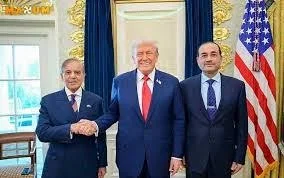
US President Trump meets with Pakistan Prime Minister Mr Shahbaz Sharif (left) along with Mr Asim Munir, Pakistan Chief of the Army in June, 2025. Source: the White House.
I grew up in Sargodha, in Punjab, which is the most populous province of Pakistan and second largest province geographically. Sargodha is famous for being home to Musaf Military Base. The city has images of old and used aircraft implanted on crossroads and roundabouts, which illustrate its military strength. The city is known as ‘City of Eagles,’ referring to Pakistan’s elite command base, which houses F-16 aircrafts and a command school. See the map below and spot Sargodha.
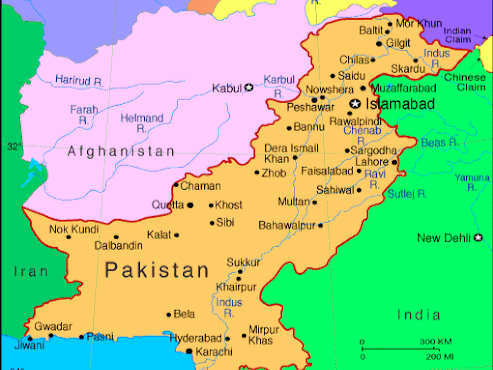
Map of Pakistan. Source: Infoplease.
My dad built a house in a civilian area near the military base. As a child, every time I would pass through the military area, I was struck by its beauty, grandeur, and cleanliness. It was so different from the civilian area I lived in. I always wondered what life was like behind the wide gates, where polished vehicles with men in military suits, neatly pressed, would often pass by.
In our family home, in the early 1990s, we would host some American engineers who came to learn Urdu (my mother tongue) from my dad since he was an English teacher in a local school. The US-Pakistan relationship has a long history that dates back to when Pakistan gained its independence in 1947.
US Geopolitical Ambitions in Pakistan
Pakistan stands uniquely at the crossroads between South Asia, Central Asia, West Asia, and the Middle East—most importantly connecting Central Asia to the Arabian Sea. Pakistani ports, especially Gwadar port in Balochistan, are huge assets that provide essential trade routes to landlocked Central Asian states such as Uzbekistan, Tajikistan, and Kyrgyzstan. Pakistan is also connected to the Persian Gulf, making it key to the Gulf States’ regional security and trade. Pakistan’s geography makes the nation a key international player.
Pakistan’s relationship with the United States is one of its most important diplomatic ties. Geopolitical and Intelligence services describe the enduring strength of the relationship between the US and Pakistan as “on and off” since 9/11. The US counterattacks on Afghanistan entangled Pakistan, which shares a border with Pakistan where terrorists would flee. This necessitated Pakistan’s status as a strategic ally for America in the war on terror. This bond was strained by the fact that Osama Bin Laden was hiding in Northern Pakistan when he was killed by US forces in 2011.
However, America’s continued dominance as Pakistan’s ally in the years after the War on Terror and a trusted friend has been challenged through the economic and development investment of China-Pakistan Economic Corridor (CPEC) through the Belt and Road Initiative. The CPEC is a $62 billion flagship investment in regional infrastructure. This project has global implications that attract big players, like the US, China, Russia, and Gulf states, towards it for their respective regional, national, and geopolitical ambitions.
In response to China’s CPEC project in Pakistan, the US has recently hinted it will help develop a port which will aid access to Pakistani mineral reserves in the town of Pasni, in Gwadar District in the province of Balochistan, which borders Afghanistan and Iran.
Despite the challenges of Pakistan’s geography, opportunities abound. The US-Pakistan’s recent engagement this summer can open its avenues, unlock local and national potential, and create economic conditions for both countries.
Trump Administration Foreign Policy Approaches Against Pakistan from 2018 to Present
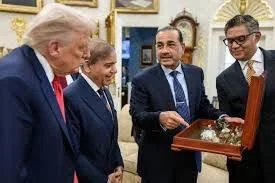
Pakistan’s Chief of Army Staff Mr Asim Munir showing rare earth Minerals from Pakistan. Source: the White House.
In November, the Trump Administration published its National Security Strategy which highlights America’s role in the world and its pursuance of national security and economic interests in Asia. Pakistan would be a key ally for the US to achieve these national security interests.
Historically, Pakistan and the United States have complimented each other in their foreign policy approaches, such as during the Cold War and most recently with the War on Terror. However, as US foreign policy in South Asia pivots towards increasingly strategic and economic considerations, rather than ideological considerations, the nations' bilateral relationship has also shifted.
The recent change in US-Pakistan relationships by the Trump Administration has attracted a lot of media attention and headlines around the world. During the previous term, President Trump distanced himself from Pakistan, stating that the US has been a friend to Pakistan, but in return it has received ‘deceit and lies,’ referring it back to Pakistan's inability to track terrorists both in its own country as well across the border in Afghanistan, despite having received financial aid.
A CNN article in 2018 reported President Trump saying, “The United States has foolishly given Pakistan more than 33 billion dollars in aid over the last 15 years, and they have given us nothing but lies & deceit, thinking of our leaders as fools. They give safe haven to the terrorists we hunt in Afghanistan, with little help. No more!” President Trump tweeted next Monday morning.
However, the Trump administration has since U-turned. How did this happen?
Part of the answer might be the recent clashes between Indian and Pakistan, who both got their independence from the British empire in 1947. Both countries have been at loggerhead with each other over territorial and border disputes multiple times. The recent escalation of war between these two nuclear-armed neighbours with tit-for-tat strikes in May of this year. The escalation between the countries was triggered due to the tragedy of the Phalgham attack, where 25 Indians and 1 Nepali national were brutally murdered by terrorists. The Indian Army responded with Operation Sandoor to target terrorist infrastructure in Pakistan and Pakistan-occupied Jammu and Kashmir. India accused Pakistan of planning these terrorist attacks and directing them in these regions. Pakistan denies these claims. The US administration initially shrugged their shoulders with Vice President JD Vance reportedly saying that an India-Pakistan war would be “fundamentally none of our business and has nothing to do with America’s ability to control it.” This US stance changed dramatically, likely sensing the severity of escalation, which could spiral into a nuclear war, intervened, and rightly so, to deescalate matters. With it also came an opportunity to which the US leapt into to influence not only Pakistan, but its wider regional ambitions in South Asia and the Middle East.
President Trump, on May 11, shared a post on Truth Social saying that, “it was time to stop the current aggression that could have led to the death and destruction of so many… millions of people could have died.” He further said, “I will work with you both to see if, after a thousand years, a solution can be arrived at concerning Kashmir.”
Pakistan sensed an opportunity to strengthen its ties with the US, by other means. It leapt to action with a hope to influence hearts and minds of the Trump Administration through diplomacy.
Diplomacy is the art of getting what you want
It is not unreasonable to conclude that the most recent Pakistan-India conflict in the summer this year, has provided an opportunity for Pakistan to get closer to the US. If diplomacy is known for being an art of getting what you want, Pakistan has carved out its relationship through diplomatic means with the US in the midst of conflict and chaos with India. It is reminiscent of the sentiment Sun Tzu, the Chinese military strategist, expressed in The Art of War, “In the midst of chaos, there is also opportunity.”
The New York Times’ Pranav Baskar reported on November 13th, recounts how Pakistan hired top US aides and lobbyists to convince the Trump Administration that engaging with Pakistan is in the national interest of the US. Unlike India, which discredited President Trump in his role regarding the escalation of the conflict between the neighbouring countries earlier this year, Pakistan nominated President Trump for the 2025 Nobel Peace Prize. Simply put, Pakistan responded diplomatically to President Trump’s sense of pride and ego, which turned the tide of their positive relationship with the US.
The current US administration also became convinced that Pakistan’s strategically important geography complements its national and foreign ambitions in Asia, its borders with China, India, Iran, and Russia. Apart from India, all of these nations are US strategic adversaries.
Building on this relationship, Pakistan and the US have also made a host of deals ranging from enriched rare-earth elements and minerals, with a $500 million partnership framework for refining and processing. The India Times reported that Pakistan's arms deal with the US, totalling $2.5 billion, means Pakistan will receive AIM-120 Advanced Medium-Range Air-to-Air Missiles (AMRAAM).
On 11 November, Natalie Baker, US Charge d’Affaires at the US Embassy in Pakistan, announced that the Exim Bank of the United States has approved $1.25 billion in financing to support mining and critical mineral extraction in Reko Diq, in the Balochistan province. The project is estimated to create 6,000 jobs in the US and 7,500 jobs in Pakistan.
Furthermore, energy-starved Pakistan has made a deal with the US to explore an oil-reserve which has been untapped previously in the Balochistan Province. Regarding the oil reserve deal, President Trump wrote on his social media, “We have just concluded a deal with the country of Pakistan, whereby Pakistan and the United States will work together on developing their massive oil reserves.”
In the words of Madeline Albright, the first woman to be US Secretary of State, “The purpose of foreign policy is to influence the policies and actions of other nations in a way that serves your interests and values. The tools available include everything from kind words to cruise missiles. Mixing them properly and with sufficient patience is the art of diplomacy.” In this case, both the US and Pakistan began to listen and build trust to achieve their respective, mutually beneficial interests.
In an increasingly evolving global order shaped by the U.S.–China competition and regional insecurity, U.S.–Pakistan relations have taken a new turn, a new lease of life. The future of this partnership, whether as solely strategic spouses or soulmates, will depend on Islamabad’s ability to maintain strategic autonomy and Washington’s willingness to engage Pakistan beyond the lens of the War on Terror.