
Famine in South Sudan: A Preventable Tragedy and America’s Moral Test
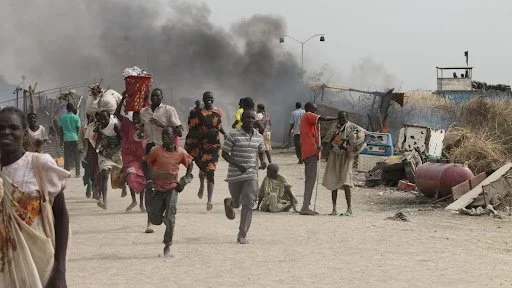
Scenes from South Sudan. Source: Center for Strategic & International Studies (CSIS).
The violence and bloodshed in South Sudan are visible from space. The United Nations (UN) reports that 7.7 million people are facing food insecurity, 2.3 million people have been internally displaced, and gross violations of human rights, such as rape and gender-based violence are frequent, as reported by Amnesty International. These are the grave glimpses of a preventable tragedy in the world’s youngest nation, where war, corruption, and climate shocks have extinguished hope.
A Crisis Fully Visible and Fully Preventable
On 11 November 2025, UN Under-Secretary General Jean-Pierre Lacroix briefed the Security Council on what he described as an unfolding catastrophe. His message was stark. Famine is approaching, displacement is accelerating, and violence continues without restraint. Yet despite the clarity of the warnings, the international response remains slow, fragmented, and weighed down by procedural caution. South Sudan joined the United Nations in July 2011, but the machinery designed to prevent mass suffering appears paralysed again. Whether meaningful action will come in time remains uncertain.
A Decade of Destruction
To understand how South Sudan reached this point, the wider political collapse in Sudan must be considered. Since its independence in 1956, Sudan has experienced more coups and attempted coups than any other country. Its long-time dictator, Omar al-Bashir, was toppled in 2019, which created a military-civilian transitional government. Bashir used corruption and conflict to tamper with government institutions and politically marginalized groups in Darfur. The current rise of Rapid Support Forces (RSF) is the symptom of such a legacy. After Bashir was toppled from his decades-long reign, a power struggle started between General Abdel Fattah al-Burhan and General Hamdan Dagalo, known as Hemedti. Their rivalry erupted into civil war in April 2023, engulfing the Darfur region in violence and sending millions fleeing. South Sudan, already fragile, became a front line in a conflict that has crossed borders and overwhelmed institutions.
A UN-led report published in September 2025, titled ‘Plundering a Nation: How Rampant Corruption Unleashed a Human Rights Crisis in South Sudan, reports that corruption is the engine of South Sudan’s decline. This is the cause of hunger, health crises, and preventable death. The Commission also noted that Government oil inflows have exceeded $25.2 billion since 2011. However, systemic corruption of the ruling elite means that revenue generated by oil and non-oil sources does not reach essential services. Instead, floods, famines, and hunger are the realities for the common man.
The UN Commission’s analysis shows that the Government’s oil inflows alone have exceeded $25.2 billion since 2011 – an enormous sum in one of the world’s poorest countries. Yet systemic corruption and diversion of both oil and non-oil revenues mean that hardly any money reaches essential services. Once the floods arrived, vast tracts of farmland were lost. The African proverb captures the dynamic: when elephants fight, it is the grass that suffers.
The Human Toll: Hunger Used as a Weapon for Violence
The scale of human suffering is immense. UN assessments indicate that nearly 6 million are experiencing acute food insecurity, while more than 1 million are in emergency conditions. Tens of thousands of people in counties such as Luakpiny, Nasir, and Fangak are already living in what the UN classifies as famine. According to the UN, famine refers to a population that faces widespread malnutrition and hunger-related deaths due to a lack of access to food. Oxfam International reports that 7.1 million people now face extreme hunger in South Sudan.
However, these conditions are not the result of natural disasters alone. Researchers like Katie Price have observed that starvation is being deliberately reinforced by political and military actors, turning hunger into a weapon of war.
Along with hunger, food insecurity, the spiral of violence continues to deepen every passing day.
Around 150,000 people have been killed since the conflict escalated and 12 million have been displaced. The BBC recently verified mass graves in el-Fasher following the killing of more than two thousand people by the Rapid Support Forces. Women and girls are carrying the heaviest death burden. According to Anna Mutavati, UN Women Regional Director for East and Southern Africa, pregnant women have been giving birth in the streets after hospitals were looted and destroyed, while others bury children lost to hunger, or disappear without justice. Her message was clear: each day of international delay produces new victims.
America’s Paradox: Funding Aid While Deporting Victims
This humanitarian emergency raises difficult questions for the United States. The country has long been South Sudan’s largest humanitarian donor, which makes recent policy developments deeply troubling. The Department of Homeland Security has announced that Temporary Protected Status (TPS) for South Sudan will end in January 2026. TPS was first introduced in 2011 because South Sudan was considered dangerous due to the ongoing conflict. Losing this designation would pose a serious threat to the personal safety of South Sudanese Nationals.
Or any extraordinary conditions which prevent South Sudanese nationals from returning, or if permitting a South Sudanese is contrary to the national interest of the United States. Ending it now, when UN agencies are warning of impending famine, presents a striking contradiction. The current administration's decision to terminate the TPS for South Sudanese is based on national interest, fraud, and public safety.
The United States continues to fund aid in South Sudan, yet it also prepares to deport people back into starvation. Many South Sudanese who have lived, worked, and raised families in America for more than a decade now risk losing their legal status and livelihoods. New asylum-seekers face an even narrower legal path. They must demonstrate individual persecution, even when the central threat to their lives is hunger, a form of harm that is difficult to document within the confines of immigration law. This is not simply a legal puzzle. It is a profound moral question.
A Test of Conscience
The New York Times reports that the US Catholic Bishops recently issued a rare statement criticising mass deportations and the rhetoric surrounding immigration. They emphasised that the nation’s moral integrity is on the line. Their intervention raises a broader question. Will the United States uphold the dignity of those fleeing hunger, or will it send them back into conditions that the international community recognises as life-threatening?
Practical options exist. Extending TPS, granting humanitarian parole, and adjusting asylum guidance to reflect famine realities would require minimal resources. These steps would demonstrate that compassion remains central to American policy.
Beyond Pity: The Need for Accountability
The crisis in South Sudan requires more than sympathy. It demands holding those who profit from conflict accountable, pressuring governments that allow hunger to persist, and protecting displaced populations.. South Sudanese families are not statistics but reminders of a collective failure. Famine results from human decisions and can therefore be prevented and reversed through deliberate action.
As the United States reflects on whom it welcomes and whom it expels, South Sudan stands as its moral mirror. The choices made now will shape countless lives and reveal whether compassion remains a guiding principle or whether it has quietly become a policy that can be allowed to expire.