
Ten Years Later, America Doesn’t Need to Revisit the Marriage Debate
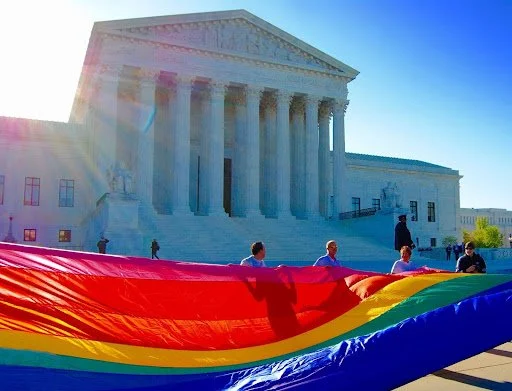
Supporters of same-sex marriage gather outside the Supreme Court of the United States on April 28, 2015, calling for affirmation of the rights recognized in Obergefell v. Hodges. Source: Wiki Commons.

On November 7th, the Supreme Court will privately decide whether to hear the appeal of the former Kentucky County Clerk Kim Davis, who refused to issue marriage licenses to same sex couples in 2015 after the Court’s landmark decision in Obergefell v. Hodges. Davis had claimed that her religious freedom was violated when she was compelled to perform her official duties. At the same time, the couples she denied marriage licenses argued that she acted not as a private citizen, but as an agent of the state, bound by the law and not her personal convictions.
But after nearly a decade of Obergefell, the Court is considering Davis’ case, which threatens to reopen a battle that many Americans had already considered resolved. The right to marry who you want, regardless of the gender of that person, is now woven into the fabric of American life. Revisiting or weakening Obergefell would not only destabilize the civil rights progress that America has made so far but also erode the very principle of equal justice under the law.
Public service is an act of trust where individuals take an oath of office, committing to uphold the Constitution and enforce the law impartially. The oath they took is not conditional on that person's beliefs. If every public official could pick and choose when and which laws to follow, then the idea of rule of law would dissolve into rule by conscience. This would render justice into a matter of personal whim, where rights depend on the beliefs of those who hold the pen.
Kim Davis is allowed to hold her religious convictions, but, as a government official, she is not allowed to impose them on others. Davis' refusal to issue marriage licenses denies citizens access to a constitutional right and humiliates couples who simply seek legal recognition of their love.
Attempting to find a compromise, Kentucky eventually changed its licenses so that clerks’ names would no longer appear on licenses, which was a reasonable accommodation that balances faith and legal obligation. This is what democracy demands, a coexistence, not an imposition. However, Davis’ case goes beyond this. She asks the Court to grant the right for public officials to deny marriage licenses based on a clerk’s personal religion. That is not religious liberty, but instead it is an invitation to chaos.
In Obergefell v. Hodges the Court held that the Fourteenth Amendment guarantees same-sex couples the right to marry. This was a moment of intense national reckoning, which was an acknowledgement that love and family are not a privilege to be rationed, but instead a freedom to be had.
Hundreds of thousands of same-sex couples have married, raised families, bought homes, and built communities. These marriages are not an abstract legal concept, but are the foundations of people’s lives. Reopening Obergefell would create and cast doubts on those families' legitimacy, and reintroduce uncertainty into what the Constitution–and the Supreme Court–has already made abundantly clear.
Some justices, such as Clarence Thomas and Samuel Alito, have signaled interest in revisiting decisions rooted in substantive due process—the idea that the Fourteenth Amendment protects certain fundamental rights, like marriage, contraception, and privacy, even if they aren’t explicitly named in the Constitution. By questioning the legitimacy of substantive due process itself, Alito and Thomas are effectively challenging the foundation of numerous other rights derived from it—making any attempt to reopen those precedents extraordinarily sweeping. The danger here isn’t judicial change itself, it’s that rejecting substantive due process would unravel decades of progress on personal liberty and privacy, leaving fundamental rights vulnerable to ideological tides. The Court’s credibility depends on respecting precedent, especially in decisions that have shaped people’s most intimate choices in life. It would suggest that equality is conditional and the dignity of LGBTQ+ Americans can be reconsidered every decade. No free society can survive on promises so fragile that they change direction whenever the political climate does.
Protecting religious freedom and ensuring equal rights are not mutually exclusive, but instead are both cornerstones of American democracy. The First Amendment safeguards personal belief while also preventing any religion from dictating public policy. Citizens may live according to their faith, but the government must serve all citizens equally, no matter what that person's faith is.
Davis’ supporters argue that forcing her to issue licenses compelled her to endorse something she opposed morally. But issuing a marriage license does not endorse a union, but instead acknowledges a legal right; just as a clerk issuing a business permit does not endorse every business, but instead performs their duty to issue said permit. When belief is used to deny others their rights, liberty stops being a shared freedom and becomes a privilege for the few. True religious freedom thrives only when paired with equal treatment for all, no matter who they are or what they believe in.
As the Justices meet behind closed doors, they face a choice between reopening old divisions or reaffirming the hard-won progress toward equality. The Court does not need to revisit Obergefell to uphold religious liberty. Still, it can and should reject Davis’s appeal while reaffirming that no public official may substitute personal conviction for constitutional duty. Marriage equality is not a social experiment or a moral controversy; it is the settled law of a nation that finally chose fairness over fear. The Supreme Court should honor that choice and let this issue rest.