
Russia's Nuclear Signaling: Moscow's Messaging in the Burevestnik Tests
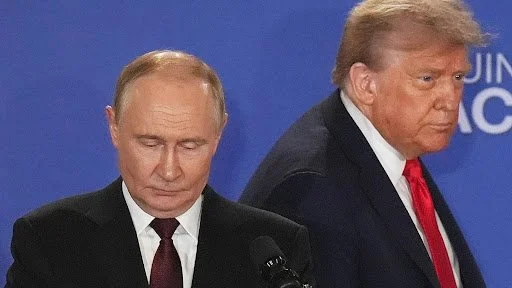
President Donald Trump and Russia's President Vladimir Putin arrive for a joint press conference at Joint Base Elmendorf-Richardson, Alaska, Friday, Aug. 15, 2025. Source: Associated Press.
On October 26, President Vladimir Putin announced that Russia had successfully tested nuclear-powered and nuclear-capable weapons: Burevestnik and Poseidon. Poseidon is an underwater nuclear-powered torpedo that, Putin claims, can carry nuclear weapons capable of causing radioactive tsunamis. Burevestnik, according to him, “has surpassed all other known missiles in the world in terms of range.” The weapon’s nuclear capabilities enable Burevestnik to fly to a near-unlimited range while avoiding radar detection.
Despite the fanfare around the supposedly new milestone in the arms race, analysts differ in their opinions of its potential impact: some liken it to a “tiny flying Chernobyl,” while others say the weapon is neither new nor game-changing. Putin first announced Burevestnik in 2018, even claiming successful testing in 2023. Despite Russia’s claims, experts say the new missiles are not as transformative as Moscow wants them to appear, serving more as a propaganda tool rather than revolutionary weaponry.
However, the announcement comes at a particularly fraught time in Russia–West relations. The ongoing Russo-Ukrainian War and Russian drone attacks across the European continent maintain the tensions. At the same time, the timing of Russia’s missile announcements appears to be a direct response to what can be described as the contentious turn in the U.S.–Russia relations.
Earlier in October, relations between Trump and Putin deteriorated significantly. President Trump abruptly cancelled plans for a summit in Budapest, citing a lack of progress in negotiations: “Every time I speak with Vladimir, I have good conversations, and then they don’t go anywhere.” On the same day, the Trump administration imposed the first and most significant sanctions of his second term on Russian oil companies — targeting Rosneft and Lukoil, which together account for half of Russia’s oil exports. The exact impact of sanctions on the Russian economy is yet to be determined. However, this move still represents a significant escalation as even the Biden administration had stopped short of sanctioning these companies in its final package, targeting only Russia’s third and fourth-largest oil companies.
Putin’s missile testing announcements came in the immediate aftermath of these developments. President Trump responded by calling the tests “inappropriate,” ordering the Pentagon to resume its own testing of nuclear weapons and missiles.
Why Now?
Trump's frustration with Russia has been building since the August 2025 Alaska summit, which failed to deliver tangible results. Since then, the US has increased intelligence sharing with Ukraine, which Washington has been previously hesitant to do. By October 2025, Russia's military campaign in Ukraine had produced marginal territorial gains at enormous cost, while the new sanctions threatened to constrain the economic foundation of Russia's war effort. The cancellation of the Budapest summit signaled that Trump's patience has limits, contradicting Moscow's apparent calculation that personal diplomacy might yield a favorable settlement.
The timing of the missile announcements — just days after Trump's sanctions and summit cancellation — reveals their role within this broader strategic context. Nuclear testing, coercive drone attacks across the European continent, and threatening rhetoric should all be analyzed together as part of Russia's coordinated strategy to achieve two objectives: dissuading NATO allies from continuing military aid to Ukraine, and forcing Washington to negotiate on terms that acknowledge Russian interests.
Modern Nuclear Signaling
The relations between the two countries have taken a decidedly contentious turn, and many believe that Moscow’s latest announcements are sending strong signals to Washington. Even though Putin never explicitly mentioned the “Golden Dome” — the Trump administration’s ambitious plan to build a powerful missile defense system — the announcement clearly emphasized the missile’s long range and ability to evade defense systems. This could indicate the U.S. as a potential target.
The fact that Putin didn’t mention the Golden Dome but clearly designed the announcement to hint at it reveals an interesting pattern in how Russia conducts strategic signaling — sending messages while maintaining plausible deniability. This represents a departure from Cold War-era nuclear rhetoric, in which threats were often explicitly declared. Today’s nuclear signaling operates through implications, rather than confrontation, allowing states to communicate resolve without triggering immediate diplomatic crises. This approach reflects how nuclear powers navigate an era characterised by complex interdependence.
Framing as a Strategy
Maria Zakharova, Russian Foreign Ministry Spokeswoman, said that the development of systems such as Burevestnik “is forced” by NATO’s aggressive actions and “takes place to maintain a strategic balance.” Moscow's characterization of Burevestnik and Poseidon as defensive responses to NATO aggression serves multiple strategic purposes for different audiences. Domestically, this narrative justifies continued military expenditure during economic hardship and reinforces the Kremlin's siege mentality. Internationally, for the Global South, non-Western countries, and populist parties inside Europe who are already skeptical of military aid to Ukraine, this narrative positions Russia as a victim rather than aggressor, placing the blame for Russia’s actions on the West.
The effectiveness of this framing should not be underestimated. While mainstream Western political and media establishments may dismiss it as transparent propaganda, it shapes perceptions among the aforementioned groups. While the contradiction remains stark — Russia waging a devastating war in Ukraine while simultaneously calling its nuclear weapons development is defensive — this matters less than one might expect. The goal is not logical consistency but rather a plausible justification for maintaining Russia's status as a global power that must be accommodated in any security architecture. Regardless of the ambiguity surrounding the actual capabilities of these missiles, the political message is clear: Russia remains a nuclear power, and attempts to isolate it will be met with an appropriate response.
The Arms Control Paradox
Russia has been accused of nuclear saber-rattling since the beginning of the war in Ukraine. First, Putin put nuclear forces on high alert; last year, Russia lowered the threshold for using nuclear weapons. The most recent development on this front occurred on October 27, when Russia terminated an already defunct plutonium disposal agreement with the US, which was designed to prevent the countries from building more nuclear weapons. Moscow had withdrawn from the agreement in 2016, but the formal denunciation last month amid ongoing tensions serves as another signal to the West.
This pattern of nuclear signaling must be understood within Russia’s broader strategic context. Earlier in September, the Russian president declared his readiness to extend the new Strategic Arms Reduction Treaty (START) agreement for an additional year if the U.S. did the same. This is the last remaining arms control treaty between the two countries, limiting the number of deployed long-range nuclear weapons.
The paradoxical nature of simultaneously seeking extended arms control and developing new weapons reveals Moscow’s actual strategic priorities, compared to its public positioning. Russia would benefit from the one-year extension as most of its resources are directed towards waging a war in Ukraine, while its economy is suffering from the impact of sanctions. Moscow may be aiming to avoid extensive arms buildup by its adversaries while its attention and resources are focused elsewhere. A proposed multi-layer missile defense system such as the “Golden Dome” in the US is exactly the kind of development Moscow would try to avoid. In fact, Russia has responded to the potential development of the “Golden Dome” by calling it a “reckless approach [that] undermines strategic stability at its core.”By showcasing weapons systems like Burevestnik, Moscow signals that it retains asymmetric options to counter any Western advantages.
Thus, the testing of Burevestnik could serve a double purpose — if the US refuses to engage in arms control cooperation, Russia suggests it can pursue technological pathways outside existing treaty constraints. If Washington engages, Moscow has breathing room to consolidate its position in Ukraine without facing an arms race it can scarcely afford.
Implications for the Nuclear Order
Beyond immediate tactical objectives connected to the Ukraine war, these developments pose a significant challenge to the existing treaties, norms, and institutions that have constrained nuclear weapons since the Cold War. The development of Russian weapons marks an undoubted milestone, signaling a potentially new chapter in the existing nuclear order. However, this should not be interpreted as indicating a fundamental shift in the global balance of power.
Whether Moscow's nuclear signaling achieves its objectives remains to be determined. What is clear, though, is that the sophisticated coordination of military testing, diplomatic pressure, and strategic messaging represents a concerted effort to reshape the rules of international security in Russia's favor.