
Rewriting the Past: The Return of Confederate Monuments Under Trump
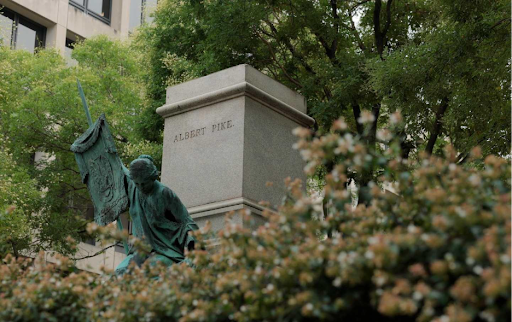
The mantle that held the statue of Gen. Albert Pike prior to its removal in the 2020 Black Lives Matter protests. Source: The Nation.
In an executive order released on March 27, 2025, titled “Restoring Truth and Sanity to American History,” President Donald Trump ordered the restoration of statues of historical figures that were removed in recent years, claiming that, “Americans have witnessed a concerted… effort to rewrite our Nation’s history… with a distorted narrative driven by ideology rather than truth.” As part of his administration's plan to reinstate certain statues and landmarks, the National Park Service announced on August 4 that it plans to restore a statue of Albert Pike, a Confederate general, which was one of more than 160 Confederate monuments removed in 2020 in the wake of the Black Lives Matter protests. In an email, the National Park Service stated, “The restoration aligns with federal responsibilities… and recent executive orders to beautify the nation’s capital.” The statue of Albert Pike, the only monument in Washington, D.C. honoring a Confederate general, was reinstated in late October.
Before serving in the Confederate Army, Pike was a lawyer and Freemason who became a key player in establishing the pre-Civil War Arkansas judiciary. Once in the army, he became a brigadier general in charge of training soldiers in the Confederacy's Indian Territory. About two years into his position, Pike’s troops in the Indian territories were accused of scalping Union troops, forcing him to resign. Before passing in 1891, he was reprieved by President Andrew Johnson. In addition to serving the Confederate cause, historians have speculated that he was involved in creating the Ku Klux Klan once the war ended. On October 27, Rep. Eleanor Holmes Norton of Washington D.C. announced in a press release, “He [Pike] resigned in disgrace after committing a war crime and dishonoring even his own Confederate military service… Pike represents the worst of the Confederacy and has no claim to be memorialized in the Nation’s capital.”
Since the statue’s installation in 1901, the memorial has long been a source of debate. The D.C. Council first called for the removal of the statue in 1992. This past August, Rep. Holmes introduced legislation to place Pike’s statue in a museum. In her October press release, she stated that she does not believe Confederate monuments should be displayed in public but rather preserved in a museum for historical purposes. Furthermore, the inscription on the plaque of Pike’s statue refers to him as an “author, poet, scholar, soldier, jurist, orator, philanthropist, and philosopher.” Evidently, Pike’s statue does not reference his service to the Confederacy or his war crimes, completely dismissing his controversial role in American history. Similar to Pike’s statue, Secretary of Defense Pete Hegseth announced the restoration of the Confederate Memorial, nicknamed the “Reconciliation Monument,” at the Arlington National Cemetery. On August 5, Hegseth stated, “It never should have been taken down by woke lemmings. Unlike the Left, we don’t believe in erasing American history—we honor it.”
The reinstatement of Confederate monuments is part of Trump’s wider agenda to alter historical narratives. His administration has faced public backlash for attempting to erase the history of marginalized groups, such as African Americans and women. Specifically, the National Park Service was under scrutiny for removing any mention of transgender people from its webpage on the Stonewall National Monument, while also ordering its staff to review any gift shop merchandise that could appear “anti-American.” Upon his arrival back in the Oval Office, Trump ordered the Department of the Interior to investigate restoring historic monuments that had been removed. Furthermore, despite Trump claiming he would never do it, the Pentagon has restored the Confederate names of multiple military bases.
The Trump administration’s actions of restoring Confederate symbols and suppressing historical narratives are not restricted to the reinstatement of Pike’s statue, but reveal a wider attempt to control public memory. By honoring disgraced figures like Albert Pike while silencing the stories of historically marginalized groups, Trump intends to alter the story of the United States into a nation that is based on nostalgia for a glamorized past, rather than accountability. The administration’s campaign to “restore truth and sanity” risks normalizing an idealized version of history that completely erases the oppression of marginalized groups and distorts the legacy of those who fought for freedom and equality for all Americans.