
Let’s Talk Censorship
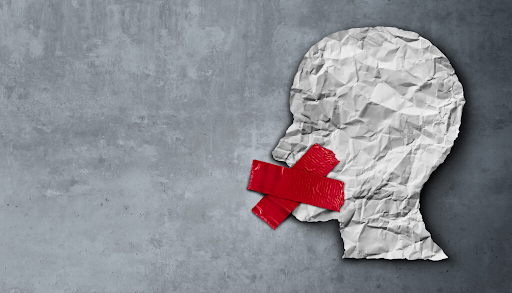
An image pulled from The Scholarly Kitchen article, “Declaration To #DefendResearch Against US Government Censorship,” depicting a crumbled portrait with a red ‘x’ covering the mouth. Source: The Scholarly Kitchen.
In May 2020, President Donald Trump launched his attack against what he described as “censorship,” after Twitter placed fact-check warnings on two of his posts. Shortly thereafter, he signed the Executive Order on Preventing Online Censorship and, following the January 6th insurrection, pursued a class-action lawsuit against major technology companies—Twitter, Facebook, and Google—accusing them of silencing conservative voices.
After his loss in the 2020 presidential election, the MAGA movement increasingly attributed the defeat to the censorship, among other reasons, that President Trump claimed to have faced. At the signing of the Preventing Online Censorship order, President Trump declared, “They have points of view. And if we go by that, it’s actually amazing that there was a success in 2016. But we can’t let this continue to happen. It’s very, very unfair.”
The “they” in President Trump’s remarks referred to social media giants. By suggesting it was “amazing” he had won in 2016 despite what he saw as suppression, President Trump implied that conservative voices had long been subject to censorship, well before it became visible to the broader public.
Let’s work under the assumption that President Trump and MAGA are correct—that selective censorship has occurred. This debate has become a non-issue; what matters now is that censorship remains very much alive and well. The Trump administration’s defense of “free speech” rings hollow when paired with its own efforts to silence opposing voices, proving that what it truly seeks is not freedom of expression, but control over who gets to speak. So, let’s talk about censorship.
The Late Show with Stephen Colbert
The Late Show with Stephen Colbert announced earlier this year that it will end in May 2026, despite strong ratings and positive reviews. Around the time of the announcement, rumors circulated about President Trump’s involvement. President Trump later clarified that he was not responsible for Colbert’s firing, yet he took to Truth Social to celebrate the decision, writing, “I absolutely love that Colbert got fired,” while also dismissing Colbert as untalented and unremarkable.
President Trump’s gloating drew immediate attention from Democratic lawmakers, many of whom raised concerns about the timing. Just three days prior to the cancellation, Trump had received a $16 million settlement from Paramount and PBS (parent companies to The Late Show with Stephen Colbert), prompting speculation about connections between the events.
Whether the cancellation of The Late Show with Stephen Colbert was political or not, the issue lies in Trump’s celebration of the silencing of a widely viewed and successful program. Moreover, this extends beyond Colbert. In the same Truth Social thread, Trump suggested that Jimmy Fallon could be “next.” This promotion of silencing dissenting voices, and celebration of cutting Colbert off the air goes directly against what President Trump spearheaded during the final moments of his first term, and throughout his entire reelection campaign—protection of free speech.
Jimmy Kimmel Live!
In a similar vein, another late-night show was recently suspended following commentary on the assassination of right-wing political activist and Turning Point U.S.A. founder, Charlie Kirk. Jimmy Kimmel Live!, a popular after-hours comedy program known for its political commentary, addressed both the assassination and the more than 100 school shootings that had taken place in 2025.
During the monologue, Kimmel highlighted efforts by the MAGA right to portray the assassin as a left-wing, African American, transgender individual; claims that he argued were entirely baseless. As Kimmel said,“Characterize this kid…as anything other than one of them…to score political points from it.”
Kimmel went on to show a clip of President Trump, who shifted from discussing Kirk’s murder to the addition of a new ballroom at the White House within seconds. While much of Kimmel’s segment was uncontroversial, his remark that the assassin could have been “one of them” sparked backlash. The Federal Communications Commission (FCC) opened scrutiny into the episode, and the show was ultimately removed and suspended from airing. However, since then, ABC has announced that Jimmy Kimmel Live! will officially be back on the air.
The President of the United States celebrating the silencing of a public figure and his FCC deplatforming that person simply because the administration disagreed with a viewpoint expressed is stunning. This is not normal, and Americans cannot allow it to become the new normal—especially as violations of free speech grow more apparent. These violations are evident not only in the statements of high-ranking officials, but also in efforts to erase history. The Trump Administration is trying to erase the lived experiences, struggles, and identities of entire communities, and if these narratives disappear, we risk losing the democratic accountability that comes from remembering past injustices.
Weaponization of Speech
In September, Attorney General Pam Bondi spoke on the murder of Charlie Kirk and launched her attack on hate speech. She said, “There's free speech and then there's hate speech, and there is no place [for it] in our society.” When asked if law enforcement would go after groups who use hate speech, Bondi said,“We will absolutely target you, go after you, if you are targeting anyone with hate speech -- and that's across the aisle.”
The takeaway is that Bondi’s definition of hate speech is politically charged, and risks the erosion of norms in our democracy. In fact, and quite importantly, Bondi classified dissent to President Trump as hate speech, further pushing harmful rhetoric and implementation of our first amendment.
This hypocrisy runs deep. For instance, Congresswoman Nancy Mace (R-SC) can freely refer to the assassin of Kirk using a slur against transgender people, intentionally demeaning an entire group. Yet when Jimmy Kimmel pushes back against that narrative, his show is pulled off the air.
Where is The Line?
These examples highlight how the government under President Trump’s leadership has quashed free speech among dissenting voices while tolerating or even encouraging hate speech from its allies. This raises urgent questions: Where is the line between hate speech and free speech? When does hypocrisy in governance become intolerable?
I believe there must be a consistent standard: hate speech should be condemned morally, but the right to speak must remain legally protected. Under President Trump, however, figures like Congresswoman Mace thrive on hate-fueled platforms, while others face censorship simply for exercising their right to speak. This selective application of “free speech” principles—deciding whose voices are amplified and whose are erased—is not just political maneuvering; it is an attack on the liberal democratic ideals the United States claims to uphold.
It is time to move beyond partisan lenses and confront what stands before us. The United States government is no longer a neutral arbiter of speech—it is actively silencing dissent and promoting only the voices that serve its interests. This is not, and cannot become, normal. Free expression is a cornerstone of democracy, and when it is manipulated or suppressed, the health of that democracy itself is at risk.a