
Food Stamps Held Up for 1.34 Million North Carolinians During Shutdown
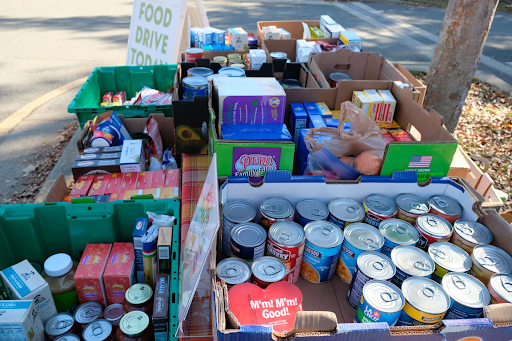
Food donations at the Eno River Farmers Market in Hillsborough. Source: WUNC.
Approximately 1.34 million North Carolinians rely on SNAP (Supplemental Nutrition Assistance Program - also called “food stamps”), the federal government program of food assistance for low-income households. On November 1st, they did not receive their full monthly benefits after the NC Department of Health and Human Services (NCDHHS) was directed by the federal government to delay benefits during the government shutdown.
SNAP is funded by the US Department of Agriculture (USDA), whose normal appropriations process was halted during the shutdown. The agency announced on October 10th that it would not use any of its $6 billion contingency fund to continue SNAP payments throughout the shutdown. In response, North Carolina and 24 other states filed a lawsuit in federal court seeking to require the USDA to continue issuing SNAP payments.
In announcing the lawsuit, NC Attorney General Jeff Jackson said USDA was playing “an illegal game of shutdown politics” and highlighted the stakes of leaving nearly 600,000 children in North Carolina without secure food access.
Later, on November 4th, following a court order by a Rhode Island federal judge, USDA stated that it would use $4.6 billion in contingency funds to issue partial SNAP benefits. The same judge ordered on November 6th that full SNAP benefits must be distributed, though the Trump administration appealed that order, and the Supreme Court paused its implementation while the appeals court was deciding. Finally, with the end of the government shutdown on November 12th, full benefits for November were distributed on November 14th.
USDA originally justified its SNAP freeze by saying in a memo that the agency’s contingency funds cannot legally be used to cover SNAP benefits. However, during previous government shutdowns, USDA has continued SNAP payments under both Democratic and Republican administrations. For example, during the December 2018-January 2019 shutdown, the first Trump administration directed states to make February 2019’s SNAP payments early before the funds available for SNAP expired.
In the recent shutdown, USDA’s policy reversal appeared abrupt, with the agency’s original Lapse of Funding Plan, issued on September 30th and since removed from its website, explaining that contingency funds could be used to pay for SNAP benefits past October.
Both sides of the political aisle have used food aid as a messaging tool during the shutdown. The SNAP website displayed a banner blaming Senate Democrats for the lack of funding. House Minority Leader Hakeem Jeffries accused the Trump administration of weaponizing hunger in choosing to cut off SNAP benefits.
Outside of government shutdowns, the federal government covers the full cost of food benefits and half of the states’ costs for implementing the program. Programs like SNAP are cost-intensive and can only realistically be funded long-term by the federal government.
NCDHHS says that SNAP is a “lean” program, costing around $5.70 per person per day, but that means it still costs slightly under $3 billion per year in North Carolina, a hefty amount compared to the state’s current annual budget appropriations of around $30 billion.
Similarly, local food banks cannot match SNAP’s effects on their own. Over the past year, the seven food banks associated with Feeding the Carolinas doled out 250 million meals, but SNAP provided nine times that number during the same period.
During the shutdown, local governments explored options to partially offset the effects of the SNAP cutoff.
For example, Durham County said it can’t cover the funds normally received from the federal government but is considering “limited” stopgap measures, including offering grocery store gift cards and emergency utility assistance. Republican State Representative Chris Humphrey, who represents three eastern North Carolina counties, proposed using state reserve funds to provide temporary assistance during the SNAP freeze.
While benefits were paused, NCDHHS and Orange County recommended that recipients “prioritize essential grocery items” until SNAP benefits were restored and provided lists of local food banks. However, NCDHHS also emphasized that pantries can only provide a “fraction” of the food assistance federal programs normally offer.
The consequences of the lack of SNAP funding also weren’t distributed equally across North Carolina. Only 3% of Orange County residents receive food stamps, but 32% of Robeson County residents, for example, do. Rural areas tend to have higher poverty rates and a higher proportion of people reliant on SNAP, with many small-town local grocers dependent on SNAP users to remain financially viable. Rural food banks, in particular, often struggle to access fresh, healthy food because they rely on donations from local grocery stores and regional food banks.
The government shutdown and disruptions to SNAP reveal the federal government’s crucial role in securing food access for millions of Americans. Local communities and food providers rallied to the extent possible but cannot offset the scale of food aid normally available from the federal government.
As a testament to SNAP’s importance — both as a policy in and of itself but also as a political tool — the bill to reopen the federal government funded SNAP until September 30th, 2026, while most other operations were only funded through next January.
Note: People in North Carolina can call 211 for information on local food programs and essential services. UNC also offers several food pantries, including the Carolina Cupboard in SASB North 1221.