
J Branch Trail Waits on UNC’s Coal Plant
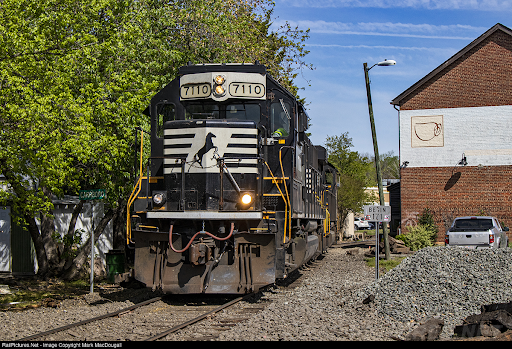
A Norfolk Southern locomotive enters Carrboro on the J Branch, the line that carries coal to UNC’s power plant. Source: RailPictures.
For more than a century, a quiet stretch of railroad has carried coal from Durham County into the heart of Chapel Hill. The line is still in use today, delivering coal to UNC’s Cogeneration Facility on Cameron Avenue, and it’s the same route the proposed J Branch greenway trail would follow. The trail would be approximately 11 miles along the tracks and has drawn strong support. However, the line cannot be fully converted to a trail until UNC stops burning coal. The timeline for that change is unknown.
On September 15, Orange County commissioners and the Carrboro Town Council heard updates on the trail’s feasibility study. The study includes both plans for a full conversion and a trail beside the tracks. The J Branch Rail Corridor belongs to three owners—Norfolk Southern, the North Carolina Railroad and UNC—but only Norfolk Southern runs trains on it, hauling coal to the university’s power plant. The 10.8-mile corridor runs from the UNC plant through downtown Carrboro and the western edge of Chapel Hill to University Station just south of Interstate 85.
Launched in November 2025, the $500,000 J Branch Rail Trail Feasibility Study is run by the Triangle West Transportation Planning Organization and is funded primarily with federal grant money. The survey collected 548 responses, with 79 percent of respondents interested in using the trail for recreation, and 35 percent for commuting.
Carrboro Mayor Barbara Foushee said the project was “very transformative, stating the trail could help the town meet its climate goals.” As long as coal deliveries continue, the tracks will stay in service.
In 2010, then-Chancellor Holden Thorp’s administration pledged to end university coal use by 2020, a deadline that has since been missed. As of 2024, UNC has successfully cut its coal use by 67 percent since 2007.
Coal remains a necessity because of how UNC’s cogeneration plant operates. The plant burns coal to boil water, and the resulting steam first spins a turbine to generate up to one-third of the university's electricity, then is piped across campus to heat buildings, provide hot water, and supply the hospital and research labs. Producing both at once is more efficient than making them separately, but it keeps the plant reliant on coal so the university needs a steady supply of it by way of the J Branch line. Because the plant’s boilers were built to burn solid fuel, any replacement for coal either has to work as a solid fuel in that equipment or requires rebuilding how the campus will make steam.
UNC has tried to find an alternative. In 2024, the university applied for a permit to burn pellets made from paper and plastic waste, but the proposal drew strong opposition at a January 2025 public hearing. UNC withdrew the request in March, saying the fuel could not meet its needs and that they would conduct a new comprehensive energy analysis. The university has not set a new date to stop burning coal.
The trial’s biggest obstacle is not funding or public support but authority, since the groups that want it have no say over when UNC’s coal use ends. State-owned university property and state-operated facilities, like the UNC Cogeneration Steam and Power Plant, fall under the regulatory authority of the North Carolina Department of Environmental Quality (NCDEQ). Carrboro, Chapel Hill and Orange County can fund studies, pass resolutions, and comment on UNC’s air permits, but they own none of the corridor and cannot require UNC to stop burning coal. UNC is both a co-owner of the line and the customer for the coal it carries.
The 2020 pledge shows how little can be enforced: within two years the administration was saying a coal-free campus wasn’t possible, and the university has since reset its goal several times, most recently to an emission-neutral campus by 2040 rather than a coal-free one. UNC has faced a Clean Air Act lawsuit, filed in 2019 by the Sierra Club and Center for Biological Diversity, and the public backlash that sank the pellet plan. Both cost the university credibility but never required it to name a new date. Chief Sustainability Officer Mike Piehler has said UNC has no coal timeline because “if you don’t have certainty about a timeline it doesn’t make sense to give one.” Any shift away from coal depends on funding limits and on whether sustainability remains a priority in South Building and the General Assembly.
This leaves the historically Black neighborhoods closest to the plant, including Pine Knolls and Tin Top, waiting on a timeline UNC has yet to provide. Until UNC sets a date, a trail beside the active tracks may be the only near-term option. The feasibility study is set to be completed by May 31, 2027.