
Ed Sheeran’s Loop Tour Debacle Calls Artists’ Involvement in Politics Into Question
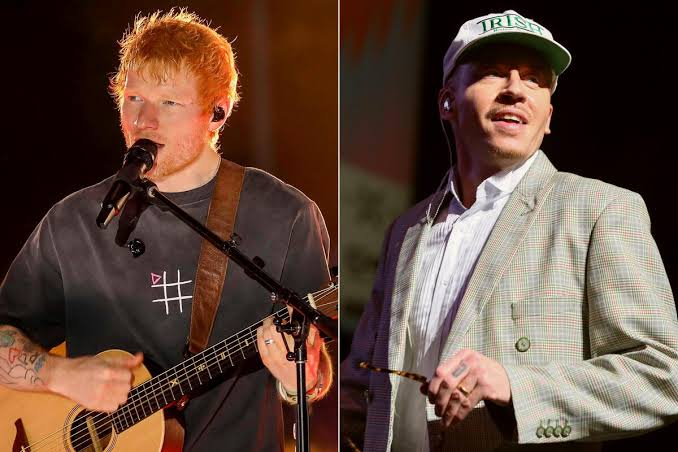
Macklemore was dropped from Ed Sheeran’s Loop Tour on September 14 after expressing his support for Palestine onstage at MetLife Stadium in New Jersey. Source: LA Times.
The world is in the midst of a polarized political climate that increasingly relies on public figures as a source of political information. As a result, the discussion surrounding how involved musical artists should be in political issues is as salient as it has ever been. For artists, creating music that brings audiences together in a neutral space has been challenged by the public’s expectation that they use their platforms and wealth to speak out on issues and create meaningful change outside of the creative realm.
The recent case involving Ed Sheeran’s Loop Tour, which featured Macklemore as an opening act, brings this imbalance to light, as two generational artists bear the brunt of a conflict that has recently divided the internet on the basis of the already-tense Israel-Palestine Conflict.
The events that unfolded following Ed Sheeran’s Loop Tour breakdown demonstrate a larger debate of whether artists have the right to speak about politics within the creative space. The drama began when Macklemore, a long-time rap artist and one of the tour’s openers, made pro-Palestinian remarks on stage at a show in New Jersey on September 4. He said, “Free Palestine,” and proceeded to introduce and play his pro-Palestinian protest song “Hind’s Hall,” which criticized Israel’s military involvement in Gaza.
Immediately following this remark, he reassured the audience that his intentions were purely peaceful — he said, “[t]o all of my Jewish brothers and sisters, criticism of Israel, criticism of apartheid, being against genocide, it in no way is criticism of you.” Despite his efforts to keep his sentiments civil, Macklemore’s statements led the Israeli-American Council for Ed Sheeran to draft a petition to drop Macklemore for the remainder of the tour.
Subsequently, Robert Kraft, the owner of the New England Patriots and Gillette Stadium (one of the original stops on the Loop Tour), joined together with several other venue owners and agreed to give Ed Sheeran an ultimatum—he could either drop Macklemore from the remaining shows, or the venues would not allow any of the artists to perform at all. Kraft backed his decision with claims that Macklemore’s words depicted “antisemitic rhetoric and imagery” that was “deeply offensive” to individuals of Jewish heritage. This situation exemplifies the utilization of power by individuals in the private sector to encroach on the freedom that artistry is supposed to provide to people regardless of background or political party.
Ed Sheeran’s response to this situation reflected a more passive, complicit approach to the debate. Following the ultimatum, Sheeran decided to continue the tour without Macklemore, as he did not want to disappoint fans by cancelling the entire tour. After this decision, he doubled down on the claim that his promoters pushed him to drop Macklemore. He also emphasized that, although he has not publicly spoken on the Israel-Palestine conflict, he still holds his opinions and supports causes in his own way.
Sheeran’s response attempted to keep the fallout as quiet as possible. While this strategy is appropriate in certain scenarios, his prioritization of downplaying the issue in this case gave the impression that he was only considering how his own image may be affected. Regardless, his plan completely backfired. Despite his efforts to keep the peace, his decision to continue the Loop Tour without Macklemore led to all three other opening acts, FINNEAS, Lukas Graham, Beoga, and Aaron Rowe, leaving the tour.
On September 15, FINNEAS wrote in an Instagram post, “[a]rtists must not be silenced when they speak up for the oppressed…I stand with Palestine and its people." The other openers echoed similar sentiments. Two days after he was dropped from the tour, Macklemore said that he would donate $1 million—almost his entire Loop Tour income—to six pro-Palestinian organizations and invited Robert Kraft to match. The Loop Tour is ongoing and scheduled to end in November, but Ed Sheeran is the only performer left.
The line between artistry and politics can become blurry, especially in today’s polarized environment. Decisions about whether political issues should be brought into the music world should be taken case by case, as every situation is different. Instances where artists incite hate or violence toward certain individuals or groups should absolutely result in consequences. Simply expressing support for certain communities should not. In this case, Macklemore did not behave in a way that should generate consequences.
One way to apply this idea could be to use past Supreme Court decisions regarding unprotected speech to decide such issues. Robert Kraft took advantage of the fact that Gillette Stadium is a private venue to justify prohibiting Macklemore from performing — this is well within his rights, as the First Amendment cannot prevent private entities from hosting or blocking whoever they choose. While this is not always problematic, artistic expression would be better protected if venues had to legally justify their decisions to block artists from their spaces.
The First Amendment, of course, protects freedom of speech, but over time courts have ruled that certain types of harmful speech are exceptions to the First Amendment and therefore subject to legal consequences. These include true threats, fighting words, obscenity, defamation, harassment, and speech that threatens the First Amendment rights of others. Requiring private entities to consider these categories when making decisions may require a constitutional amendment. This suggestion may seem radical, but it would actually ensure further protection of the First Amendment, as private entities would not use personal biases while deciding who gets to perform in their venues.
While some may argue that an amendment like this would decrease the power of the private sector of the music industry, it would really only have the power to prevent sentiments that are truly harmful (proving that something meets the standard of unprotected speech is exceedingly difficult); the rest would be up to the venue. More importantly, it would increase artistic freedom that could transpire throughout the music industry and beyond—music is a crucial vehicle for political storytelling.
If unprotected speech were the standard for blocking artists from venues, Macklemore’s actions certainly would not meet it—he was simply expressing his acknowledgement and support of the Palestinian people; he made it very clear that his intention was not to criticize or promote hate toward Jewish individuals, but quite the opposite—to spread love and condemn genocide. The act of dropping Macklemore from the Loop Tour has further normalized the wielding of power by the private sector to suppress not only creative freedom, but also struggling populations, namely Palestinians. Now, the Loop Tour is not only centered on politics but on expression, which directly contradicts the point of music itself.
The controversy surrounding the Loop Tour has displayed, on a large scale, the struggle between artistic expression and current global issues, and has called into question the point of musical performance—should music constitute a neutral space where people from all backgrounds and ideologies come together, or do artists hold a responsibility to call attention to political issues, as they hold platforms that are composed of millions of people?
Macklemore’s spoken support of Palestine sparked significant controversy, but the conflict in the Middle East was already highly controversial. In fact, it is too significant and longstanding of an issue to downplay, as Ed Sheeran tried to do. Additionally, Macklemore did not vocalize any sentiments that would incite hate toward any population. Robert Kraft’s decision and the other venue owners’ decisions to drop Macklemore from the tour clarified the need for legal standards within private entities, as this case jeopardized the freedom and unity music is supposed to provide. After all, is artistry not a reflection of real life?