
House Democrats Tentatively Prepare for Trump Oversight
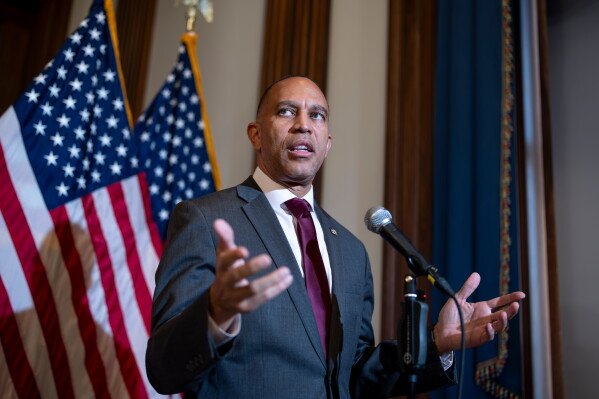
House minority leader Hakeem Jeffries (D-N.Y.) speaking about the Trump Administration’s policies. Source: AP News.
As both parties prepare for the midterm elections in November, attention is increasingly turning to what a change in congressional control could mean for the Trump administration and its contentious policies. Democrats seek to regain control of the House. Party leaders are already preparing an extensive oversight agenda that could transform Congress into a major source of scrutiny for the administration during the final two years of Trump’s presidency.
According to Reuters, Democrats would gain a majority in the House of Representatives if the election were held on October 4, with 216 to 237 seats and a projection of 229 seats. Rep. Robert Garcia (CA-42), who would be positioned to lead the Oversight Committee, and Rep. Jamie Raskin (MD-08), who would be positioned to lead the Judiciary Committee, have already outlined an extensive list of potential investigations into Trump’s second term. These include allegations of self-enrichment by the Trump family and potential conflicts between the President’s official actions and personal financial interests.
According to Raskin, the Democrats’ top priority would be investigating what he called the administration’s “systems of bribery, kickback and financial corruption” and alleged efforts to defraud the American public. Other potential investigations would examine alleged civil rights violations involving people deported to third-country prisons and the deaths of American civilians during immigration protests amid the administration’s immigration crackdowns this year. Together, the planned inquiries would give Democrats an opportunity to scrutinize both the administration’s financial dealings and controversial policy implementation.
Democratic lawmakers have also discussed specific avenues for accountability should their party regain a majority in Congress. During Trump’s first term, House Democrats impeached him twice, though the Senate acquitted him both times. Democratic leaders preparing for a potential 2027 majority appear more interested, at least initially, in investigations and public hearings than pursuing a third impeachment. According to Raskin, “Nobody on the Democratic side is afraid of impeachment,” calling it a “tool in the toolbox.” In addition to impeachment, Democrats have emphasized using the House’s subpoena power and congressional hearings to investigate the executive branch and key public figures, aiming to make their findings public.
Congressional investigations into opposing-party presidents are not uncommon, but what distinguishes the current plans is the Democrats’ investigation and the polarization of modern American politics. The Brookings Institution suggests that members of Congress are more likely to criticize the opposing party during oversight hearings. Ideologically extreme lawmakers participate disproportionately in oversight. This reflects a broader shift in congressional politics. According to Pew Research Center, Republicans and Democrats in Congress are ideologically farther apart than they were 50 years ago.
A potential Democratic majority would therefore place these investigations at the intersection of two trends: Congress’s longstanding responsibility to oversee the executive branch and the growing partisan divide surrounding that responsibility. Investigations into the Trump Administration could uncover misconduct and check presidential power. However, these investigations could also unfold in a political environment where Congressional oversight is increasingly partisan.