
What Serbia’s Opposition Can Learn from Hungary and Georgia
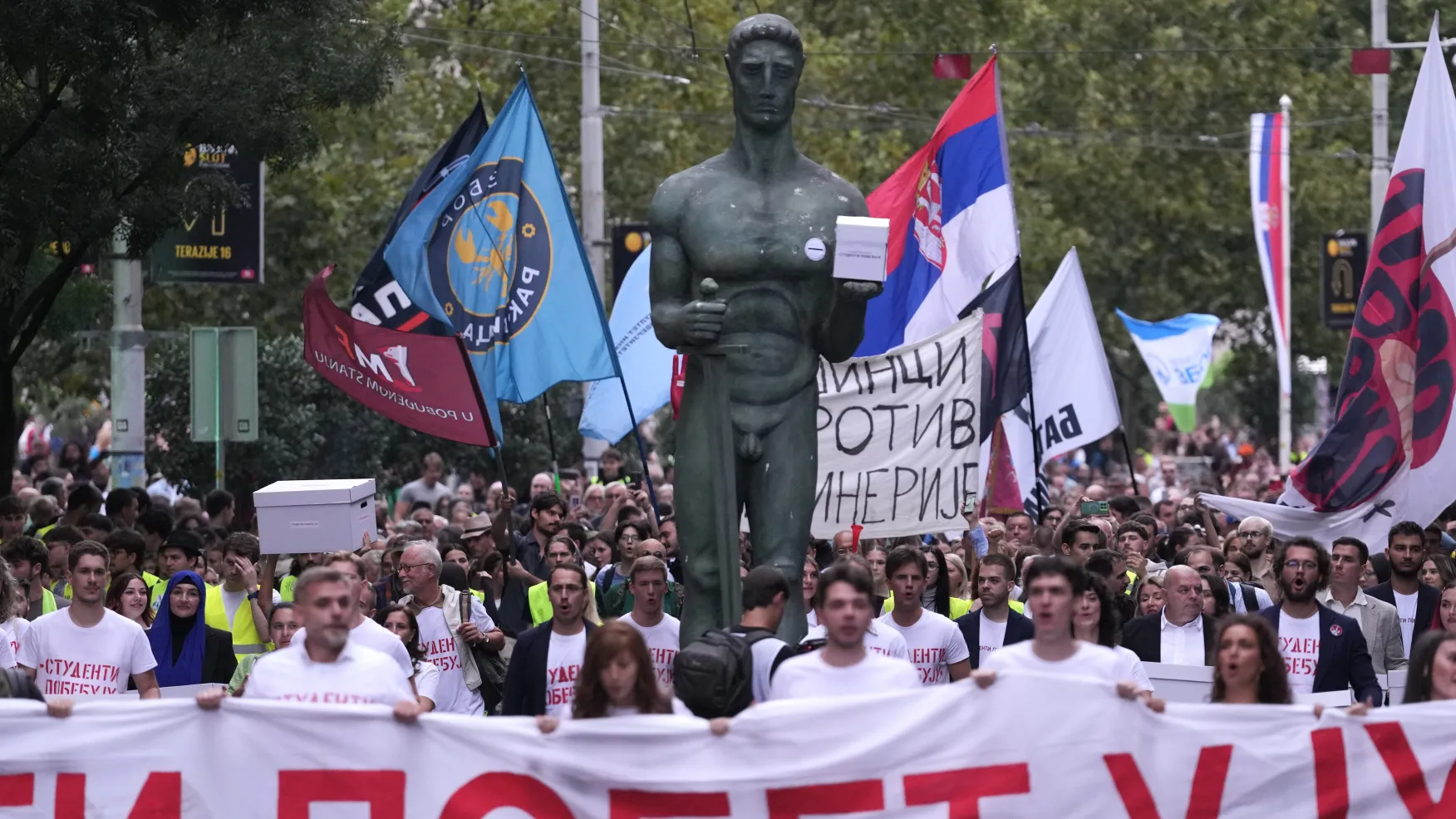
Supporters deliver signatures for the “Student list” to Serbia's Republic Election Commission. Belgrade, September 14, 2026. Source: Associated Press.
On September 27, Aleksandar Vučić, former Serbian President, resigned from a nearly decade-long presidency in preparation for early parliamentary elections. He announced plans to run for prime minister as the leader of the Serbian Progressive Party (SNS), which has governed Serbia for fourteen years. The snap election comes amid escalating tensions and political unrest.
Serbia has been in a state of upheaval since the Novi Sad railway station canopy collapsed in November 2024, killing 16 people. Protests immediately broke out, demanding high-level accountability and institutional transparency, blaming the tragedy on systemic corruption and flawed construction work.
Students rapidly assumed leadership of the movement, organizing massive rallies, blockades, and walkouts, demanding snap Parliamentary elections. After two years of anti-government protests, the student movement, which initially began as an informal coalition, officially entered the election race.
The polls are divisive. An opinion survey conducted in June 2026 by Democracy Action Lab (DAL) at Stanford University shows that among decided voters (70 percent), 44.9 percent favored the Student List compared to 35.7 percent for SNS. Conversely, a recent survey by the pro-government firm Faktor Plus placed Aleksandar Vučić ahead at 48.6 percent, with the Student List receiving 37.1 percent.
The polarized environment and divided polling results suggest that neither the ruling party nor the opposition can expect an easy victory.
Democratic standards in Serbia have declined under Vučić. For 14 years, the SNS rule has enabled the government to capture state institutions, control media, and tilt the electoral playing field in its favor, making another parliamentary majority for the ruling party highly probable. However, the opposition might still beat the odds if it presents a united front before election day. Recent examples from Hungary and Georgia show how the opposition can either capitalize on critical moments like this or squander them.
In April 2026, following sixteen years of illiberal rule, Hungarian Prime Minister Viktor Orbán was ousted when Péter Magyar’s Tisza Party won an overwhelming majority. Orbán tilted the electoral playing field in his favor by capturing state institutions, controlling the media, and using propaganda and state resources. Defeat seemed unlikely. Yet, the opposition prevailed, driven by several factors that Orbán’s control of the system could not contain.
The economic decline under Fidesz was Orbán’s most obvious vulnerability in the elections. However, that alone does not explain his defeat. The decisive turn came from opposition unity and rural voters.
A shared ambition to remove Orbán unified Hungary’s opposition. Péter Magyar, though center-right and himself a defector from Orbán Fidesz, received support from both centrist and leftist parties.
Recognizing that urban voters were already committed to the opposition, Magyar’s campaign largely focused on traditional Fidesz strongholds across rural Hungary, where he spent most of his time leading up to the elections. Appealing to rural voters paid off—by securing victories in both rural and urban areas, Tisza Party won 138 of the 199 seats in the parliament.
Not every opposition got its breakthrough. Georgia is another textbook case of democratic backsliding under one ruling party and the closest parallel to Serbia. Georgian Dream’s fourteen years in power have been marked by political tensions and civic unrest over growing authoritarianism, yet the party has maintained a majority in four consecutive elections. The run-up to the 2024 parliamentary elections shows what Georgia’s opposition got wrong.
In spring 2024, mass demonstrations against a controversial “foreign agents” law erupted across major cities for months. In response, the ruling party adopted an attrition strategy, using force only occasionally to wear the crowds down before the October elections.
The gamble largely paid off: the protest movement lost momentum before opposition parties could turn this energy into electoral gains, and just enough manipulation at the polls kept the regime in power. The opposition’s failure to unite and run a strong campaign contributed to this defeat. Opposition parties spent months debating alliances and strategies and barely left the comfort of urban areas where anti-government sentiment was already strong. Rural areas, where Georgian Dream’s support is concentrated, went uncontested, and the election results reflected this: the official count gave the ruling party landslides up to 90 percent in some rural districts, while it underperformed in major cities. The lesson is that protest energy does not automatically convert into votes—without a unified campaign, it fades.
Serbian opposition has a lot to draw from these two cases.
Without Hungary’s EU oversight, Serbia’s electoral system is far more exposed to manipulation, so beating the ruling party will take exceptionally high turnout—closer to Hungary’s 79 percent than Georgia’s 58 percent. Showing a united front and maintaining a real presence in rural areas will be crucial for victory.
Serbia’s student movement already enjoys strong support among the anti-government voters, and its 250-candidate list shows its organizational capacity. Some characterize the movement as a “populist catch-all” trying to appeal to everyone. That breadth is both its strength and a risk: broad appeal is what a winning coalition needs, but without a shared program or ideology it is hard to keep supporters together.
However, the election outcome will depend on the movement’s ability to mobilize voters. Unlike Magyar’s Tisza, the student movement remains leaderless and has refused to cooperate with existing opposition parties, which undercuts the united front Serbia’s opposition needs. The movement is expected to absorb most opposition votes, but without unification, a divided opposition risks “wasting” crucial ballots in a tightly contested election. Hungary and Georgia point to the same conclusion from opposite outcomes: unity gives opposition a much better chance of ousting an entrenched ruling party.