
Resolution or Pause? The U.S.-Denmark-Greenland Security Agreement
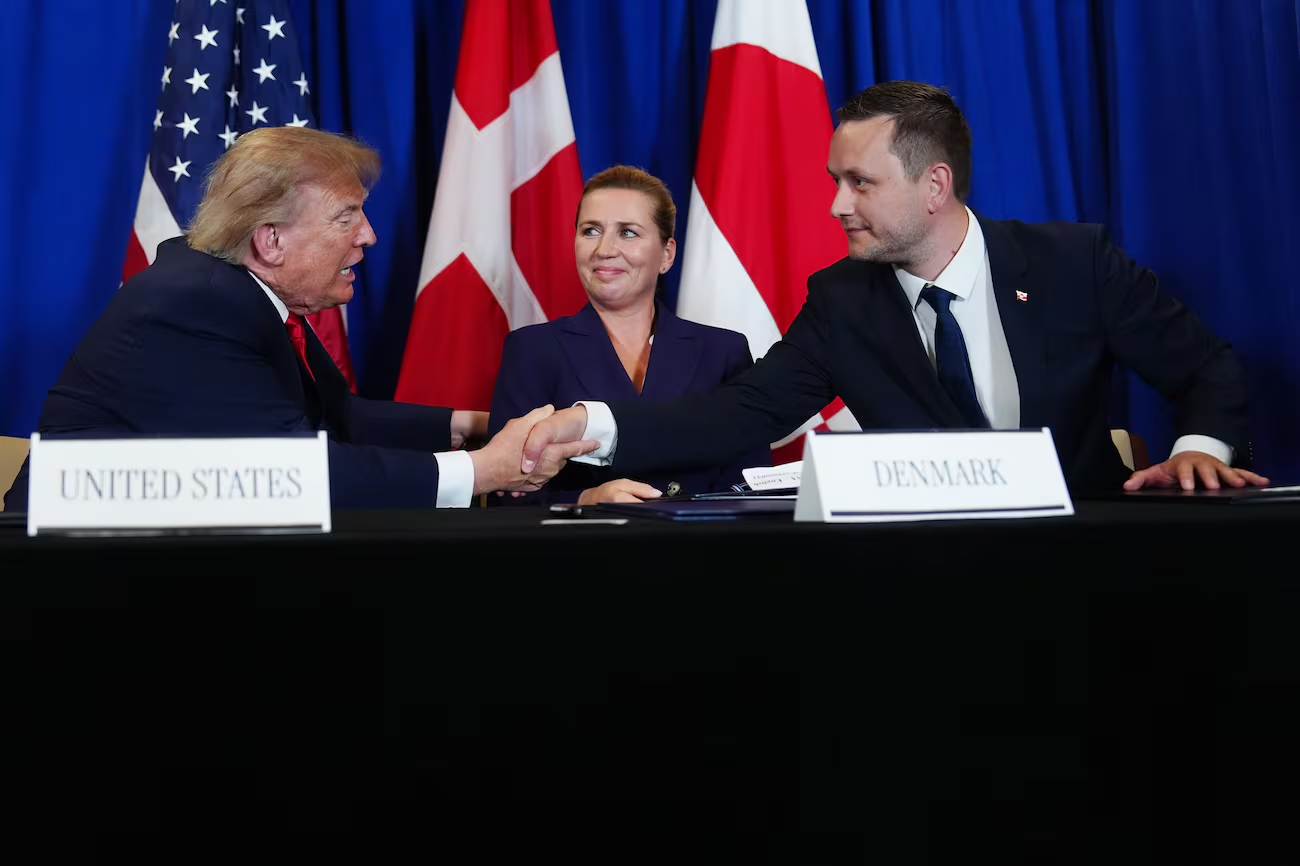
U.S. President Donald Trump (left) shakes the hand of Greenland Prime Minister Jens-Frederik Nielsen (right) before signing the security agreement with Danish Prime Minister Mette Frederiksen (center), watching. Source: WBTV.
On September 18, U.S. President Donald Trump announced that the United States, Denmark, and Greenland had reached a security agreement, ending months of tension over his repeated proposals to acquire the Arctic territory. The announcement comes after roughly a year and a half of friction following Trump’s second-term inauguration, during which he expressed interest in acquiring the island.
According to a statement from the White House, the agreement does not stand on its own; instead, it formally amends the 1951 Defense of Greenland Agreement—a Cold War-era pact under the North Atlantic Treaty that first authorized defense areas on the island—as well as the 2004 Igaliku Agreement that later updated it. Washington negotiated expanded access as an extension of that framework, replacing it and ensuring Danish sovereignty remains embedded in the agreement’s premise. Under this framework, the amendment grants permanent basing, meaning the U.S. military installations on the island indefinitely, and overflight rights that would survive Greenlandic independence. The amendment allows Washington to add installations after consulting Danish and Greenlandic authorities. It also bars non-NATO countries from establishing bases and requires written U.S. approval before adversary nations can make “sensitive investments” in the territory.
Whether these provisions amount to a major American concession is being contested. A U.S. State Department official quoted by the BBC noted that the restrictions are intended to prevent China and Russia from building bases or making sensitive investments, but could not say whether other countries might later be labeled “adversaries” under the same rules. Mikkel Olesen of the Danish Institute for International Studies observed that the provision was unlikely to represent a real trade-off, given that neither Denmark nor Greenland had ever permitted Russian or Chinese bases on the island.
The agreement does not transfer sovereignty, nor does it create the sovereign U.S. territory that earlier proposals had suggested. In January 2026, Trump and NATO’s Mark Rutte discussed a framework where American installations would become sovereign U.S. territory. Greenlandic officials regretted this outright. The September agreement abandons that proposal, instead keeping U.S. installations within Danish and Greenlandic territory rather than considering them separate sovereign American soil. Danish Prime Minister Mette Frederiksen recognizes sovereignty and Denmark’s territorial integrity and Greenlanders’ right to self-determination, directly acknowledging that Greenland’s political future, including possible eventual independence, remains Greenland’s decision. Greenland’s prime minister, Jens-Frederik Nielsen, described the pact as recognizing Greenland’s own interests. President Trump, by contrast, framed the outcome as establishing permanent control over security.
Greenland’s independence movement adds political uncertainty. Every major party in Greenland’s parliament supports eventual independence from Denmark, and polling shows broad public support for independence even as residents have remained wary of Trump’s proposals. Pele Broberg, leader of the pro-independence Naleraq party, argued that Greenland should ultimately pursue a free-association arrangement with Denmark paired with a direct security relationship with the US, rather than remain subject to talks between Copenhagen and Washington. Broberg’s argument and the shared sentiment of Greenlanders underscore a fundamental tension that this security agreement does not resolve.
Whether the agreement represents a genuine resolution or a pause in a longer dispute may depend on pending details. As written, both sides can claim victory: Trump can claim a permanent, expanded security footprint while Frederiksen and Nielsen can walk away with a Kingdom left intact. The United States gets permanent bases, overflight rights, and say over who else operates on the island. But the agreement also doesn’t answer what the Greenlanders may want. The agreement guarantees self-determination in writing, but it does not spell out how that guarantee would work in practice, especially if Greenland continues moving toward independence in the coming years.