
A Privilege, Not a Right: Three Media Outlets Banned from White House
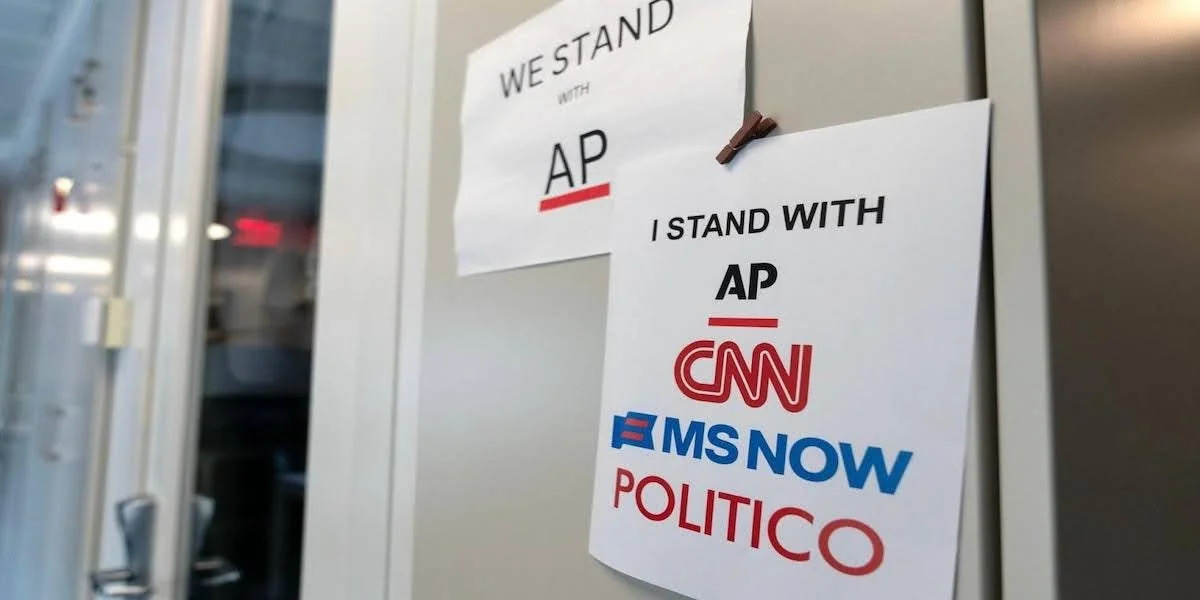
Papers showcasing support for the banned news outlets hang in the White House press room, September 19, 2026. Source: Jose Luis Magana/AP Photo.
The freedom of the press is enshrined in what is widely considered the most important amendment in the Bill of Rights—the First Amendment. What constitutes this “freedom,” however, has been the source of debate throughout United States history, and the recent actions of the Trump Administration have brought these tensions back to light. On the afternoon of Friday, September 18, President Trump announced on Truth Social that CNN, MS NOW, and Politico were banned from the White House. Sure enough, when reporters from these organizations attempted to enter the White House on Saturday morning, they were turned away and their badges deactivated.
As expected, the three news outlets responded with legal action, suing the Trump Administration to restore their access on the grounds that their First Amendment rights were violated. Four days later, however, the Department of Justice filed a court document urging the court to side with Trump, citing national security concerns and declaring White House access a “privilege—not a right.”
While the organizations awaited the judge’s ruling, ABC, CBS, Fox News, and NBC—which comprise the White House television press pool along with CNN—acted in solidarity and ceased their television coverage of the president. Such an act of protest was unprecedented, and the president was left without an accompanying representative from the television pool during the unveiling of the new South Lawn helipad, Xi Jinping’s state visit, and his trip to New York for the United Nations General Assembly. The White House, however, took this opportunity to promote Trump TV, its own news channel, which political opponents have deemed “state-run media.”
There was irony to be found in Xi Jinping visiting the White House less than a week after the media ban and promotion of Trump TV. The Chinese government maintains strict control over the media and relies on censorship to choose what its citizens see. To witness similar control over the media—the banning of three news outlets and promotion of government-run news—in a country grounded in freedom, like the United States, is jarring.
Early morning on September 24, U.S. District Judge Timothy Kelly temporarily lifted the ban, allowing CNN, MS NOW, and Politico reporters to enter the White House until a final decision was reached. Consequently, White House pool coverage of President Trump resumed the next day.
While media coverage is largely back to normal, the future is unclear. The lift on the ban is set to expire on October 8—fourteen days after Judge Kelly issued the restraining order. If the ban holds up, it will throw out the precedent set in Sherrill v. Night, a landmark 1977 D.C. Circuit Court of Appeals case that established that journalists cannot be denied White House press passes without compelling reasons and due process. While the Trump Administration claims to have compelling reasons for the ban, due process was not followed, according to Judge Kelly, since no prior notice was given. Such a decision from the courts could set a precedent for future presidents to pick and choose who can report from within the White House walls—a fear former President of the White House Correspondents Association Weijia Jiang expressed.
President Trump’s actions crossed a previously defined line between the president and the press. Democratic Party icons, including Presidents Barack Obama and Bill Clinton and former Secretary of State Hillary Clinton, noted that the tension between the press and the president is a part of democracy and stressed the need for politicians to set politics aside when it comes to obeying the Constitution.
Across the aisle, Senator John Barrasso and Attorney General Todd Blanche—both Republicans—have voiced their support for the ban. Because the media outlets were not reporting fairly, they argued, the president had the right to ban them to ensure Americans were receiving accurate news.
Nonetheless, with midterms right around the corner, a diverse set of viewpoints in the media is particularly crucial. President Trump’s actions, however, have restricted the flow of information available to voters, and at a time when the United States’ position on the World Press Freedom Index is the lowest it has been in history—standing at 64 out of 180 countries—many have grown weary of the degradation of press freedoms. Whether Trump’s media restriction was a justifiable move to protect national security and curb biased reporting ultimately lies in the court’s hands. For now, Americans will have to decide for themselves whether the President’s actions were for their sake or for his public image.