
EU-Canada Pact Heralds Bloc’s Enlargement Again
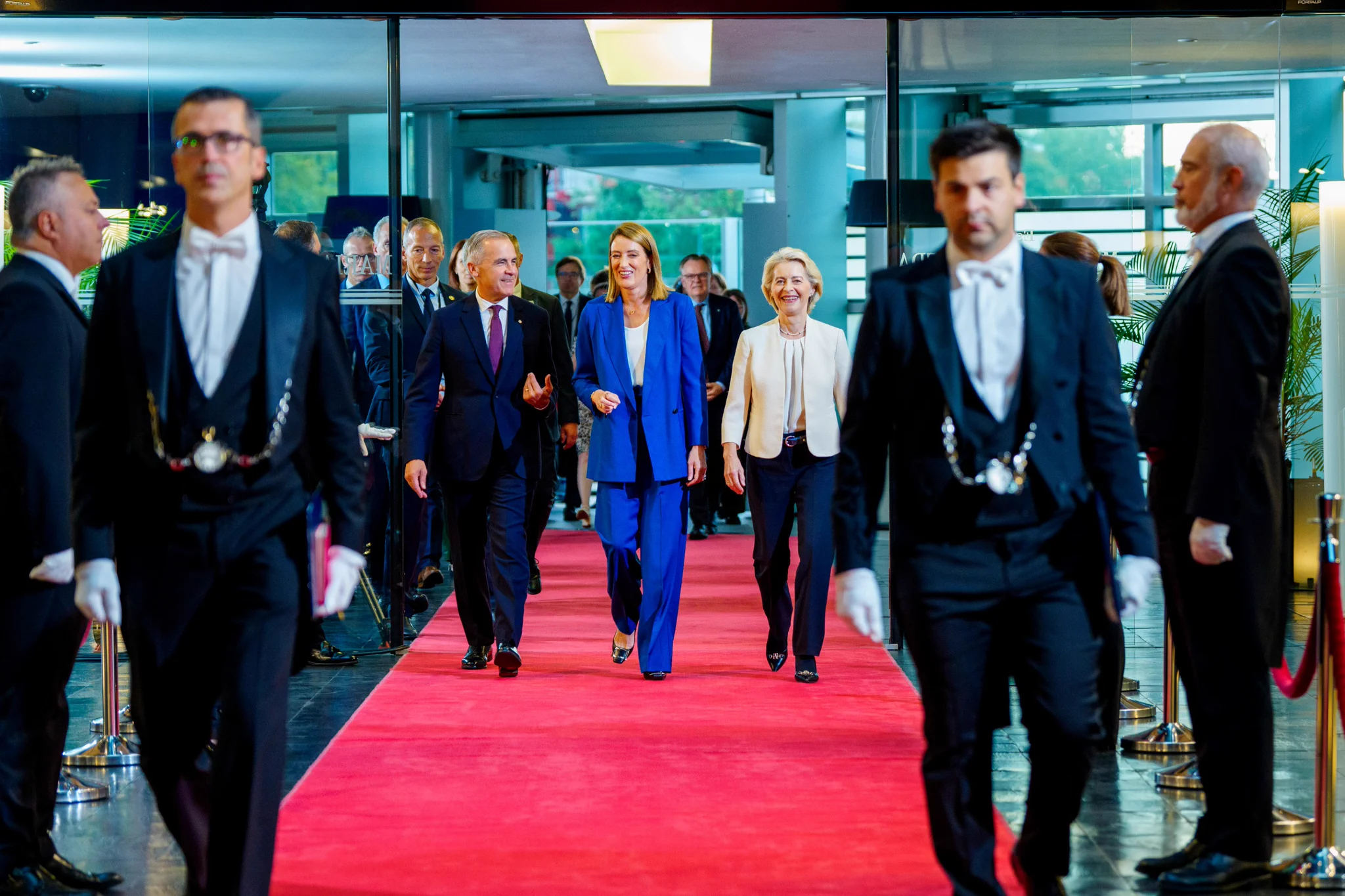
Prime Minister Carney, European Commission President Ursula von der Leyen, and European Parliament President Roberta Metsola before the European Parliament on September 16. Source: @CanadianPM on X.com.
Both sides of the Atlantic welcomed European Commission President Ursula von der Leyen’s invitation for Canada to become the first “associate member” of the European Union during the annual European Parliament’s State of the Union address with open arms. Though Canadian Prime Minister Mark Carney received a standing ovation, the other side of the Atlantic has more questions than answers, as current candidate countries Montenegro, Albania, or Ukraine were rarely mentioned.
Von der Leyen’s call to elevate the EU’s relationship with Canada to “the highest level possible” accompanied a sense of urgency to reimagine partnerships amid looming economic, artificial intelligence, and cybersecurity threats. Chief among all concerns, though, was gratitude for their shared values, in part due to their cooperation across defense in Ukraine, climate change, artificial intelligence, and supply chains. Von der Leyen said, “We share one ocean, one set of values, one way of seeing the world.” Carney similarly repeated the same idea at the Toronto International Film Festival, as analysts wonder if this is to justify their unusual transatlantic alliance to critics, who may argue this is simply to pressure the President of the United States away from economic aggression.
The EU and Canada may argue this is a natural next step for their relationship as they already share a provisional Comprehensive Economic and Trade Agreement (CETA), Canada’s biggest bilateral initiative since the North American Free Trade Agreement (NAFTA), which was dissolved in June 2020. Although not fully in force, it eliminated duties on 99 percent of all tariff lines for European goods exported to Canada; however, full implementation requires ratification by the national parliaments of all EU member states.
However, European Parliamentarians may see the CETA’s progression toward an “Alliance for the Future” as Von der Leyen stepping on member states’ toes to accelerate the alliance. National capitals report never being consulted on Canada’s associate membership before the address, and diplomats granted anonymity labelled the secrecy as “dangerous” and “unwise”, according to Politico. The European Commission President has already received criticism from Parliamentarians over her centralized and hierarchical leadership in a failed no-confidence vote. Manon Aubry, a French member of the European Parliament, added to increasing discontent and questioned Von der Leyen’s democratic and popular mandate for Canada’s membership in the EU.
Additional members of the European Parliament may raise eyebrows, as Politico reported that earlier drafts of the State of the Union address did not feature the Canadian initiative. The Parliament’s polarisation could mean there are more differences between the 27 member states over the Union’s expansion and Von der Leyen’s authority that may need to be resolved before another member could be added.
Discussions of what benefits associate membership may entail are already underway. Membership may reflect the European Economic Area’s access to the EU’s single market, built around the free movement of goods, services, capital and people throughout the 27-member bloc. If “associate membership” reflects the benefits that full members of the EU have, Canadians could also be privy to living, studying, working, and retiring anywhere in the EU, on top of access to EU funding, agricultural subsidies, and recourse to the European Court of Justice. However, Canada may need to fulfill supranational obligations, including adopting the acquis, the complete acceptance and implementation of the entire body of existing EU law and treaties. These could also include contributing to the EU budget and adopting the euro currency, if Canada chooses to integrate deeper into the eurozone under the Economic and Monetary Union.
For Europe, the ‘associate membership’ offer appears to be another throwback, reminiscent of the bloc’s 2004 “Big Bang” enlargement, which added twelve countries before other rapid changes, including the adoption of the Lisbon Treaty and the widespread circulation of the euro. The 27-nation bloc has since faced various challenges, including Russia’s invasion of Ukraine, sovereign debt, and migration crises. Meanwhile, candidate countries such as Ukraine, Montenegro, and Albania are still waiting to join the EU after more than two decades of negotiations. They face significant roadblocks, like pro-Russian member states blocking Ukraine’s membership or the EU’s concerns over democratic backsliding for both Georgia and Serbia. Although Montenegro has been named a “front-runner” among applicant states, it is not expected to achieve full membership until 2028 at the earliest. Yet, it has been thirteen years since the last country joined the Union, and more than twenty years since the EU promised accession to the Western Balkans at the 2003 Thessaloniki summit. Frustration amongst the Western Balkans may stifle Canadian ambitions for a quick entry.
As European Parliamentarians and critics alike race to quell candidate countries’ anxieties, non-candidate countries are also reassessing their ties to the bloc. Norway, Liechtenstein and Iceland are part of the EU’s internal market in the European Free Trade Association (EFTA). However, they are not part of the EU’s customs union, trade policy framework, or judicial participation. Similarly, Switzerland, another non-candidate country, supports bilateral agreement packages with the EU and participates in the Schengen Area, while also contributing financially to the post-2004 member states. None of these nations have full decision-making power within the bloc, offering a preview of what Canadian membership in the EU could entail in the absence of a defined framework.
Other non-EU member states, especially Türkiye, have had more public and seemingly harried stances over recent EU changes in the UN General Assembly. Despite the EU’s reliance on Turkish regional security and migration management, President Recep Tayyip Erdoğan warned that he may review relations with the bloc. Türkiye's forty-year-long application has repeatedly stalled as EU officials cite human rights concerns and democratic backsliding. Nevertheless, the two entities share a 217 billion euros customs union, heavily dependent on arms and defence given its position in the Corridor. This surpasses the EU-Canada trade relationship, worth a mere 92 billion euros.
Multiple non-members have similarly been attracted by the prospect of EU integration before being swayed by eurosceptic worries. Switzerland, Norway, Iceland and Greenland have also held unsuccessful referendums, and Greenland swiftly exited the EU’s predecessor, the European Economic Community, in 1985. But eurosceptic anxieties over loss of regulatory autonomy and economic governance under the EU seem to still be potent after the eurozone crisis. Greece’s bailout referendum in 2015 even inspired Citigroup to label their eurosceptic ambitions as “Grexit” during the eurozone crisis, before Brexit happened a year later.
The EU sustained political goodwill, but the Troika’s structural adjustment policies during the eurozone crisis caused long-lasting political damage, which far-right and anti-EU figures such as Dutch Member of the House of Representatives Geert Wilders and Marine Le Pen in France have capitalized on. Furthermore, the financial burden of enlargement extends beyond political cost, as expenses to current member states rise to more than 256 billion euros should they expand to the nine candidate countries, excluding Canada.
Ex-EU members have also weighed in on Von der Leyen’s offer to Canada as British Prime Minister Andy Burnham continued lobbying for the UK’s inclusion in “Made in Europe” laws during the UN General Assembly, but associate membership remains off the table. He said, “The European Union made it clear that that wasn’t open to us.” British diplomats may view this as favoritism towards Canada, given that the EU Chief Brexit Negotiator previously said no nation can have a relationship with the EU where they can be “half in and half out” of the single market. Under the Trade and Cooperation Agreement, the UK still enjoys tariff-free, quota-free trade in qualifying goods with the EU, though frictionless trade remains far from reality. British politicians may yield that the UK failed to reach a post-Brexit deal that could have mirrored the potential perks of associate EU membership now presented to Carney. As former Bank of England governor, he had warned about Brexit’s recession impacts despite calls that he breached his impartiality mandate, but his fears of lower economic growth, business investment and a weaker pound came to fruition regardless. Meanwhile, other British Commonwealth of Nations countries, like Australia, seem to take great interest in Canada’s approach in deepening their ties to the EU.
Debates over integrating more member states into the European Union will intensify in the coming weeks amid the excitement that Canadians could enjoy the benefits of EU membership. However, they may have to first wait for the potentially hefty financial contributions and regulatory burdens that associate membership may come with, if it even comes at all. As always, candidate countries will continue to reflect on their own statuses, and non-members will try to seek an answer to the age-old question of whether deepening their partnership with the EU is worth it. Europe and the transatlantic community will grapple with what it means to be in the EU if associate membership allows Canadians to enjoy access privileges, such as subsidized university education in Brussels, that remain out of reach for Ukrainians. After waves of EU expansion, many European citizens in applicant countries may still wonder whether the “ever closer union” will ever be that close for them.