
Implications of Xi-Trump Summit in Washington, D.C.
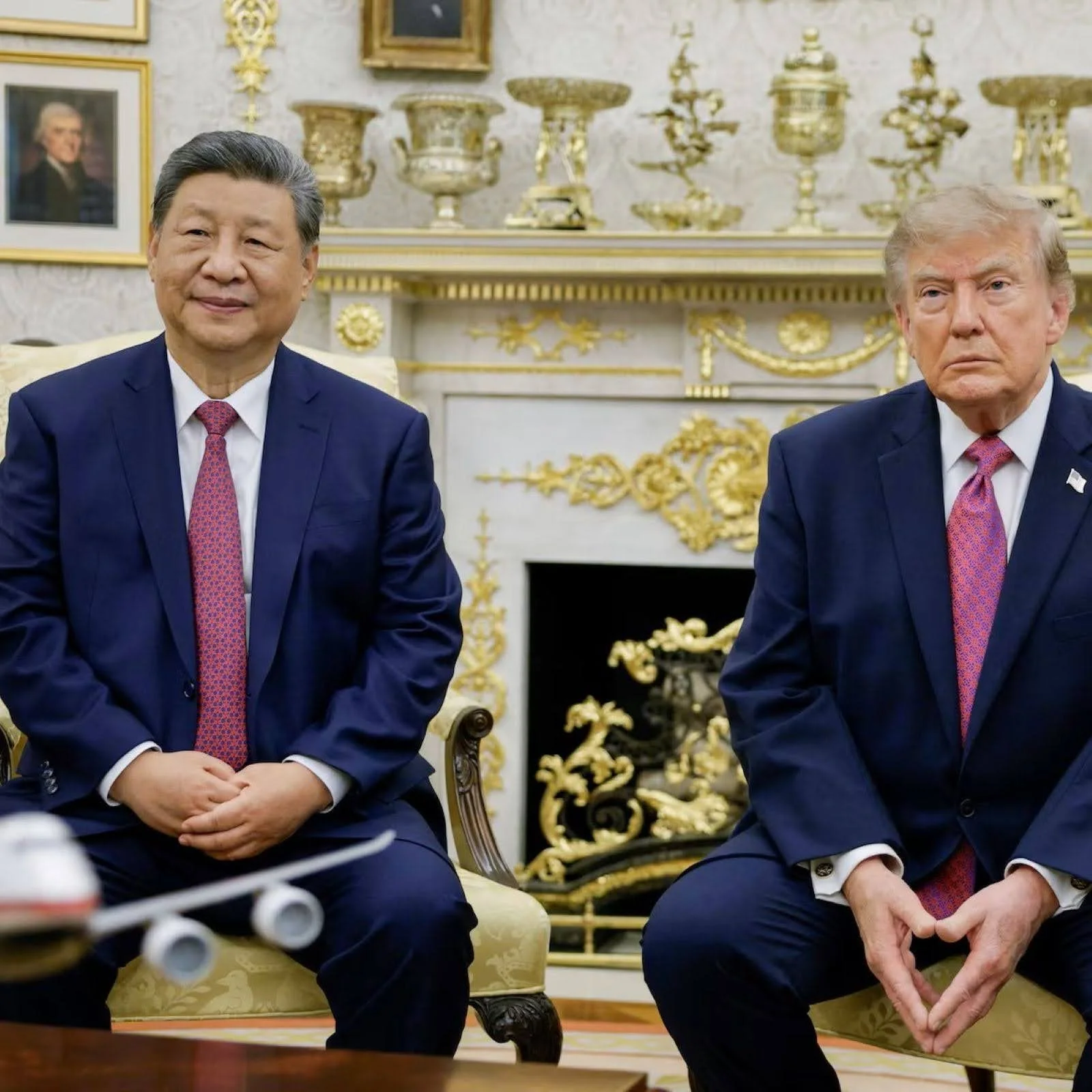
Presidents Trump and Xi in the Oval Office. Source: Reuters.
This past week saw Chinese President Xi Jinping arriving for his first summit in Washington, D.C. in over a decade. President Trump welcomed Xi at the airport before beginning a three-day summit that included a tour of a new helicopter landing pad at the White House, the U.S. Constitution at the National Archives, and a state dinner in Xi’s honor.
The summit came amid an increasingly chaotic international environment marked by Russia’s ongoing war in Ukraine, conflict between the United States and Israel against Iran that has shut down the Strait of Hormuz, and advancements in artificial intelligence with implications for Sino-American competition and the global economy. As such, a meeting between the two most powerful men in the world offered an opportunity for cooperation towards resolving these challenges, while also risking a possible deterioration in relations.
Conversations between the two governments ran the gambit from tariffs and artificial intelligence to Taiwan and agricultural sales. However, despite the high-level stakes surrounding the summit, the tangible outputs from the event were minimal. On the economic front, both sides agreed to extend a truce on tariffs that had been in place since October 2025 but was set to end later this year.
The truce was extended for two months, offering both sides room to continue negotiations and reach a longer-lasting agreement. Both sides agreed to start an agricultural trade working group that may lower tariffs for crops, something that would be beneficial for farmers in Republican-leaning states in the Midwest. Trump acknowledged as much when stating that “our farmers are going to be happy.” The White House also announced that China has agreed to buy 10 million tons of coal annually in 2027 and 2028, although China made no mention of this agreement, raising questions about the finality of the deal. The trade talks also made no progress on rare earth minerals or semiconductors, two topics that featured prominently in last year’s trade war and which have profound security implications for both countries. Rare earth minerals are necessary in virtually all modern technology and advanced semiconductors are a vital component in the race for advanced AI.
The topic of AI, which members of Congress and the tech industry had been hoping would be a central component of the summit, received little attention. Notwithstanding the presence of major tech leaders at the White House for the state dinner, including Tesla CEO Elon Musk, CEO of OpenAI Sam Altman, Apple Chairman Tim Cook, and Nvidia CEO Jensen Huang, no major breakthroughs on AI policies were made during the summit, though both sides reached consensus on minor issues. The Chinese side has seemingly agreed to use Trump’s preferred term “super intelligence.”
The two governments also established a communications channel to handle AI-related incidents and manage military crises. However, no agreements were reached on establishing firm guardrails and in public remarks, Trump continued to downplay the danger AI poses to humanity. Ultimately, though, when asked about achievements on the AI front, U.S. Trade Representative Jamieson Greer responded: “I wouldn’t say anything new.”
President Trump came into the summit with a relatively weak hand and limited leverage. With U.S. forces stuck in a war with Iran more than six months after initially launching air strikes and with an unfavorable political picture for him and Republicans going into the midterm elections, Xi had little incentive to offer Trump support free of charge. In fact, the very act of being feted in D.C., with Trump arriving in person to meet Xi at the airport, feeds the narrative of China as a rising power on equal terms with the United States.
As one Chinese student said in response to viewing Xi’s reception in Washington, “I’m quite impressed because it shows that our country has become really powerful.” The immense pomp and pageantry of the summit, to include Trump’s decision to personally welcome Xi at the airport, supports China’s desire to be perceived as a global peer of equal standing to the United States.
Nevertheless, Xi entered the summit facing his own challenges at home. China's economy is sluggish, with growth for 2026 projected at 4.5-5%, compared to 5% in 2025. These economic struggles threaten the Communist Party’s legitimacy that rests on improving the standard of living for its citizens. President Xi also did not make any progress on a core interest for China: Taiwan. Xi went into the summit hoping to move Trump away from the long-held U.S. policy in which Washington supports the “One China” policy but insists that unification occur through peaceful means and maintains the right to sell arms to Taiwan for the purpose of self-defense.
The United States’ commitment to a policy of strategic ambiguity toward Taiwan for now dissuades China from taking any military action against the island nation for fear of how the U.S. will respond. America’s ambassador to China, David Purdue, said, “There’s no change, no change in the Taiwan policy here . . . China has tried to coerce change in that regard. We are not changing the language.” With Xi leaving the summit without any change in this policy, the security situation in the Taiwan Strait remains stable for now, which is particularly beneficial as U.S. forces remain preoccupied in the Middle East.
Arguably the most concerning product of the summit had to do not with AI, Taiwan, or trade disputes but Trump’s offer to sell weapons to China. Ambassador Purdue said the President asked Xi if he would “like to buy some [weapons].” The statements may have been intended as a joke to highlight the United States’ superior military technology. Numerous laws would prohibit the sale of American arms to China and such a sale would contradict decades of U.S. policy. Nevertheless, for U.S. allies in the region, the comment may come off as indicative of a lack of concern by the Trump administration towards Chinese military intentions in East Asia.
The truce on tariffs and agreements on sale of agricultural products will be welcomed by various sectors of the U.S. economy. But the summit did not produce any solutions to the most pressing problems facing the world, nor did it change the underlying conditions that have influenced competition between Beijing and Washington in recent years. Both parties did demonstrate an ability to come together, discuss issues of mutual interest, and remain cordial in spite of strategic competition. This, while not groundbreaking, is a success in itself. Yet in the aggregate, for a meeting between the leaders of the two most powerful nations during a time of multiple regional conflicts, economic uncertainty, and rapid technological changes, the summit’s results were negligible, with little expectation that any resolutions are forthcoming.
It remains to be seen whether any breakthroughs will occur when President Xi and President Trump meet in November for the Asia-Pacific Economic Cooperation summit in Shenzhen, China or the G20 summit in Miami in December.