
Techxit: The EU’s Fight to Reclaim Its Digital Future
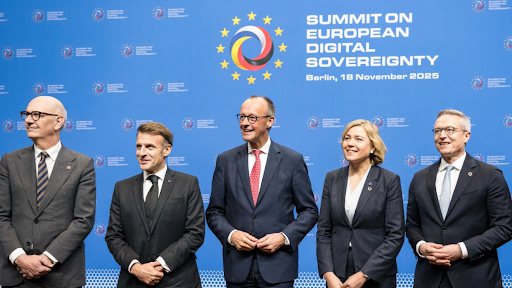
EU leaders and officials gather at the November 2025 Summit on European Digital Sovereignty. Source: Henna Virkkunen on LinkedIn.
Imagine what everyday life might look like if major power services stopped working and all electronic usage came to a screeching halt. Regional outages. Tax portals and national ID systems are down. Hospitals without access to software and digital medical records. Payments frozen at banks.
This became reality for much of Portugal, Spain, and parts of south-west France when their people suffered a massive power outage in April 2025, suspected by some to have been a cyber attack. Big tech companies are now so deeply woven into everyday life that the extent of their power over ordinary people often goes unnoticed. What may have once been a singular calamity is now becoming a growing worry for many European leaders in the wake of a Trump administration with an increasingly brash approach toward the EU. The threat of access to American digital infrastructure being leveraged as part of geopolitical negotiations loomed at the annual World Economic Forum in Switzerland this January, where tech sovereignty official Henna Virkkunen told attendees that the reliance of European countries on foreign companies could be “weaponized against [them].”
One of the most decisive examples of this came in February 2025, when Microsoft cancelled the emails of lead International Criminal Court (ICC) prosecutors following the court’s decision to issue an arrest warrant for Israeli Prime Minister Benjamin Netanyahu. Washington has brawled with European officials over data transfers for years now, with EU member states estimated to depend on foreign countries for more than 80% of digital needs, and Amazon, Google, and Microsoft grasping over 60% of the international market.
This stark dominance raises concerns over how digital infrastructure has the potential to be used as a tool of geopolitical force. America’s administration could plausibly force its tech giants to cut services in certain areas for political leverage or coercion, already holding the power to mandate the release of important international data via the American CLOUD Act. Previous efforts by the EU to weaken the U.S. monopoly, such as antitrust sanctions and new digital regulations, have done little for progress. Such suspicions, coupled with a growing sense that the EU is falling behind the U.S. and China in technological innovation on a global scale, have led to the most decisive action by member nations and their local leaders in recent years.
France announced in early February that its millions of government workers would cut out video conferencing tools from U.S. providers, like Zoom, altogether by 2027, instead switching to domestic alternatives. Others have followed suit: Schleswig-Holstein transitioned 44,000 public-sector email accounts from Microsoft to an open-source platform last year. In a January 22nd vote, the European Parliament passed a report urging the European Commission to pinpoint sectors where dependence on non-EU suppliers could be reduced. The new EU-backed Sovereign European Cloud API (SECA) offers controlled digital infrastructure for all European providers.
In response to the growing push toward European ‘digital sovereignty,’ providers such as Amazon have launched special forms of “European Sovereign Cloud” in an attempt to meet stricter EU privacy requirements. Yet in spite of the growing push for domestic digital alternatives, a report by IDC Global claims that a mere 4% of organizations in Europe indicate they will stop using international cloud vendors, choosing only local alternatives. Some speculators, therefore, believe that the prospect of a total abandonment of U.S. digital providers in Europe (‘techxit’) is unlikely. Rather, we may be looking forward to what IDC calls a “glocal” approach: meshing global tech innovation with domestic oversight.
Yet new concepts may expose deeper tensions: sovereignty, security, and competitiveness collide, forcing Europe to navigate a future where technological dependence is inseparable from geopolitical leverage, and where hesitation could cede the initiative to actors who already treat infrastructure as a weapon.