
Narrow Margins and High Stakes for the 2026 Fight for the House
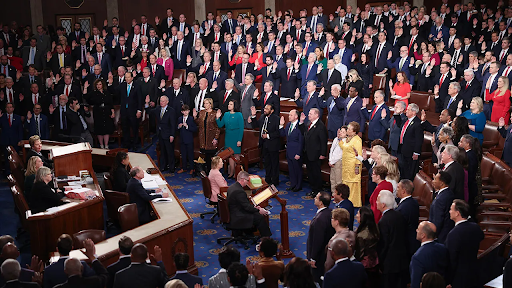
Members of the 119th Congress being sworn in on the House’s first day in session in January 2025. Source: Pew Research Center

After a string of impressive victories in the 2025 off-year elections, where Democrats had major wins in states like Virginia, New Jersey, and New York, the party seems well-positioned to retake the House of Representatives. The 2026 midterms are particularly significant, as the House is currently held by one of the narrowest margins in modern history, meaning defending every seat will become critically important for Republicans. A shift of only three seats for the Democrats could shatter the trifecta Republicans currently enjoy and significantly influence national policymaking for the last two years of Donald Trump’s presidency. The President has repeatedly emphasized the stakes of maintaining a Republican majority in the midterms, warning that, if Republicans lose, “[Democrats will] find a reason to impeach me. I’ll get impeached.”
So will Democrats regain the ground they lost in 2024?
Yes, but it won’t be easy, and every race will matter.
The numbers, though, are giving them reason for optimism. A recent study from The Cook Political Report, published in early January 2026, shows 18 House races moving toward likely Democratic wins, with 8 races shifting from “likely Democrat” to “solid Democrat” in the last few months of 2025 to early 2026. As , points out, “If the election were held today, Republicans would need to win roughly three-quarters of the Toss-Up races to keep control of the House. Though that’s not impossible, it looks increasingly difficult.” Public opinion polls tell a points out, “If the election were held today, Republicans would need to win roughly three-quarters of the Toss-Up races to keep control of the House. Though that’s not impossible, it looks increasingly difficult.” Public opinion polls tell a
But this outcome isn’t surprising, as it follows the trends of recent history. Midterm elections have historically favored the party not in the White House. In fact, since 1938, the president's party has lost seats in twenty of the past twenty midterms. At the same time, unhappiness with the current president doesn’t mean unquestioned support for Democrats. Democratic congressional leaders face skepticism from their own voters as well. According to a CNN poll, approval for Democrats in Congress stands at 28%, compared 35% for Republicans. Much of this frustration followed the end of the government shutdown in November 2025, when many Democratic-leaning voters felt that party leaders in Congress “could have held out” for extensions of ACA subsidies. Fortunately, CNN/SRRS found that 66% of Democrat-leaning registered voters are “extremely enthusiastic” to vote in the midterms, compared to 50% of Republican-leaning voters. This high voter mobilization could tip the scales in evenly divided battleground districts. However, to turn that enthusiasm into actual votes, incumbent and aspiring House Democrats will need to make clear to voters how exactly they will fight Republican policies if elected.
While the numbers favor Democrats in 2026, Republicans aren't out of the fight yet. In the past year, there have been several mid-decade map changes, following public pressure from Donald Trump and Republican leadership to maintain the House majority. Thus, Republicans are expected to pick up seats in Texas, North Carolina, and Ohio by packing Democratic voters, often voters of color, in urban districts while spreading out suburban or rural Republican votes to add additional Republican-leaning seats. As a result, Democrats will either lose existing seats or be forced to defend them in far more competitive districts than in previous cycles. Yet, voters have been pushing back. In November 2025, California voters approved Proposition 50, a measure that temporarily redraws congressional maps, giving Democrats five additional seats to counter the five new Republican-leaning seats in Texas directly. This redistricting battle is unprecedented in modern history and has created some of the most competitive congressional districts in recent cycles.
Let’s take a look at some of these races.
Texas’s 34th Congressional District (TX-34)
For example, one of the most closely watched districts is Texas’s 34th, located in the southern Rio Grande Valley (RGV). This district, which has a majority Hispanic population, had consistently supported Democrats before 2024, but flipped Republican in 2024. According to interviews with multiple Rio Grande Valley voters and political organizers, much of this stems from frustration with persistently high costs of living. While affordability is a common concern nationwide and across the political spectrum, the Rio Grande Valley faces some of the highest poverty rates in the country, intensifying these pressures. Combined with the region’s proximity to the southern border, residents experience the realities of immigration firsthand. Many voters are worried that high immigration levels cast the region in a negative light or strain already limited local resources, leading some to favor Republican policies. As one voter put it, “I’m all for the humanitarian, but we also need to take care of Americans as well—Americans first. There are families struggling here in America, here in the Rio Grande Valley as well.” To make matters worse, Democrats have also been targeting key oil and gas industries that serve as major sources of employment in the Valley. Taken together, these added pressures explain why a national concern caused such a dramatic political shift towards the right in the RGV.
Already a major target for Republicans at the start of the cycle, the district became even more competitive after Texas lawmakers redrew congressional maps in August 2025 to strengthen Republican control of the House. As a result of the redraw, the district lost heavily democratic Hidalgo County and instead absorbed southern portions of Nueces County, where the Republican vote share is higher. Following these changes, Donald Trump’s margin of victory in 2024 amongst voters in the district increased from 4.5 points to 10 points. Despite this structural Republican advantage and loss of Democrat support, the Cook Political Report reclassified Texas’s 34th District from “Lean Republican” to “Toss Up” in January 2026, signaling continued electoral uncertainty. Republicans view the district as a key opportunity to solidify their narrow House majority. However, much of this optimism relies on the hope that Latino voters will continue swinging towards Republicans. In 2024, Donald Trump made considerable gains among working-class Latino voters, with roughly 46% backing the Republican. GOP strategists are depending on these same voters to turn out and vote red again in 2026. But even that expectation seems fragile. A Pew poll from November 2025 reveals that 70% of Latino respondents disapproved of Trump’s job performance. Meanwhile, 65% disapproved of the administration’s approach to immigration, and 61% said his policies worsened the economy. As the second-largest voting bloc in the United States, Latino voters represent a diverse, evolving, and electorally decisive group that Republicans can’t afford to lose. As Fox News commentator Jessica Tarlov noted, “Texas gerrymander only works if you are going to get 2024 Latino margins.” Right now, these margins are far from guaranteed. Many Latino voters don’t feel the same confidence in the Republican Party compared to 2 years prior. “There’s a sense of betrayal,” said a Latino voter in South Texas who voted for Trump in 2024. In response, national Democrats have responded by directing increased resources toward Texas and named incumbent Vincente Gonzalez, a frontline candidate to support. After years of placing Texas on the back burner, Democrats are now joining Republicans in viewing wins in Texas as central to their broader strategy to control the House.
Ohio’s 1st and 9th Congressional Districts (OH-1 and OH-9)
Similarly, Ohio’s 1st congressional district, located in southwestern Ohio and covering Cincinnati, is another must-hold district for Democrats, as it is one of the few Democratic districts in the state. Ohio originally had a map that had 10 Republican seats and 5 Democratic seats. However, that changed to a 12-3 advantage for Republicans after redistricting. Ohio was already due for a redraw, but Republican leaders took the chance as an opportunity to redistrict in their favor. The Ohio Redistricting Commission accepted the map with bipartisan support. Senate Minority Leader Nickie Antonio commented, “I do believe with this map we have averted a disaster.” In this new map, Ohio’s 1st District and Ohio’s 9th District are less Democratic and are predicted to lean red, but they are still battleground districts that have popular, longstanding incumbents and districts that Obama won by double digits. While both are exceptionally more competitive, Democrats are positive they can hold them.
In Ohio’s 9th District, long-time incumbent Marcy Kaptur was reelected in 2024 by combining pro-labor messaging with opposition to multiple free trade agreements, including the North American Free Trade Agreement (NAFTA), which appeals to older manufacturing communities that have dramatically swung towards Republicans in the Trump era. However, Ohio’s broader rightward shift has made Kaptur increasingly vulnerable. She was one of only 13 Democrats to win in a district won by Donald Trump, and her vote share has gone down significantly from 68% in 2016 to just 48% in 2024. Republicans have intensified efforts to flip this district, while Democrats have responded—similarly to what they are doing in Texas—by increasing funding and national attention toward the state as well. “When you organize everywhere, you can win anywhere…The DNC is ensuring that Ohio Democrats have the resources they need to go on offense,” said Abhi Rahman, a spokesperson for the Democratic National Committee. That investment has been welcomed by local leaders. “We had been, by and large, ignored,” said David Brook, a Democratic chair of Cuyahoga County.
Meanwhile, in Ohio’s 1st District, Representative Greg Landsman has emphasized affordability and the rising costs of raising a family, a message that could boost his popularity among more swing suburban voters. Notably, according to Ohio Democrats, both former Senator Sherrod Brown and former President Joe Biden have both won in Representative Landsman’s redrawn district, suggesting serious prospects of a Democratic-hold come November, despite increased competitiveness. Ohio has long been considered a political bellwether, accurately aligning with the outcome of 14 presidential elections before breaking the streak in 2020. Although the state has trended Republican relative to the nation in recent years, a Democratic victory remains possible, and could offer a blueprint for how the party can survive post redistricting and across the Midwest in 2028.
New York’s 17th Congressional District (NY-17)
Finally, New York’s 17th congressional district, a suburban district located just north of New York City and in the lower Hudson Valley, stands out as one of the Republican Party’s most critical must-holds. Republican Representative Mike Lawler narrowly won a second term in the district, defeating Democrat Mondaire Jones by 2.3 points. What makes NY-17 particularly interesting is that, despite a Democratic voter registration advantage and backing Vice President Kamala Harris in 2024 (and Biden in 2020), the district has elected a Republican to the House for the second time.
Looking at his second campaign, Mike Lawler focused heavily on affordability and solidarity with the Jewish community. This district includes a sizable Orthodox Jewish population, and Lawler has built strong support by emphasizing his opposition to antisemitism. Further, the district is home to suburban “bedroom communities” whose residents commute to New York City, with priorities focused on the cost of living. Thus, Lawler concentrated on affordability issues, saying in his victory speech, “We have a crisis at our southern border… and here in New York, we have seen disastrous consequences from one-party rule… people cannot afford to live in this state.”
However, his recent voters on federal policies raised questions about his commitment to this assurance. After promising not to cut Medicaid benefits, Lawler’s votes in favor of the “One Big Beautiful Bill,” which included cuts to Medicaid and SNAP, appear to contradict the affordability track he originally campaigned on. His votes directly affect many constituents who rely on these programs, sparking heated confrontations at town hall meetings where voters chanted at Lawler, “Not a dime. Not a dollar. No more cuts, from Mike Lawler.”
Noticing the unrest, Democratic strategists have since signaled plans to highlight these votes as evidence that Lawler’s record no longer aligns with the district’s healthcare concerns. In a district as evenly divided as NY-17, that disconnect may prove decisive in determining whether Republicans can hold the seat. In early January 2026, the Cook Political Report even reclassified the race from “Lean Republican” to “Toss-Up,” signaling growing uncertainty about Lawler’s hold on the seat. Similar to Texas’s 34th, Republicans’ tendency to backtrack on promises, especially on issues like affordability, poses one of the biggest threats to maintaining their House majority.
Road to November
Democrats have a real shot at flipping the House. Past electoral patterns and current data point in their favor, but the path forward is far from certain. Democrats will need to maintain leads in multiple competitive districts, push back against recent redistricting efforts, and rebuild public trust in politicians currently in power. None of this, however, guarantees victory. With seven months to go until November 4th, anything can happen, and if this political climate has shown us anything, it’s that the only certain thing is uncertainty.