
The Logic of Repression Following the 2026 Uprisings in Iran
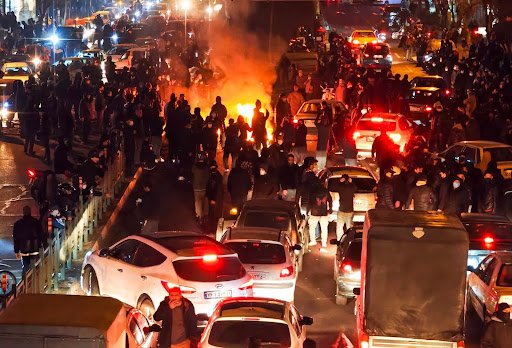
Unrest in the streets on January 8th, 2026, as demonstrators protest the Islamic Republic Government in Iran. Source: Getty Images.
On December 28th, 2025, millions gathered across Iran to protest the Islamic Republic Government and the country’s deepest and longest economic crisis in modern history. The event has been described as the largest uprising since the 1979 Islamic Revolution, which brought down the Pahlavi dynasty. As a result, the Iranian government has ordered extreme and brutal crackdowns that have already caused over 12,000 deaths and a historically extensive internet blackout.
What distinguishes these protests from prior unrest in Iran is not only their scale, but the regime’s previously unfounded willingness to combine mass lethal force and total information control to preserve power. The Islamic Republic appears to have treated the demonstrations as an existential threat to regime survival, resulting in deadly skirmishes within the state.
In 2024, Iran’s currency experienced a sudden devaluation and sharp inflation, mainly due to domestic failures, including poor monetary and fiscal policies, economic mismanagement, and chronic budget deficits. Catalyzed by the lack of spending cuts and growing reliance on the central bank to print money, the Rial’s value has since eroded significantly, and the economy has experienced accelerated capital flight into dollars, gold, and real assets. This economic downturn precipitated social unrest due to the general collapse of confidence and many Iranians’ growing perception of the Rial as an unreliable store of value.
For many citizens, as the Rial lost credibility, everyday economic activity became inseparable from political dissatisfaction, eroding the implicit social contract in which citizens tolerate political repression in exchange for basic stability.
These issues, as well as repeated electricity and gas disruptions, unreasonable cost of living, a mismanaged water crisis, and rampant government corruption, were among the grievances that sparked the recent protests. For many Iranians, the crisis meant that the state was no longer capable of competent governance, a clear signal that it was time to rise.
Demonstrations began as peaceful strikes in shopping centers in Tehran and later spread to businesses, stores, cafes, and workers, as well as to online shops and social media influencers nationwide. The participation of shopkeepers and retail workers in these protests indicates that the unrest was no longer confined to politically active groups but had expanded into a mass social movement.
Protestors began to congregate in public squares and in front of government buildings, mostly non-violently, until a video and photo of an unidentified protester who refused to move for the police in the middle of the Jomhuri Eslami Street in Tehran went viral; he was later beaten and forced to leave. The protester became known as Tehran's Tank Man, a reference to the Tank Man during the 1989 Tiananmen Square protests, which served as a symbolic turning point: protests escalated and were met with increasing force.
In the days leading up to and following the New Year, citizens gathered in large rallies across the country, chanting several notable slogans that reflected anti-government sentiment, calls for the restoration of the monarchy, and a sense of unity among protesters. Phrases such as “Death to the Dictator,” “Don't be afraid, don't be afraid, we are all together,” and “This is the final battle, Pahlavi will return,” were heard in the streets and documented in videos. At this time, the government began deploying large numbers of security forces and military personnel to disperse the demonstrators and dismantle the rallies. It was also at this time that security forces began using lethal force to counteract protestors.
Reports and videos corroborated that police began using melee force, then tear gas, and eventually firing live ammunition into crowds against protestors. Information first from Lorestan, Lordegan County, Tehran, and Qom reported multiple deaths and a high number of injuries. Eventually, reported death counts began to climb, and video evidence of police violence against the protestors began circulating on the Internet. The government’s decision to escalate the situation by ordering the firing of live ammunition further indicates that when authoritarian regimes perceive mass protest as a direct threat to the regime, violent suppression becomes a deliberate policy choice rather than a reactive measure.
Later, U.S. President Donald Trump released a statement warning Iran that if they shoot protesters, the U.S. will “come to their rescue.” Supreme Leader Ali Khamenei responded by saying "We will not yield to the enemy," and that the "rioters must be put in their place." Such direct messaging underscores Tehran’s fear of mass political mobilization, and the characterization of civilians and protesters as “the enemy” suggests the state has deprioritized governing in the public interest in favor of preserving power.
Evidence suggests that the Supreme Leader kept his promise and continued to order the killing of demonstrators. Sources close to Iran's Supreme National Security Council report that the killing of protesters was carried out on the direct order of Khamenei, with forces authorized to “shoot to kill” and even raid hospitals to “finish off” protesters who had been hospitalized at the time. Moreover, the Iranian government accused the United States and Israel of fuelling the protests, which analysts suggest may be a tactic to increase security forces' willingness to kill protesters. By framing the unrest as foreign-instigated, the regime justified extreme violence internally while increasing security forces’ willingness to use lethal force against civilians.
On January 8th, the Iranian Government, using military jammers, imposed significant restrictions on telephone and internet access, prompting Internet traffic reporter NetBlocks to record an almost zero percent network connectivity nationwide. By severing communication channels, the state reduced protesters’ ability to coordinate while simultaneously limiting international monitoring, scrutiny, and accountability. These measures were widely seen as part of the authorities' efforts to suppress dissent and control the narrative around the unrest. Nobel laureate Shirin Ebadi even warned that, under the Internet blackout, the Islamic Republic may massacre the protesters.
Not until January 16th, after 200 continuous hours of internet blackout, did NetBlocks report a two percent uptick in connectivity. During these 8 days, very little information left Iran; however, based on eyewitness videos and reports from journalists within the country, Iran International and CBS News reported that at least 12,000 people had been killed and more than 22,000 arrested. The head of Iran's judiciary stated that those arrested during the nationwide protests would be swiftly tried and executed. Thus, the blackout effectively served its purpose, lowering the political cost of repression. Without real-time footage, external pressure diminished, allowing violence to proceed with reduced resistance.
On January 15th, the government imposed a nationwide curfew to prevent further protests and deployed security forces and tanks to patrol towns and cities nationwide. ABC News has reported that in the four days following, “the crackdown has been so severe the protests have pretty much come to a halt.”
In this 23-day timespan, the country of Iran has gone from millions protesting in the streets to empty neighborhoods, with tens of thousands either dead, injured, or in custody. The Iranian government undoubtedly used the veil of internet bans to ruthlessly massacre civilians and impose even further extreme restrictions on basic freedoms. Despite Donald Trump being informed that killings of protesters in Iran had ceased, it is likely killings will continue amidst internet blackouts and through executions of those arrested.
Although the demonstrations have subsided, the underlying economic and legitimacy crises remain unresolved. Mass repression secures short-term control, but it increases the likelihood that future unrest will be more sudden, more violent, and more difficult to contain without even greater force. When that day comes, it is to be sure that the Iranian government will continue to meet it with extreme force, repression, and silencing.