
China is Wooing the West with Visa Waivers
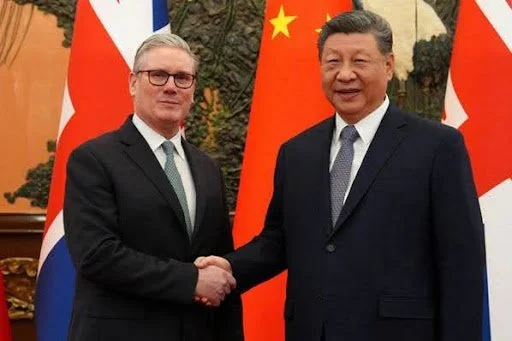
Britain's Prime Minister Keir Starmer shakes hands with Chinese President Xi Jinping ahead of a bilateral meeting in Beijing, China, on January 29, 2026. Source: Asharq Al-Awsat.
On February 16, the People’s Republic of China announced that it had extended its visa waiver to Canada and the UK, allowing nationals from both countries to enter China and stay up to 30 days for various purposes. This development is one of the latest to come out of recent meetings between leaders of the countries earlier this year. In a span of less than two weeks, Chinese President Xi Jinping hosted both Canadian Prime MinisterMark Carney and British Prime Minister Keith Starmer on their first leader-led delegation to visit China in nearly a decade.
The most visible short-term benefit is the ease of travel for Canadians and Brits looking to visit China. Previously, nationals of the UK and Canada were entitled to a short three-day or six-day transit visa exemption. However, the new program will allow them to stay in China for up to 30 days for purposes including tourism, business, or visits to family and friends.
The visa waiver currently extends to a growing list of 79 countries, including the two recent additions, the UK and Canada, until the end of this year. Under the new program, China is hoping to reinvigorate its pandemic-stricken tourism industry by opening the country to international travelers whose budget and consumer discretion exceed those of domestic tourists. In addition to unilaterally easing travel access, the Chinese government has also been making it easier for international travellers. Most notably, foreign bank accounts can now be linked to WeChat and Alipay accounts, the duopoly digital payment apps necessary for making everyday payments in China.
There is little doubt that the interest is bilateral. More than 200,000 Canadians visited China in the first quarter of 2025, almost double the year before. China is also the fourth-most popular travel location for Canadians after the U.S., Mexico, and the Dominican Republic. Similarly, the UK has seen a healthy rebound in travel interest in China post-pandemic. In 2024, 620,000 Brits chose China as their destination, making China a top 10 ex-European choice. Unsurprisingly, the new visa waiver is expected to produce a long-awaited stimulus to China’s inbound tourism and stimulate cultural exchange between the countries.
On a wider scope, the leaders’ excursions to China hold serious implications far beyond visa and travel issues between the countries. Trade was on the agenda for both meetings as the two countries sought favorable trade deals while navigating the economic policy of their once-close ally, the United States.
On one hand, the current Trump administration is seeking to advance its Make America Great Again agenda at the expense of long-lasting historical relationships in recent months, and Canada and the UK both find themselves on this undesirable tariff list. A levy of 50% on Canadian steel, aluminum, and copper and 25% on automobiles, trucks, and buses remains in place despite last week’s Supreme Court ruling, as does a similar 25% tariff on UK steel and aluminum.
On the other hand, the Chinese government is actively taking advantage of the widening rifts among Western powers. During last month’s visit, British PM Starmer reached an agreement with China to conduct a “feasibility study” about the possibility of a trade deal, while his Canadian counterpart, Carney, vowed to lower tariffs on Chinese electric vehicles to a most-favored-nation rate and increase exports to China by a full 50% by 2030.
Primitive as these agreements are, they are arguably China’s first step to filling the economic rift that the U.S. is inducing on its long-standing trade partners. Two forces will be in play on the global stage for the foreseeable future: America-First tariffs that continue to plague the world with uncertainty and American unilateralism, and China’s strategic open-up and push for stronger trade ties and economic dependence. Ironically, the former is leaving Western nations that have historically sided more with the U.S., with few choices other than seeking out China in order to protect their own interests. In other words, the U.S. is pushing former allies into the arms of China, either directly or indirectly.
China’s manufacturing prowess, technical advancement, and enormous consumer market have rendered it an important variable, in addition to the U.S., in every national leader’s diplomatic equation. America is still the world’s largest economy by GDP and biggest importer by volume. Yet, siding with the U.S. likely means making concessions to the current Trump administration and accepting the accompanying unpredictability. China, in contrast, boasts supremacy in its exporting capabilities and provides an attractive import market with more than one billion domestic consumers. However, tilting toward China will raise national security issues, as seen in the case of China’s latest embassy project in London. After 7 long years of controversial planning and lobbying, the new Chinese embassy, envisioned to be the largest in Europe and ten times as big as the current one, has finally received the go-ahead from Britain’s government to break ground. Past concerns include fears that the PRC will use this new embassy as a spying base or eavesdrop on fibre-optic cables connecting the adjacent London Financial District. However, the British government is confident that they can mitigate these national risks, as noted by Dan Jarvis, British Minister for Security.
It is not naive to believe that the visa waiver is more than a pure gesture of diplomatic goodwill to prop up China’s inbound tourism. In reality, the waiver and the preliminary trade talks are heavily calculated moves by the PRC to attract stronger economic ties from non-traditional allies. In contrast to the ruthless America First agenda that continues to alienate former allies, including the UK and Canada, China’s recent diplomatic efforts are methodically positioning the Eastern powerhouse as a stable, open, and attractive alternative. However, the wild card remains national security, as tightening trade involvement will likely raise tensions around intelligence, technology, and infrastructure. Ultimately, countries’ realignment with China is proving inevitable, partly because China is a worthy contender for global influence, partly because the U.S. leaves them little choice.