
A Continental Partnership: The EU and India Deal
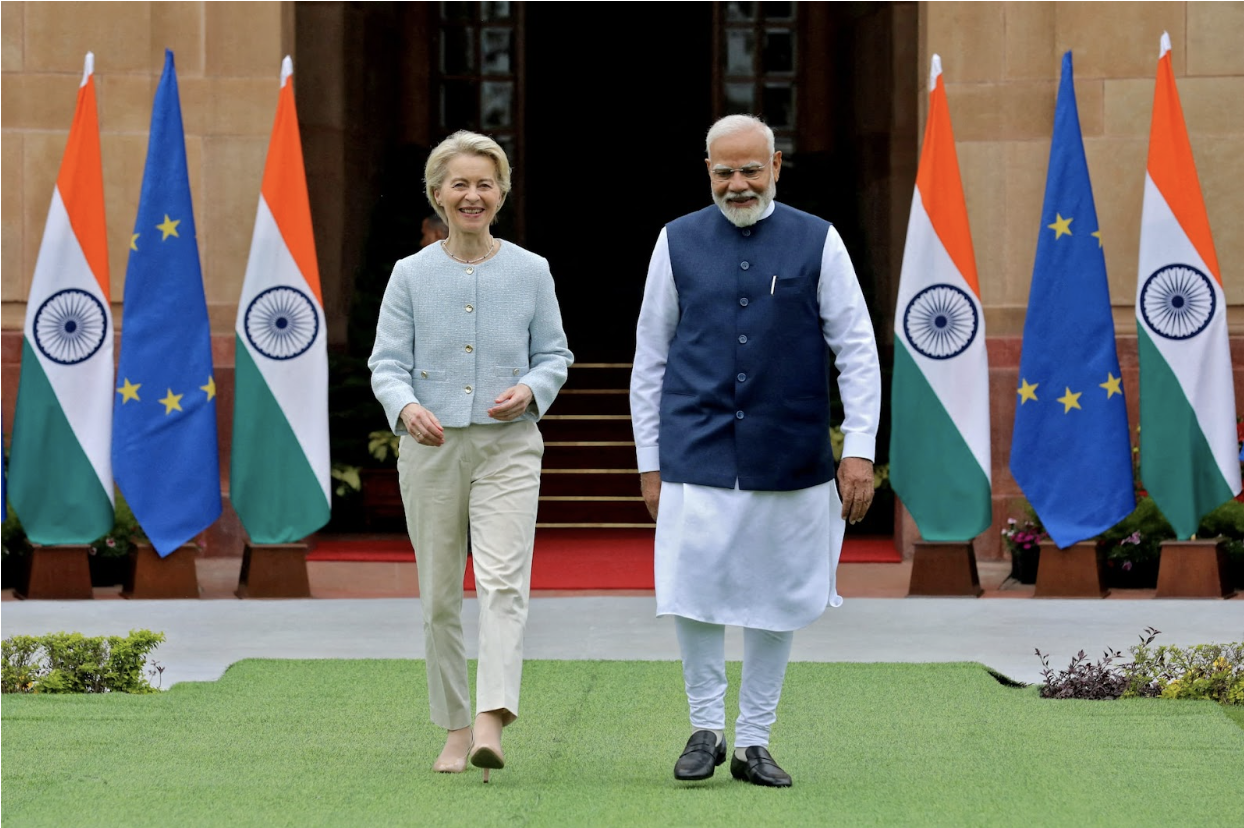
European Commission President Ursula von der Leyen walks with Indian Prime Minister Narendra Modi at Hyderabad House, New Delhi, India. Photo property of Reuters.
The first month of the year has brought what has been coined as the “mother of all deals” within the political world. On January 27, EU Commission President Ursula von der Leyen and Indian Prime Minister Narendra Modi met at Hyderabad House in New Delhi during India’s Republic Day to sign a deal that has taken nearly two decades to negotiate. While it is thought that the EU largely sticks to trading agreements within its member states, recent events have required the entity to expand beyond the continent. The recent tariffs by the United States and an attempt to secure itself as a stable, economic powerhouse have left the EU with a mission to secure new transatlantic partners, in this case, with India. The new agreement will benefit both parties immensely, but will it be enough for the EU?
The negotiations first started in 2007, when a comprehensive Free Trade Agreement (FTA) was signed. This reduced trade barriers, specifically fees between India and the EU, allowing for preliminary economic talks to continue. In 2013, however, negotiations stalled due to significant differences between the two parties about market access, especially on tariffs and services, as well as disagreements over regulatory standards in sensitive sectors (agriculture, energy, etc). Only in 2021, when both leaders decided to resume official negotiations, did the idea of a new comprehensive trade deal form. This was a formal restart aimed at creating an agreement that was mutually beneficial. The re-launch of the FTA was not included in this round of negotiations, but was included the following year. What followed were five separate rounds of talks, largely in Brussels, that looked over several aspects of a future trade deal, all of which had to be negotiated down to the most minute detail.
The new EU-India trade deal is largely presented as an economic benefit because it links two of the world's largest markets, which together account for a quarter of global GDP and nearly two billion people. Besides lowering trade barriers, which were included under the FTA, a central element of the agreement is the reduction of tariffs on a vast majority of goods. This is expected to save billions of euros annually and significantly increase the competitiveness of European exports in India, where they had previously been less competitive than in the United States. Indian sectors will benefit from this too. Textiles and pharmaceuticals will have better access to the EU’s high-income consumer market. In a world that is currently shifting global trade patterns, the deal will allow for India to become a strong counterweight as the EU seeks to diversify supply chains away from China.
The agreement is much more than just a commercial arrangement, though—it carries significant political meaning for both sides. Amid stalled tensions with the U.S., the pact aims to become a geopolitical stabilizer that will reinforce support for a rules-based international economic order and counter rising protectionism. For the EU, the deal primarily provides a much-needed political boost to EU leaders by showing domestic constituencies that the EU can create opportunities for exporters and secure unprecedented market access in Asia. For India, the agreement is perhaps much greater. By locking in greater access to the EU’s market, India gains leverage at a time when other partners, notably the U.S., have imposed tariffs, making alternative markets more attractive for Indian exporters.
The deal is a significant achievement for the EU, but it’s far from enough on its own. Even after signing, the agreement has to pass political scrutiny inside the EU. The European Parliament and potentially national legislatures will be looking at this agreement carefully. If anything is flagged, then the EU might face a repeat of the EU-Mercosur deal, shelved after strong domestic opposition. A major challenge will be regulatory barriers, especially related to any climate policies expressed within the pact. The EU has several environmental standards aimed at pricing carbon emissions, which could act like implicit trade costs that offset the tariff reductions the deal promises. If Indian exporters face high carbon levies or struggle to meet complex traceability requirements, the benefit of tariff cuts will be very limited. On a political level, the EU will have to manage how this deal fits into its broader relationships. Some U.S. officials have begun to criticize the EU for prioritizing trade with India in ways they see as weakening Western unity on issues like sanctions against Russia.
The agreement formed by the EU and India is something to be proud of, both economically and politically. However, there is a noticeable shift in the transatlantic relationship now. The U.S. is no longer the dominant trading partner, and the world must get used to that. The EU is looking to Asia now, in the hopes that in this chaotic world, they may find solace in a new alliance.