
Private Equity Isn’t Driving the Housing Crisis
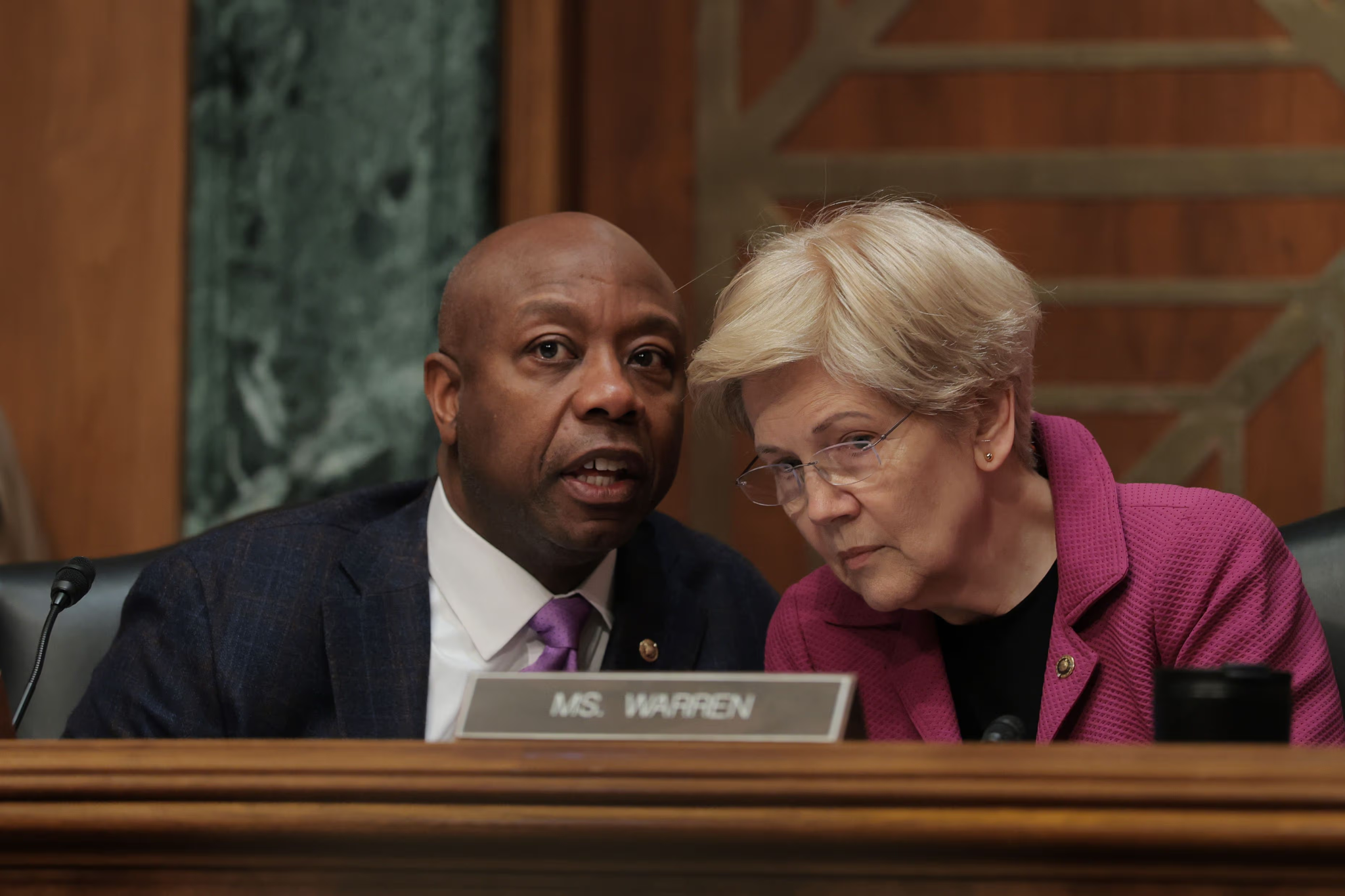
Senators Tim Scott and Elizabeth Warren, the cosponsors of the 21st Century ROAD to Housing Act, speak during a Senate Committee on Banking, Housing, and Urban Affairs hearing in June 2025. Source: CoinDesk.
Meet Alex. A UNC-Chapel Hill alumnus, Alex works in Raleigh as a digital marketing specialist and makes $80,000 a year. He just got engaged to his fiancée, Alyssa, and they’ve discussed starting a family in the next few years. He remembers, “Mom and Dad bought their first house when they were about my age—maybe I should start looking on Zillow.” So Alex starts scrolling. And scrolling. And scrolling. There’s a nice mid-century modern just outside downtown for $1.1 million, a ranch in suburban Apex for $550,000, and a run-down two-story in the Johnston County exurbs for $370,000. None of this is a surprise, since he recently read that the median home price in the U.S. is $405,300.
So Alex does some math. He has about $5,400 in his savings account, the median for Americans under 35, and he assumes that if he saves aggressively in the next couple of years, he can boost that to $10,000 for a down payment. Even if he has to wipe out his savings, he reasons, it’ll be worthwhile long-term, especially if he no longer has to pay rent. But the numbers don’t work; even with additional state assistance, he would still face a monthly mortgage payment far exceeding his take-home pay. Needless to say, Alex closes his Zillow tab and goes to bed frustrated. It doesn’t seem as if he’ll own a home any time soon.
Data shows that this experience isn’t unique to Alex. In the last thirty years, home prices have increased by around 91%, and the median first-time home buyer in America is now forty years old, an all-time high. As Brookings shows, the consequence of these shifting statistics is that the U.S. is short 4.9 million homes as of 2024. With the barrier to market entry so high, it’s no surprise that young Americans are struggling in the current U.S. housing system; 67% of Generation Z say they have difficulty covering housing costs, compared to only 36% of Baby Boomers. People are growing frustrated with the cost of housing, and they are increasingly blaming one actor for their dilemma: private equity.
Private equity (PE) is the industry of investment firms that pool money to acquire and manage assets such as small businesses and residential properties, usually for the purpose of increasing their value over time. Their presence in housing grew rapidly after the 2008 financial crisis, with home prices collapsing and foreclosures surging after the housing bubble popped. During this time, PE firms saw an opportunity to buy large numbers of homes at a discount. Rather than reselling them, many converted these properties into rentals, building portfolios of single-family homes managed centrally by the firms and their partners. A similar dynamic has played out over time with apartments, with PE owning over 10% of all apartment units in the United States today. This evolution has led many to view private equity as the central driver of rising housing costs.
The argument against PE in housing rests on a fairly straightforward economic intuition. In any market, the supply of available properties is scarce, and prices fluctuate based on the buying power of prospective purchasers. Applying this to real-world conditions, FRED data shows homeowner vacancy rates in the United States at a near-record low of 1.1%, which Freddie Mac reports suggests a constrained supply that places pressure on housing prices to increase. So, with vast amounts of capital that someone like Alex can’t match, PE firms can outbid individual buyers, driving up the average price of housing. This is especially true in already tight markets, where even a modest increase in demand can push prices upward.
Then, the firms convert property previously owned by individuals into rental units to guarantee steady cash flow, leaving fewer properties available for those seeking to own their homes. As the Federal Reserve Bank of St. Louis notes, large-scale institutional investor ownership of single-family homes skyrocketed after the 2008 financial crisis, as firms acquired homes and shifted them into the rental market to ensure consistent revenue. As a result, single-family rental homes now make up roughly 18% of U.S. housing stock.
In markets where this ownership becomes concentrated among a handful of firms, critics argue that large landlords may also gain pricing power, allowing them to raise rents and fees in ways that would be harder in a more fragmented market. For instance, one peer-reviewed study found that an additional 1-3 buy-to-rent properties within 150 meters of a home increases nearby price growth by roughly 2.67%, with larger effects in lower-income and majority-Black neighborhoods. The product of all this is a massive barrier to entry for the cherished personal milestone of buying a house, matched by higher prices for the remaining rental properties. Senators Tim Scott (R-SC) and Elizabeth Warren (D-MA) reflect this view in their 21st Century Road to Housing Act, which targets institutional investors in an effort to prevent them from pricing out individual buyers in already supply-constrained markets.
Critiques of PE are not without merit. In certain markets, private equity firms do compete directly with individual buyers, convert homes into rentals, and, when ownership becomes concentrated, may exert upward pressure on rents. But the issue is that the critical model works best under the assumption that housing supply is fixed at current levels. In economic terms, this reflects a short-run condition of low supply elasticity, where increases in housing prices do not correlate with significant new construction (often due to permitting delays and zoning restrictions). After all, if there are only so many homes to go around, then more buyers simply means higher prices, rather than an incentive for developers to add to the supply of available properties. In that framework, investor activity does not trigger new construction, but rather intensifies competition over a fixed number of units.
However, this isn’t the case unless it’s made to be. In most markets, housing supply is variable over time, and developers can usually build new units whenever rising prices create a sufficient profit incentive unless artificial constraints are placed on building capacity. The belief otherwise parallels the “lump of labor” fallacy: the mistaken idea that there is a fixed amount of something to go around. While the term is most commonly used in labor economics, it also applies to housing; it is inaccurate to suggest that housing supply cannot expand in response to rising prices, particularly in less-regulated markets. Further, large institutional investors own less than 0.5% of the total single-family housing stock nationwide, according to Urban Institute analysis. This footprint makes PE firms a politically convenient target, but an implausible root cause. So, it is worth considering, “What if we simply build more houses?”
The answer lies less in investors’ behaviors and more in the rules governing what can be built in the first place. In many of the country’s most in-demand cities, local zoning laws often partially ban the construction of multi-family housing or severely limit building height, artificially constraining the supply of available units. In fact, roughly 75% of land zoned for housing in major U.S. cities permits only single-family homes. Further, even when projects are allowed, they can be slowed by lengthy permitting processes and reviews; for instance, the average federal environmental review takes 2.2 years to complete, which can delay construction, increase risk, and discourage investment.
These delays are reinforced by the way local input works in practice. Community meetings tend to attract the people with the strongest opinions on housing construction; those who are indifferent rarely show up, while those who fear change are highly motivated to attend. This skews participation toward an opposition composed of homeowners protecting the value of their existing property rather than prospective buyers who would benefit from lower costs. The result of all this is a housing market where demand rises freely, but supply is artificially constrained.
This tension is now playing out at the federal level. Consider the 21st Century ROAD to Housing Act, a sweeping bipartisan package cosponsored by Senators Tim Scott and Elizabeth Warren. The bill is built around the central premise that the United States is not building enough housing, with Warren stating her desire to “boost housing supply and bring down costs.” To its credit, the legislation includes provisions for “cutting regulatory red tape,” as Scott puts it, which will likely lower housing costs through an increased supply of available units. At the same time, however, it reflects a politically intuitive instinct to blame one rhetorically “easy” actor for a problem (in this case, private equity) as the source of the housing crisis. Among its more prominent provisions is a ban on large institutional investors purchasing single-family homes, rooted in the belief that corporate ownership is pricing out individuals like Alex.
That instinct is understandable. When cash-rich firms compete with individual buyers, the imbalance feels obvious and unfair. But this logic only holds at scale if housing supply is fixed. If there are only so many homes to go around, then changing who is allowed to buy them may shift ownership at the margins, but it does little to change the number of homes available. In that sense, the ROAD to Housing Act correctly identifies the problem but fails to offer a meaningful solution.
The legislation could actually make the housing crisis worse at the margins. While the bill carves out exceptions for build-to-rent development, it requires investors using those exceptions to sell the homes to individual buyers within seven years. That forced-sale clock changes the financial math on new construction: equity investors and developers pricing in a mandatory selling event are less likely to fund projects in the first place, since they know they won’t be able to profit after the seven years are exhausted. In a country still millions of housing units short, a policy that makes it harder to finance new supply risks shrinking the pipeline of homes that haven’t been built yet.
None of this is to say that concerns about private equity are misplaced entirely. After all, institutional buyers do compete directly with individuals in certain markets, reducing access to homeownership at the margin and exerting some pricing power when ownership becomes too concentrated. These effects are real, and they deserve scrutiny, but they are nonetheless secondary. That’s because they operate in a system where the fundamental constraint is that there are not enough homes. In a market with abundant supply, the ability of any single group, whether private equity firms or individual buyers, to meaningfully influence prices is limited, since buyers can simply take their business elsewhere. So, by increasing supply, any marginal negative externalities associated with PE in the housing market can be outweighed.
That idea matters because it points toward a very different solution than that advocated by PE’s critics. Restricting private equity may redistribute who gets to buy existing homes, but it does not meaningfully increase the number of units available, and may, at the margin, reduce the investment needed to build new ones. By contrast, policies that expand supply by loosening zoning restrictions and accelerating permitting address the problem at its source, reducing costs across the board.
For Alex, this distinction is not abstract. Whether PE firms are active in his local market or not, the core issue remains the same: there are not enough affordable homes available for him to buy. The housing crisis isn’t driven by who’s purchasing homes, but rather by the shortage of homes available to purchase. Consequently, restricting institutional investors might slightly change who he competes with, but it does not fundamentally alter the math that forced him to close his Zillow tab in the first place. Only increasing the supply of housing would actually change that outcome.