
It’s Time for Democrats to Use the Nuclear Option in the Gerrymandering Wars
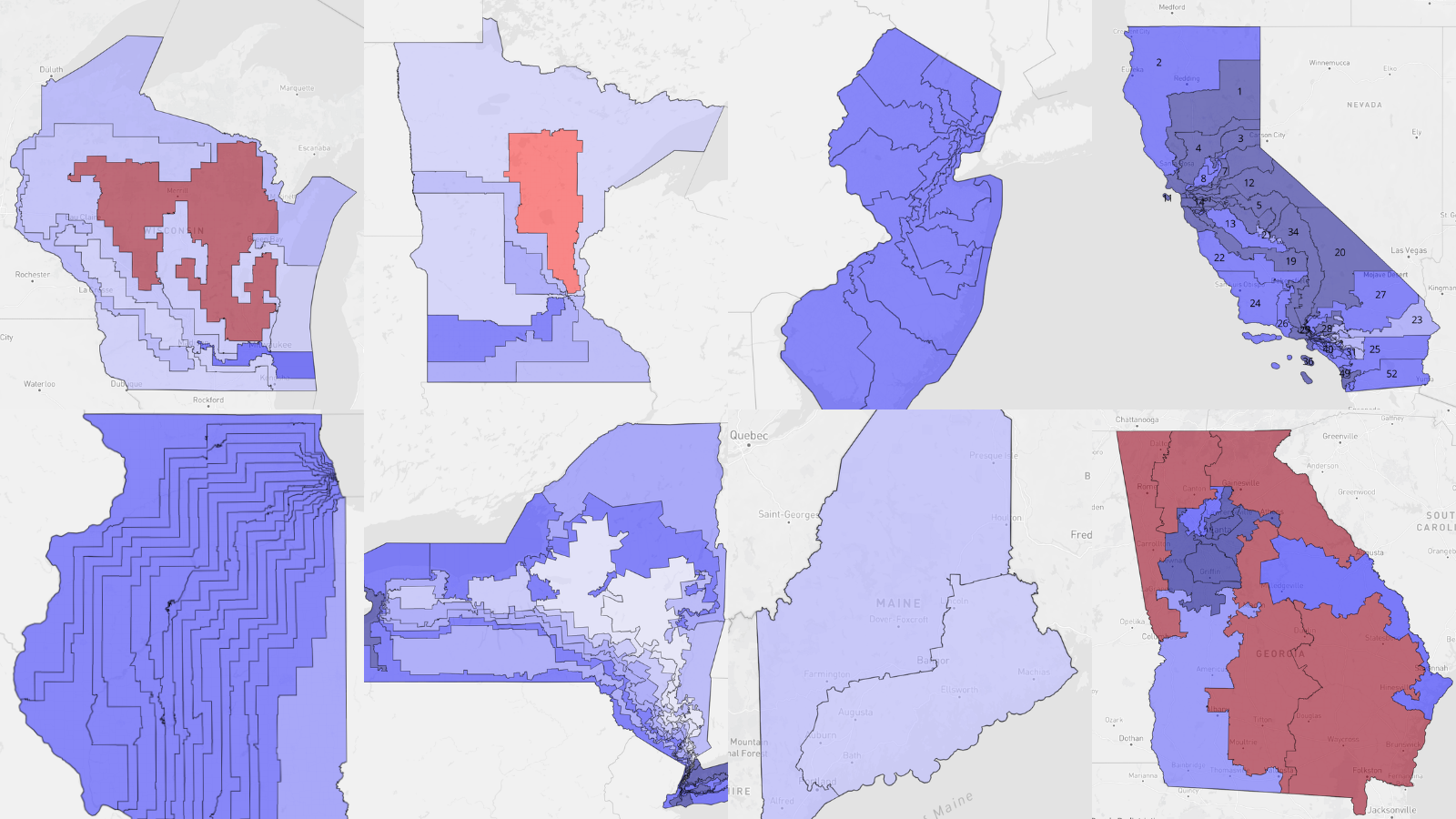
Potential Democratic Gerrymanders by 2028. Source: Dave's Redistricting Application.
Over the last year, America’s political landscape has been redefined by an unprecedented series of many mid-decade congressional redistricting. By April 28, 2026, the states of Texas, North Carolina, Missouri, California, and Virginia had all redrawn their districts to favor Republicans in the first three and Democrats in the latter two for this November's elections. This development, which started when Texas’s Republican-controlled legislature, at the urging of President Trump, redrew its maps to favor Republicans, has been exclusively partisan, as both sides attempt to outflank the other, with their eyes on securing a House majority in this year’s elections.
This already-fraught situation was exponentially complicated by the Supreme Court’s decision in Louisiana v. Callais, handed down on April 29. The Supreme Court ruled, in a murky 36-page opinion written by conservative Justice Samuel Alito, that Louisiana’s congressional map, which comprised 2 majority-minority districts, exceeded the State’s constitutional consideration of race as prescribed in §2 of the 1965 Voting Rights Act (VRA). §2 of the VRA, which has historically allowed for the remedial consideration of race when drawing congressional districts to benefit those denied equal electoral opportunity, has been effectively gutted by this opinion, as the Court held that §2 only applies where there is clear evidence of intentional racial discrimination—a bar that, as a practical matter, is almost impossible to clear. This is the case because approximately 83% of African-American voters lean Democratic, meaning that a state can credibly and, thanks to the 2019 decision Rucho v. Common Cause, legally claim that they did not consider race when drawing districts, instead considering partisan affiliation. Because there is currently so much overlap between majority-minority areas and areas that favor the Democratic Party, Republican state legislatures can now dilute or pack this vote as much as they want without dealing with the past constraints of the landmark civil rights legislation.
The impacts of this decision have been immediate. Tennessee has redrawn its congressional map to eliminate the State's last majority-minority district in Memphis, creating a likely 9-0 gerrymander for Republicans, and making 2027 likely to be the first time since Reconstruction that either party holds all of Tennessee's congressional seats. Other southern states, such as Louisiana, Alabama, South Carolina, and Florida, currently pursuing similar redistricting efforts to eliminate majority-minority districts within their borders.
As Republicans started the gerrymandering war in 2025-2026 and are likely to eliminate well over a dozen Democratic-held seats, pressure has built on Democratic-controlled state governments to respond proportionately. Despite the party's uncanny ability to fumble the ball a yard from the end zone, Democrats managed to effectively fight back in the early months of the conflict. Governors Gavin Newsom of California and Abigail Spanberger of Virginia both proposed new maps, likely drawing a total of 9 Republicans out of their seats. Both governors also drew a favorable contrast to the GOP-led gerrymandering attempts by putting the maps directly to the voters rather than simply ramming them through the state legislature. In both cases, the maps were approved by voters, with a tsunami of support in California and a smaller, but still decisive, win in Virginia.
However, disaster for Democrats struck on May 8, 2026, when the Virginia Supreme Court ruled in a 4-3 decision that Virginia’s ballot referendum was “null and void” on procedural grounds, as early voting had already begun in the state under the old congressional lines. By “protecting” the votes of the fraction of a percent of Virginia’s population that had voted early in the state’s primaries, the Virginia Supreme Court ironically nullified the votes of over 6.3 million Virginians, 51.7% of whom voted for the new maps just a month prior.
Factoring in the Virginia Supreme Court’s decision and the redistricting currently underway as of May 9, 2026, the overall impacts are as follows:

As of May 9, 2026. Louisiana’s range reflects uncertainty in the final map. The Virginia Supreme Court nullified Virginia’s D +4 gain on May 8, 2026.
Despite embracing comparably ethical partisan gerrymanders through ballot referenda rather than legislative fiat, it is clear that Democrats cannot keep playing by a different rule book than Republicans. Electoral politics is a zero-sum game. There is no such thing as a moral victory. If Democrats throw their hands up after the Virginia Supreme Court's ruling and unilaterally disarm, they would not only relegate themselves to permanent minority status short of an exceptional wave election but also reduce the likelihood of partisan gerrymandering ever being outlawed. So long as one side is benefitting disproportionately from partisan gerrymandering, they will block any attempts at future reform. In light of this, the time has come for Democrats to embrace the nuclear option, all-out, maximum gerrymandering by any means necessary.
The states of Oregon, Illinois, Maryland, New Jersey, and Maine can all potentially redraw their maps before the 2026 elections. In the first three, redistricting is controlled primarily by the state legislature, offering Democrats 1 pick-up opportunity in Oregon, 3 in Illinois, and 1 in Maryland. New Jersey uses a commission whose members are appointed by the state legislature. Still, New Jersey Democrats have recently floated the idea of packing that commission to produce a gerrymander that would likely net the party 3-4 seats. Maine presents a different, but still important, situation. While Democrats currently hold both of its House seats, President Trump carried out the state’s 2nd Congressional District in all three of his presidential runs, and its popular incumbent, Democrat Jared Golden, is retiring, leaving the seat vulnerable. Maine's Democratic lawmakers should seek to shore up the 2nd District by diluting it with Democratic votes drawn from the 1st, currently represented by Chellie Pingree, to give Democrats a more competitive footing this November.
If the states mentioned receive court challenges similar to those in Virginia, Democrats can cite Republicans’ 2023 actions in Ohio as precedent to keep the maps alive in litigation. During the 2021 redistricting cycle, the Ohio Supreme Court struck down GOP-backed legislative maps five times and congressional maps twice, yet elections were held on the unconstitutional lines anyway. The Republican cynically concluded that so long as a new map could be continually resubmitted, debated, and rejected before a court could force compliance, time would eventually run out. The state would have no choice but to use the map most recently prescribed, but not yet struck down. While legally weaselly, Democrats need to acknowledge that these are the kind of tactics they’re up against and exhaust all of the legal options they have available.
While infeasible before November 2026, New York and California could pursue voter-approved constitutional amendments to override their current redistricting commissions ahead of the 2028 elections, hypothetically yielding Democrats an additional 9-10 seats in New York and the remaining 5 GOP-held seats in California.
Lastly, while Minnesota, Wisconsin, Pennsylvania, and Georgia do not currently have Democratic trifectas, all four are expected to have competitive enough state legislative and gubernatorial elections in November that Democrats could plausibly win full control in each. This would allow them to redraw their congressional maps before 2028, picking up a potential 3 seats in Minnesota, 5 in Wisconsin, 7 in Pennsylvania, and 4 in Georgia.
Overall, these efforts could yield Democrats anywhere from 22 to 43 House seats by 2028, completely turning the tables on Republicans' current gerrymandering advantage. While radical in the short term, this nuclear option should be framed not as mere retaliation, but as a necessary step in the longer-term effort to ban partisan gerrymandering nationwide through federal legislation. If Republicans lose their structural advantage from gerrymandering, they will be far more likely to come to the negotiating table on such legislation, legislation they previously blocked in 2021.
Regardless of Republican willingness to cooperate, however, ending partisan gerrymandering nationwide should be the top priority for Democrats if they return to a federal trifecta in January 2029, as the surest guarantor of the sacred American principle of one person, one vote. Gerrymandering may be the evil of our time, but Democrats cannot overcome it by bringing another strongly-worded letter to a gun fight. The only way for partisan gerrymandering to improve in the long term is for it to get measurably worse in the short term.