
Trump Considers NATO Withdrawal as Member States Withhold Support for Iran War
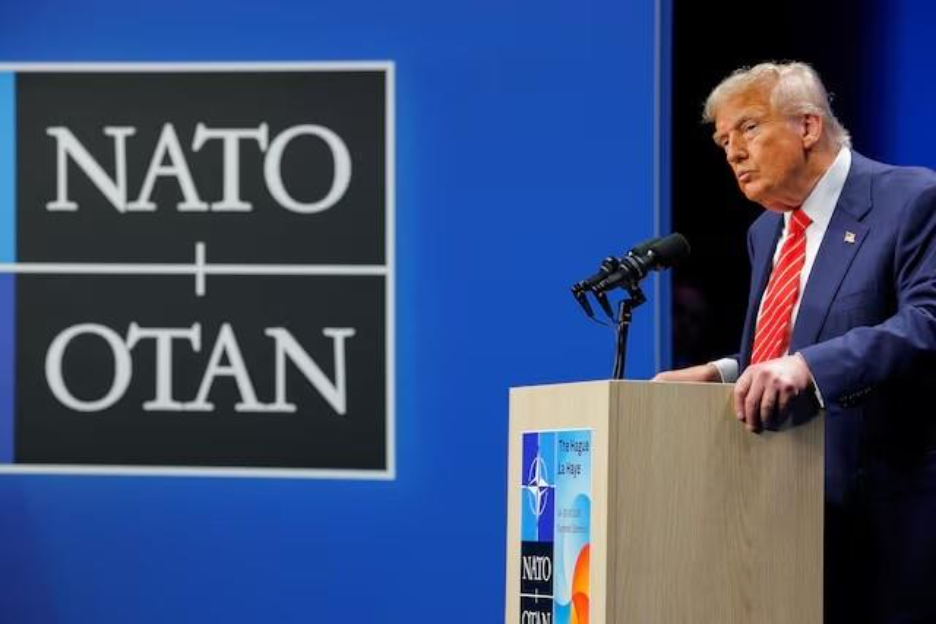
Donald Trump speaking at a June 2025 NATO press conference in the Hague, Netherlands. Source: The Standard.
In an interview with Reuters on April 1, President Donald Trump said that he was “absolutely without question” considering pulling the United States out of NATO. This statement, along with multiple others made in the last couple of weeks, is in response to the organization’s lack of support for the U.S.-Israeli war with Iran. According to Ivo Daalder, the US representative at NATO headquarters from 2009 to 2013, President Trump’s supposed threats are “the worst crisis NATO has ever confronted.” However, as of the day the interview was published, the President had not consulted with Congress on pulling the US out of the organization.
In a separate interview regarding NATO membership, Trump gave his opinion that other member countries should immediately aid the US’s military operations, referencing NATO Article 5. While an attack on one country prompts the others to act, they will only do so if there is a shared agreement among member states. Furthermore, Article 5 only applies to conflicts that take place on European and North American soil, which has only been invoked once following the September 11 attacks. Before being sworn into office in 2017, Trump referred to NATO as a “paper tiger,” suggesting it lacked real capability to act and was costly for the United States to maintain. Much of his previous concerns surrounded the 2014 agreement that each member state is required to allocate 2% of its GDP to funding national defense. However, since then, NATO military spending has increased due to the Russo-Ukrainian War and Trump’s threats to leave. The last time the President threatened to leave the organization was in 2019. In his memoir, former NATO Secretary General Jens Stoltenberg said, “We saw clear signs that Trump was preparing to act on his threat.” Regarding the US’ military operations in Iran, both Italy and Spain have denied permission for US aircraft to stop while en route to the Middle East. Secretary of State Marco Rubio said, “NATO is a one-way street,” and that the coalition had not considered American interests.
Though the President has made numerous threats to walk out of NATO, he cannot do so without approval from Congress, due to a bill passed in 2023 sponsored by then-Senator Marco Rubio. In Rubio’s Senate tenure, he strongly backed the US-NATO alliance. Along with Democratic Senator Tim Kaine, Rubio sponsored a bill ordering two-thirds of Senate approval or an act of Congress to withdraw from NATO. As the US wades deeper into its military operations in the Middle East, several senators from across the aisle voiced their disdain for President Trump’s comments. Republican Senator Thom Tillis, co-chair of the Senate NATO Observer Group, and Democratic Senator Jeanne Shaheen, the ranking Democrat on the Senate Foreign Relations Committee, issued a joint statement assuring that Congress will prevent the President from withdrawing the US from NATO without proper approval. On the Senate Appropriations Subcommittee on Defense, Democratic Senator Chris Coons and Republican Senator Mitch McConnell praised NATO as the “most successful military alliance in history.”
Despite President Trump’s threats to withdraw from NATO, there are significant legal barriers he must go through, making such a move unlikely in the near future. Still, his remarks have heightened tensions with NATO allies who are cautious about supporting US military operations in Iran. As the United States expands its presence in the Middle East, cohesion among NATO member states may be compromised, with international lawmakers monitoring whether Trump’s rhetoric will translate into policy.